
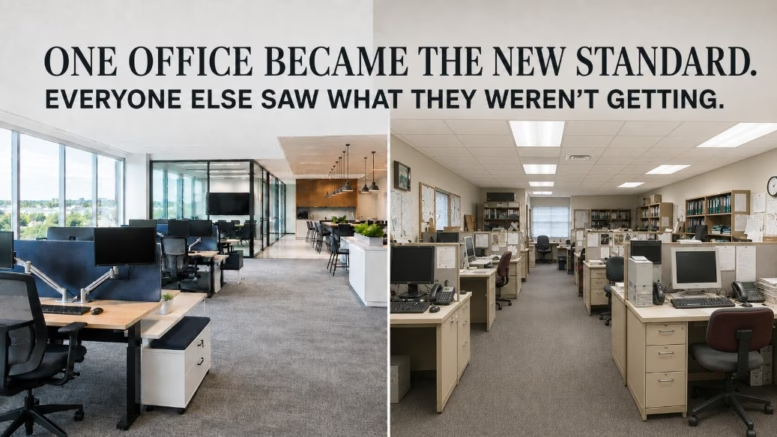
A workplace investment at one address changes expectations everywhere else—and leaves facilities to explain the difference.
While I was developing this article, someone told me what happened at her company.
The company had built a brand-new office. When employees from another location toured it, they could not believe the difference.
There were collaboration spaces, modern technology in the conference rooms, and beautiful break rooms.
Then they returned to their own workplace.
Some conference-room chairs were so dirty that sitting down sent a puff of dust into the air. There was mold on the ceiling. A drain in someone’s office sometimes backed up when a bathroom was flushed.
Employees started asking why their workplace was being left in that condition while another group received a brand-new office.
The response was new ice and coffee machines.
The company had spent money at the older location. It had not addressed what employees were actually raising.
That is when a workplace investment at one address becomes a capital-planning problem everywhere else.
A new office does more than improve one location. It changes what employees across the portfolio consider acceptable and makes existing conditions much harder for leadership to defend.
One Project Reset the Standard
I have seen the same comparison across a multi-location portfolio.
One location was getting a new building. Another was receiving a targeted refresh. Two others were not scheduled for meaningful improvements anytime soon.
Employees moving into the new location would receive bright, open space, new furniture, sit-stand desks, dual monitors on articulating arms, new bathrooms, and a new café.
Employees elsewhere remained in cramped quarters with dated furniture—some of it going back to the 1970s—single monitors sitting on stands, and uneven heating and cooling.
Conditions they had accepted for years became harder to accept once they saw what their colleagues would receive.
Why are they getting a new office while we are only getting a refresh?
Why are they getting new furniture while ours is decades old?
When is our location going to be addressed?
And underneath those questions:
Why are we being treated as second fiddle?
Employees do not compare capital classifications. They compare what they see.
Where the work allowed it, some departments began asking whether they could join the new location. Employees tied to laboratories, clinical environments, retail operations, manufacturing spaces, or other specialized locations did not have that option. Their attention turned instead to the conditions where they already worked.
Leadership does not have to make every office identical.
It does have to decide the minimum workplace conditions it is willing to accept at any location.
A new café or specialized collaboration space may be specific to one project. Functional technology, reasonable temperature control, serviceable bathrooms, and furniture employees can work from may belong to that minimum.
If leadership does not draw that line, employees will draw it for themselves when they compare locations.
The Capital Plan May Still Be Right
An organization cannot renovate every location at the same time.
Workplace improvements compete with infrastructure, building systems, regulatory work, technology, business expansion, and lease commitments. One location may have an expiring lease. Another may support a growing part of the business. An unattractive but functional office may remain behind more urgent needs.
A location may also be more complicated to renovate than employees realize. What looks like a furniture-and-paint project may require infrastructure work, operational disruption, or temporary relocation.
Someone still has to go first.
The difficulty is that employees rarely see the portfolio analysis behind that decision. They see one group receiving a bright new workplace while they return every day to conditions leadership has decided can wait.
The comparison can leave people feeling that their location or department has been overlooked, even when the allocation is defensible.
That feedback belongs in the decision, but it should not set the next project by itself.
Complaints are evidence. They are not instructions to the capital plan.
Leadership may conclude that a location remains functional, an improvement must wait, or a requested renovation will not be funded. Those may be the right decisions.
Someone still has to explain them.
The Person Hearing the Feedback Often Did Not Make the Decision
The questions do not usually reach the executives who decided where the capital would go.
They reach facilities.
Employees ask the facilities manager or office manager why another location received a new office while theirs was left behind. They ask when their improvements are coming and why they are being treated differently.
The person hearing those concerns may not control the capital budget, set the portfolio priorities, or know when another location will be funded.
The only honest answer may be:
That was leadership’s decision.
That leaves facilities defending a capital allocation without the authority, rationale, or future plan needed to explain it.
The concerns then return as requests for furniture, technology, bathrooms, break areas, heating and cooling improvements, or an immediate refresh. None of those items may be included in the approved capital plan.
A capital plan should give facilities more than a project list. It should explain why one location went first, what minimum conditions apply elsewhere, what can be addressed now, and where the remaining locations sit in the sequence.
Facilities should not have to invent that answer after the questions begin.
A Targeted Improvement Has to Address the Actual Problem
There is a large gap between giving everyone a new office and doing nothing.
At the older location, the immediate need was not another amenity. It was remediating the mold, correcting the drain backup, replacing conference-room chairs that released dust when someone sat down, and providing conference-room technology that worked.
Those improvements would not have made the two offices equal. They would have addressed conditions employees were dealing with every day.
Employees do not benchmark the spend. They benchmark whether the problem they keep raising gets fixed.
New ice and coffee machines may have been appreciated. They did not answer what employees were asking leadership to address.
A targeted improvement can be the right capital response, but only if it goes toward the actual problem. Otherwise, leadership spends money and still leaves the underlying condition—and the comparison—untouched.
Before the Next Workplace Project Is Approved
Require one additional discussion at the capital review:
What will employees at the other locations compare against this investment, and what is our response?
Ask facilities to identify the recurring workplace issues at locations not included in the project. Check those concerns against work orders, known deficiencies, business priorities, and available capital.
Then make three decisions:
What should be corrected now through targeted improvements?
What belongs in a future capital cycle?
What will not be funded?
Leadership must decide which differences are acceptable and give facilities an explanation it can stand behind.
Whether or not there is a separate capital-planning department, someone has to own that function.
Otherwise, the decision gets made at the leadership table and the consequences are left at the facilities desk.
About the Author: Richard Neuman advises organizations on capital planning, project governance, and complex capital programs. He has overseen more than $2 billion in capital investments across commercial real estate, healthcare, utilities, industrial, broadcast, and development projects.
He writes candidly from an owner-side perspective about the executive decisions and organizational dynamics that shape capital project outcomes.
Leading a major capital program or facing a complex capital decision?
Contact Richard.
Subscribe for insights on capital planning, project governance, and the executive decisions that shape project outcomes long before construction begins.




Be the first to comment on "The New Office Opened. Everyone Else Started Comparing."