
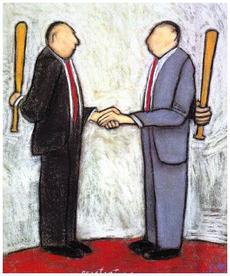
The project team had a plan for the tenant’s construction. Then we realized another tenant’s operation was directly below it.
Clients entrust their project teams to make smart decisions and keep the work moving. But some of the more difficult project issues are not contained within the space being built.
I was managing a tenant improvement project in an early-20th-century landmark tower. Part of the project included construction of a gym.
We knew the equipment could create floor-load, vibration and sound concerns, so we brought in structural and acoustical engineers to evaluate the conditions and develop appropriate structural and noise-abatement measures.
That was the obvious technical problem.
Then we looked downstairs.
The tenant directly below our project happened to be a previous client of mine. Their operation included a model shop where employees used spraying and cutting equipment.
Our construction was above them.
Their operation was below us.
And suddenly each project team had the ability to disrupt the other.
The Project Boundary Wasn’t the Impact Boundary
Our plans addressed the work inside our tenant’s space. But construction noise, vibration, dust, access and safety requirements do not necessarily stop at the lease line.
Neither do the effects of another tenant’s operation.
If we needed to perform probing, weight-drop testing or other investigative work, we needed access to occupied floors above and below us. Some of that work could interfere with normal business operations.
At the same time, fumes or odors from the model shop below could potentially migrate into our space while construction was underway.
Neither tenant was doing anything wrong.
The problem was that two legitimate operations were about to occupy the same building at the same time with very different needs.
We Could Have Treated It as Someone Else’s Problem
There was an easy adversarial path.
We could have gone to the landlord, cited the lease, raised complaints and demanded that the other tenant change its operation.
They could have done exactly the same thing when our construction disrupted them.
That might have established everyone’s contractual position.
It probably would not have produced the best project outcome.
Instead, we spoke directly with the other tenant and explained what we were planning. We discussed when disruptive work would occur, what testing we needed to perform and what each side could do to reduce the effect on the other.
They were cooperative.
So were we.
Their spraying and cutting activities were coordinated to minimize interference with our work. We included some related work within our construction scope where it made sense. Our own disruptive activities were scheduled with their operation in mind.
The landlord supported the coordination.
A potential tenant-versus-tenant problem became a manageable project interface.
Ask Who Else the Work Can Affect
This is one of the questions I want answered before construction begins:
Who can this project disrupt who isn’t sitting in our project meetings?
It may be the tenant upstairs or downstairs.
It may be building operations, security, loading-dock personnel or another contractor working elsewhere in the property.
It may be a neighboring business whose customers use the same entrance.
It may even be the owner’s own employees occupying another portion of the building.
Those parties do not necessarily need seats at every project meeting. But someone on the project team needs to identify the interfaces and decide how they will be managed.
Construction logistics should account for more than getting workers and materials into the project space.
They should account for what happens around it.
Coordination Works Better Before There Is a Complaint
Once another tenant complains, the conversation changes.
Now there may be a landlord involved, lease provisions being reviewed, attorneys copied and positions being defended.
Sometimes that is unavoidable.
But if the potential conflict can be identified beforehand, the discussion can begin differently:
Here is what we’re going to do. How could it affect you, and how do we keep both operations working?
That was essentially what happened on this project.
Reasonable people, good communication and some flexibility prevented a foreseeable construction issue from becoming something much larger.
And yes, I still hoped their spraying and cutting equipment wouldn’t upset the barking dog.
Leadership Takeaway: A project’s physical boundaries do not define its operational impacts. Before construction begins, identify who else the work can affect and establish the coordination, access and communication protocols before disruption turns into conflict.
About the Author: Richard Neuman advises organizations on capital planning, project governance, and complex capital programs. He has overseen more than $2 billion in capital investments across commercial real estate, healthcare, utilities, industrial, broadcast, and development projects.
He writes candidly from an owner-side perspective about the executive decisions and organizational dynamics that shape capital project outcomes.
Leading a major capital program or facing a complex capital decision?
Contact Richard.
Subscribe for insights on capital planning, project governance, and the executive decisions that shape project outcomes long before construction begins.


Be the first to comment on "The Construction Was Upstairs. The Disruption Wasn’t."