
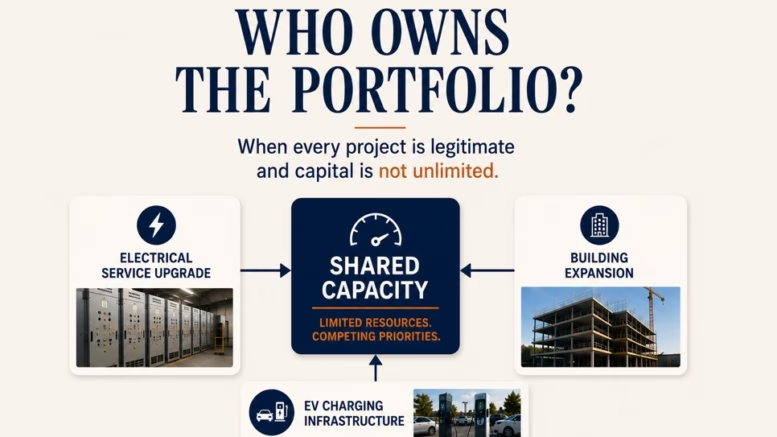
The tipping point isn’t more projects. It’s when every new priority begins changing the assumptions behind projects already in the plan.
Organizations don’t wake up one day and decide they need a capital planning function.
At first, projects can usually be evaluated on their own merits.
Facilities identifies an aging chiller. Operations needs additional space. IT requests new infrastructure. Each request can be considered independently, and each decision has relatively little impact on the others.
Then the organization changes.
Leadership approves a strategic initiative. The business acquires another facility. A business unit creates unexpected capacity demands. A regulatory requirement accelerates infrastructure improvements. An aging asset reaches the point where replacement can no longer be deferred.
None of those decisions are unusual.
What changes is that every new priority begins changing the assumptions behind projects already in the capital plan.
Infrastructure sized for one initiative no longer supports another. Funding committed six months ago no longer reflects today’s priorities. Decisions that once stood on their own begin reshaping every decision that follows.
Nothing is technically wrong.
The organization has simply reached the point where projects are no longer independent.
That’s often when leadership concludes Facilities has become the problem.
In many cases, it hasn’t.
When Facilities Starts Carrying Someone Else’s Responsibility
Leadership doesn’t experience organizational structure. It experiences outcomes
Projects take longer to approve. Budgets become harder to build. Departments compete for funding. Capital requests arrive faster than leadership can comfortably evaluate them.
Eventually someone asks Facilities why everything has become so difficult.
It’s a fair question.
It’s often directed at the wrong function.
Strong facilities organizations understand their assets better than anyone else. They know which systems are approaching the end of their useful life, where maintenance costs are increasing, and which infrastructure limitations will eventually affect future projects.
They’re often the first to recognize future capital needs.
Deciding how those needs compete with executive priorities, business opportunities, operational demands, and limited capital is a different responsibility.
The Question Isn’t What Facilities Can Do
This isn’t a question of capability.
Many facilities organizations already manage planning, design, construction, commissioning, and major capital projects exceptionally well.
The gap isn’t expertise.
It’s ownership.
Someone has to continually evaluate how executive decisions, business opportunities, operational needs, and aging assets reshape the capital program, then determine how limited capital should be allocated across competing priorities.
Capital planning complements Facilities—it doesn’t replace it.
Facilities understands the assets.
Capital planning exists because someone has to continually reconcile those asset needs with changing organizational priorities.
In many organizations, that responsibility extends from pre-planning through construction and into occupancy, helping ensure individual projects remain aligned with broader organizational objectives as conditions change.
Whether that responsibility sits within Facilities or elsewhere in the organization matters less than ensuring someone owns portfolio-level decision-making.
The Hidden Signal
Most organizations assume the challenge is simply managing a larger capital program.
The real signal is that every unexpected priority begins changing the assumptions behind projects already in the capital plan.
That’s when the conversation changes.
Leadership spends more time resolving competing priorities than discussing long-term strategy.
Facilities can explain the condition of every major asset.
The harder question becomes how today’s decision changes tomorrow’s options.
That’s the point where the conversation shifts from managing projects to governing a portfolio.
One Last Observation
At your next capital planning meeting, don’t start with the project list.
Listen for the first time someone says,
“We weren’t planning on this.”
It might be a strategic initiative that wasn’t in last year’s capital plan.
It might be an acquisition.
It might be an infrastructure failure that can no longer wait.
The example isn’t what matters.
Watch what happens next.
Does the conversation immediately focus on solving the new problem?
Or does someone step back and ask what this changes across the rest of the portfolio?
That’s the real test.
A capital plan isn’t tested when everything goes according to plan.
It’s tested the moment something wasn’t part of the plan.
Most leadership teams don’t discover how their organization makes capital decisions during the annual planning process.
They discover it the first time the plan has to change.
About the Author: Richard Neuman advises organizations on capital planning, project governance, and complex capital programs. He has overseen more than $2 billion in capital investments across commercial real estate, healthcare, utilities, industrial, broadcast, and development projects.
He writes candidly from an owner-side perspective about the executive decisions and organizational dynamics that shape capital project outcomes.
Leading a major capital program or facing a complex capital decision?
Contact Richard.
Subscribe for insights on capital planning, project governance, and the executive decisions that shape project outcomes long before construction begins.




Be the first to comment on "The Hidden Signal That Your Organization Has Outgrown a Facilities-Only Approach"