
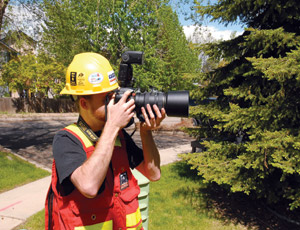
Photos, 360° capture and AI can create a remarkable visual record of a project. The owner still has to decide what should be captured before it disappears.
Originally published May 2012. Updated October 2026 to reflect current construction documentation, reality capture and owner-side closeout practices.
What’s behind that wall? Will you puncture a pipe?
When I first wrote about construction photography in 2012, my point was straightforward: document the work before it becomes concealed.
Photos and video could document pre-existing conditions, show what was installed inside walls and above ceilings, record underground work and provide a visual history of the project.
That remains good practice.
What has changed dramatically is our ability to capture, organize and retrieve that information.
A project team can now supplement conventional photos and video with 360° reality capture, location-based imagery and other digital documentation. Instead of relying entirely on someone to anticipate which individual photograph may become important years later, a project can create a much more systematic visual record of what existed at different stages of construction.
AI can make that growing record easier to organize, search and analyze.
The technology has improved.
The owner’s question hasn’t:
When this wall closes, what information are we losing?
Capture What Will Become Concealed
Construction creates information that has a very short shelf life.
One week, the wall is open and the electrical conduit, plumbing, blocking, insulation and structural connections are plainly visible.
The next week, they’re gone.
Not actually gone, of course.
They’re behind the finished wall.
The same thing happens above ceilings, below slabs, underground and inside building assemblies.
Once the work is concealed, recovering that information may require exploratory openings, scanning, assumptions based on drawings or, in the worst case, finding something you didn’t expect during future construction.
That is why I want the project team thinking about documentation before the work disappears.
Depending on the project, that record might include:
- in-wall electrical, plumbing and other MEP rough-in;
- above-ceiling utilities;
- firestopping and penetrations;
- structural connections;
- blocking and backing;
- waterproofing and envelope assemblies;
- underground utilities and drainage;
- equipment connections;
- insulation and concealed materials;
- existing conditions uncovered during demolition; and
- other work that will become difficult or impossible to inspect later.
Not every project requires the same level of documentation.
But once the wall closes, the opportunity to capture it is gone.
From Construction Photos to Reality Capture
Traditional photos and video still have an important role.
A photograph can document a specific condition extremely well. Video can provide context around an area that may be difficult to capture in a single image. Both can document deficiencies, record work before concealment, support an RFI or change discussion, document existing conditions and provide evidence of progress.
The limitation has often been organization.
A project can accumulate thousands of images and hours of video with filenames that mean very little six months later.
Where was this taken?
Which room?
Which wall?
What date?
Was this before or after the revision?
Is there another image showing the adjacent condition?
Today’s reality-capture tools can address some of those limitations.
360° cameras can capture much broader areas during a site walk. Depending on the system being used, imagery can be associated with locations on a floor plan, organized chronologically and compared with captures from different stages of construction.
That can turn a collection of photos and videos into something closer to a navigable visual history of the project.
AI Can Help Find the Information. It Doesn’t Decide What Matters.
AI adds another capability.
As visual project records become larger, software can increasingly help organize, classify, compare and retrieve information contained within them.
That can make an enormous visual archive more useful.
But AI does not eliminate the need for a documentation strategy.
A project can capture thousands of images and still create a poor owner record.
If important areas weren’t captured before concealment, AI cannot recreate what was never documented.
If nobody establishes how locations are identified, what stages should be captured, how frequently documentation occurs or where the permanent record will reside, more technology may simply produce more information to sort through.
The objective isn’t to create the largest photo and video library.
It is to create a record someone can actually use.
The Record Has Value After Construction
Construction documentation shouldn’t be thought of solely as a tool for managing construction.
Its value may become greater after the project is complete.
Imagine a future renovation where someone asks:
Can we core here?
What’s above this ceiling?
Where does that line run?
Was blocking installed behind this wall?
What was here before we covered it?
Is this condition original, or was it part of the renovation?
A useful visual record can help answer those questions before exploratory demolition begins.
It may also assist with warranty investigations, maintenance, future capital work, claims, troubleshooting and planning.
The original article used photos and video to help answer those questions.
Today we can potentially provide the next team with something far more comprehensive.
But only if the information survives the project.
Who Owns the Visual Record?
This is where the owner needs to look beyond the construction phase.
A contractor may use an excellent cloud platform during the project. The team may have access to photos, video, 360° walks, drawings and other documentation while construction is underway.
Then the project closes.
What happens to the information?
The owner should understand:
- What visual documentation is being created?
- Where is it stored?
- How is it indexed or associated with project locations?
- Who owns the data?
- Who has access during construction?
- What happens when the contractor’s or consultant’s subscription ends?
- Can the information be exported?
- In what format?
- Will the owner be able to retrieve it years later?
- Where will the permanent record reside after turnover?
Those questions belong in the documentation and closeout strategy, not in a frantic conversation at the end of the project.
A Picture Is Useful Only If You Can Find It
The technology available today would have been remarkable when I first wrote this article in 2012.
We can capture more of a project, organize it more intelligently and potentially retrieve information that once would have required someone to remember which folder contained a particular photograph or video.
But the fundamental owner-side principle hasn’t changed.
Construction continually covers up information.
Before that happens, somebody should ask:
When this wall closes, what information are we losing?
And before the project closes, the owner should ask one more question:
Who keeps the answer?
About the Author: Richard Neuman advises organizations on capital planning, project governance, and complex capital programs. He has overseen more than $2 billion in capital investments across commercial real estate, healthcare, utilities, industrial, broadcast, and development projects.
He writes candidly from an owner-side perspective about the executive decisions and organizational dynamics that shape capital project outcomes.
Leading a major capital program or facing a complex capital decision?
Contact Richard.
Subscribe for insights on capital planning, project governance, and the executive decisions that shape project outcomes long before construction begins.


I cant agree more – before and after records are essential in recording what has been done and noting any defects that were there before a project commences and avoid picking up the costs for putting these right
I couldn’t agree more! I am a firm believer and was saved by this simple but effective tool. Good article.
It’s also great to be able to present your client with before/afterlook photos at a hand-over ceremony. I’ve found that this has always been appreciated by my clients and the photos have often ended in the boardroom and in in-house magazines.