
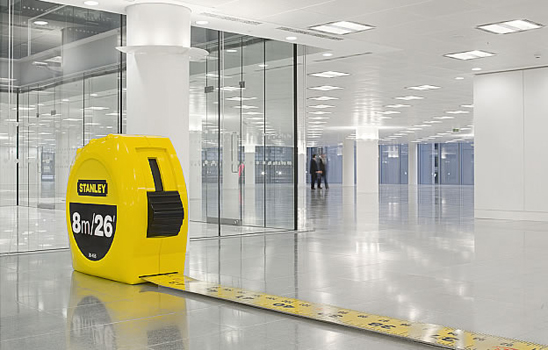
The rentable square footage in a lease is not necessarily the area you can walk through. Before comparing rents, understand what the measurement includes.
Originally published July 2012. Updated October 2026 to reflect current office measurement standards and owner-side leasing considerations.
Two office spaces are each marketed as 10,000 square feet.
One may give you considerably more usable workplace than the other.
Neither number necessarily has to be wrong.
That’s the part of commercial real estate measurement that can confuse tenants.
A tenant sees 10,000 square feet and naturally thinks:
“I’m leasing 10,000 square feet of office.”
But the number used to calculate rent may include an allocation of common areas in addition to the area occupied exclusively by the tenant.
So before comparing two rental rates, I would ask another question:
“Ten thousand square feet measured how?”
Rentable Area Is Not the Same as the Space You Occupy
Commercial office leases are commonly based on rentable area.
That number can be larger than the area devoted exclusively to the tenant because the methodology can allocate portions of common or shared building areas to occupants.
That isn’t inherently improper.
The current BOMA 2024 Office Standard—ANSI/BOMA Z65.1-2024—is specifically intended to calculate rentable area for office buildings and provide consistent area information for leasing and other purposes. BOMA International
The important point for the tenant is understanding which number is being quoted and how it was determined.
“10,000 square feet” by itself doesn’t tell you enough.
The Measurement Standard Matters
When someone tells me a building was measured “according to BOMA,” my next question would be:
“Which BOMA standard?”
BOMA has revised its office measurement standard over time. The current office standard is the 2024 edition, and BOMA maintains separate standards for other property types, including industrial, retail, mixed-use and gross areas. BOMA International
Even within the current office standard, methodology matters. BOMA’s own education for the 2024 standard addresses Method A and Method B, boundary areas and the distinction between occupant area and rentable area. BOMA International
So “BOMA measurement” shouldn’t be treated as a magic phrase that ends the discussion.
It should begin a more useful one:
What standard and methodology were used to produce the number in the lease?
A Floor Plan Isn’t Necessarily a Measurement
A floor plan attached to a lease can be useful.
It doesn’t necessarily establish the area.
The drawing may have been created for leasing, design, construction or marketing purposes. Existing drawings may also differ from what was ultimately constructed.
BOMA itself notes that an area calculated from building plans can differ from an area determined through field measurements and emphasizes the importance of documented, reliable and verifiable area calculations. BOMA International
That doesn’t mean every tenant needs to send someone through the building with a tape measure.
It does mean I wouldn’t assume that a number printed on a marketing plan has been independently verified.
Two 10,000-Square-Foot Deals May Not Be Equivalent
Suppose Tenant A is considering 10,000 rentable square feet in one building.
Tenant B is considering 10,000 rentable square feet somewhere else.
Both landlords quote the same rent per rentable square foot.
At first glance, the economics look identical.
But suppose one tenant receives substantially more area for its exclusive use after the applicable common-area allocations are accounted for.
Now the comparison looks different.
The quoted rental rate hasn’t changed.
The amount of workplace the tenant receives for that rent has.
That’s why I wouldn’t compare office alternatives using rental rate alone.
I would want to understand both:
What are we paying for?
and
How much usable workplace are we actually getting?
The Program Fits in Usable Space, Not Rentable Space
This is where a real-estate measurement issue becomes a capital-project issue.
The business says it needs:
120 workstations.
Eight offices.
Six conference rooms.
A café.
Storage.
Technology rooms.
Support space.
The broker identifies a 25,000-square-foot opportunity.
Does the program fit?
You can’t answer that from the rentable-area number alone.
The architect and project team need to understand the actual space available for planning.
Otherwise, an owner can spend weeks negotiating a transaction only to discover during test fits that the space doesn’t accommodate the program as expected.
The lease economics may have looked attractive.
The space still doesn’t work.
Verify the Number When the Number Matters
Not every transaction warrants an elaborate independent measurement exercise.
But the larger the lease, the longer the term and the more sensitive the program is to available area, the more important the measurement becomes.
If there is uncertainty, have a qualified professional review the calculation.
And don’t assume that field measurement is automatically the only correct answer either. BOMA does not prescribe one particular source or measurement technique; what matters is applying the appropriate standard consistently and documenting the calculation. BOMA International
The goal isn’t to prove that someone else’s number is wrong.
It’s to understand what the number represents before you base a business decision on it.
Put the Measurement Basis in the Transaction
If rentable area is material to the economics of the deal, I want the parties to understand the measurement basis before the lease is executed.
That may mean identifying the measurement standard and edition, reviewing the landlord’s area calculations, confirming the relevant floor plans and establishing how any disagreement over area will be resolved.
Those are issues for the broker, attorney and appropriate measurement professionals to address as part of the transaction.
From the owner’s perspective, the objective is simpler:
Don’t allow an undefined square-footage number to become the foundation of the deal.
The Cheapest Rent Per Square Foot May Not Be the Cheapest Space
A tenant may spend considerable effort negotiating the rental rate while paying much less attention to the number being multiplied by that rate.
That’s backwards.
If rent is calculated using rentable square footage, then both parts of the equation matter.
And there is another calculation beyond the lease:
Does the space actually support the business requirement?
A well-negotiated rental rate on a space that doesn’t efficiently accommodate the program isn’t necessarily a good real-estate decision.
Before comparing office alternatives, I would want three numbers clearly understood:
How much area is being used to calculate the rent?
How much area is available for the tenant’s exclusive use?
How much area does the business actually need?
Once those numbers are clear, the rent-per-square-foot comparison starts to mean something.
About the Author: Richard Neuman advises organizations on capital planning, project governance, and complex capital programs. He has overseen more than $2 billion in capital investments across commercial real estate, healthcare, utilities, industrial, broadcast, and development projects.
He writes candidly from an owner-side perspective about the executive decisions and organizational dynamics that shape capital project outcomes.
Leading a major capital program or facing a complex capital decision?
Contact Richard.
Subscribe for insights on capital planning, project governance, and the executive decisions that shape project outcomes long before construction begins.


The more things change, the more they remain the same. They will always need to know the value of real estate, and they will always hire good, experienced appraisers to express their opinions. Our task is to be there when and where they need us.