A code-compliant fixture can still be installed at a height that makes little sense for the people expected to use it.
Originally published September 22, 2011. Updated October 2026. The project story and original photographs remain as published; the accessibility discussion has been updated to reflect current standards and a distinction I didn’t make clearly enough at the time.
In some areas of life it’s all about your reach… this shouldn’t be one of them… especially given the fact that it’s a touchy subject that most people either don’t, or don’t want to, think about.
I’ll do my best to maintain some decorum.
At a commercial office fit-out, I really had to go. I mean my teeth were swimming.
If you’ve ever been on a commercial interior renovation job site, the existing (and often new) bathrooms are not maintained until just before the tenant moves in. There’s a reason contractors carry toilet paper in their jobsite gang box—that’s because there isn’t any around.
Often a country fair Porta-Potty is cleaner than the pre-move-in bathrooms that the trades use during construction. Tenants cringe too when they walk around their uncompleted space and peek into the bathroom.
The porcelain palace could use some scrubbing bubbles.
Luckily, though, the general contractor saw the pain on my face and advised me one urinal on the second floor had just been installed.
With new relief in sight, I walked into the men’s room, unzipped to do my business and while standing up against the urinal, I noticed something just wasn’t so American Standard.
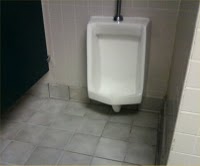
Either I grew taller or the urinal was so low that it could have been installed for kids.
I don’t mean to brag, but had I had a cup of coffee and rested it on top of the porcelain, I could have peed into it. The drain below the rim was practically touching the floor.
The general contractor assured me the urinal was low to meet ADA requirements.
But this seemed too low for practical use by non-disabled users.
I consulted with the architect. The project team reviewed the installation, the wall was opened up, the plumbing was raised and the rim ended up at 17 inches above the finished floor.
What the Accessibility Requirement Actually Says
Looking back at this article years later, there’s an important distinction I didn’t make clearly enough at the time.
The ADA Standards require an accessible urinal to be either stall-type or wall-hung with the rim 17 inches maximum above the finish floor or ground. The standards also establish other requirements for the accessible fixture, including minimum depth and clear floor space.
The important word is maximum.
Seventeen inches isn’t a recommended mounting height for every urinal in a commercial restroom. It’s the maximum rim height for the accessible urinal.
That’s different from saying every urinal in the room should be mounted at 17 inches.
Code Compliance and Good Design Aren’t Always the Same Question
My original reaction was essentially:
If the accessible urinal can be as high as 17 inches, why wouldn’t we put it there?
That’s understandable given what I was looking at, but it wasn’t quite the right question.
The better questions are:
Which fixture is required to meet the accessibility requirements?
What mounting height satisfies those requirements?
And what heights make sense for the other fixtures and the people who will use them?
Accessibility requirements establish criteria that must be satisfied. They don’t eliminate the need for the design team to think about usability.
And that’s really what bothered me when I walked into that bathroom.
Nobody needed a tape measure to recognize that something didn’t look right.
Sometimes You Have to Look at What Was Built
The plumbing still had to be moved on this project. The photograph makes pretty clear why.
But the larger lesson has held up better than my original recommendation.
Drawings, specifications and code requirements can all be correct on paper while something in the field still deserves another look.
A dimension being code-compliant doesn’t automatically make every application of that dimension a good design decision.
Sometimes you still have to walk into the room and look at what was actually built.

Be the first to comment on "Urinals – Size Really Does Matter"