
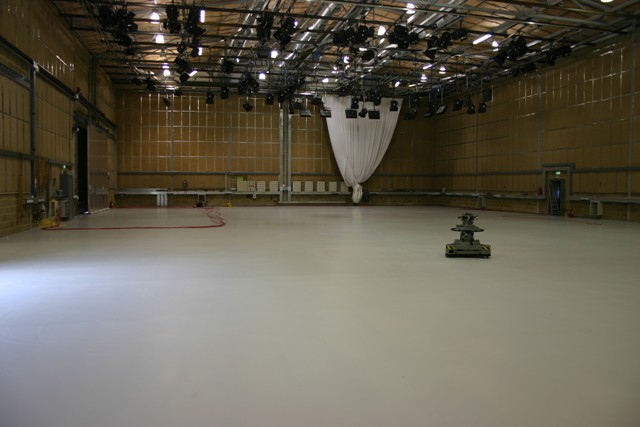
In a television studio, the floor is not simply a finish. It is part of the production environment.
Originally published August 2012. Updated October 2026 with additional perspective from my experience managing television studio operations.
A television studio floor may look like an ordinary finished surface.
It isn’t.
When I was responsible for television studio operations, one of the things I learned was how much the floor affects what viewers ultimately see on the air.
A camera pedestal rolling across a studio floor can magnify imperfections that would barely be noticed in an office or conventional commercial space. A joint, ridge or uneven transition can translate directly into unwanted camera movement.
That means the flooring decision starts with a different question:
What does this floor have to do operationally?
The Camera Changes the Requirement
Studio cameras aren’t lightweight pieces of equipment being rolled around occasionally.
Camera pedestals can carry substantial weight, and during a production they need to move smoothly and predictably across the floor. The operator may be tracking a subject, repositioning during a live program or executing a planned camera move.
If the floor isn’t sufficiently smooth and level, the audience may see the result.
That creates requirements that go beyond choosing a flooring material that looks good and can withstand normal foot traffic.
The underlying surface matters.
Transitions matter.
Joints matter.
Repairs matter.
And the way the finished floor performs under moving equipment matters.
Flat Isn’t Necessarily Flat Enough
A floor that would be perfectly acceptable for many commercial uses may not provide the performance a studio requires.
The challenge isn’t simply achieving a generally level slab. The finished surface needs to support smooth camera movement across the areas where cameras will operate.
That can make substrate preparation particularly important.
Imperfections that might ordinarily disappear beneath carpet or another forgiving finish can become much more consequential when a heavy camera pedestal repeatedly crosses them.
The requirements therefore need to be understood before the flooring system is selected—not after the cameras arrive.
Loads Matter Too
Cameras aren’t the only equipment moving through a studio.
Scenery, lighting equipment, lifts, carts and other production equipment may place significant concentrated and rolling loads on the floor.
A flooring system that performs well in an office may react very differently when subjected to that environment.
Durability is therefore more than resistance to ordinary wear.
The floor needs to tolerate the equipment and operating practices of the studio without creating dents, ridges, failed seams or other conditions that eventually affect production.
Acoustics Can Enter the Decision
Television studios are also controlled acoustic environments.
The floor is one component of that environment.
Material selection can affect sound reflection, impact noise and the way equipment movement is heard within the studio.
That doesn’t mean the flooring decision is driven by acoustics alone. It means flooring has to be coordinated with the broader studio design rather than treated as an isolated finish selection.
The best flooring solution has to work with the production requirements, structural conditions, acoustical design and maintenance expectations.
Think About the Repair Before You Need It
Studio floors take abuse.
Eventually something will be damaged.
That makes repairability an important part of the original decision.
Can a damaged area be repaired without creating a noticeable transition?
Will the replacement material match?
Will the repair create a seam that affects camera movement?
How long does the material require before the studio can return to service?
Those questions become particularly important in a facility where taking a studio offline can affect production schedules.
The lowest initial flooring cost may not be the lowest operating cost if every repair becomes a production problem.
Start With the Operation
Looking back at this issue from an owner-side capital perspective, the larger lesson isn’t really about television studio flooring.
It’s about how specialized facilities should be designed.
A conventional specification can be technically acceptable and still fail the operation it is supposed to support.
Before selecting the system, the project team needs to understand how the space will actually be used:
- What equipment will operate there?
- How will it move?
- What loads will the floor experience?
- What tolerances does the operation require?
- What happens when the surface is damaged?
- How much downtime is acceptable for maintenance or repair?
Those requirements should inform the design and specification before procurement and installation.
A studio floor isn’t successful because it looks good when construction is finished.
It’s successful when nobody watching the program ever has a reason to notice it.
About the Author: Richard Neuman advises organizations on capital planning, project governance, and complex capital programs. He has overseen more than $2 billion in capital investments across commercial real estate, healthcare, utilities, industrial, broadcast, and development projects.
He writes candidly from an owner-side perspective about the executive decisions and organizational dynamics that shape capital project outcomes.
Leading a major capital program or facing a complex capital decision?
Contact Richard.
Subscribe for insights on capital planning, project governance, and the executive decisions that shape project outcomes long before construction begins.
How about having a Virtual Studio Set… One would not have to go through the hassles of redoing the sets every time a program changes. And one could create a set at the click of a mouse or a button…
Chris, the same flooring principals would still apply to virtual sets. Virtual ses utilize green screen/chroma technology to display the backgrounds and floors are often painted with chrmoa key green paint. Sensors can track camera movement, so as cameras truck across the floor the software changes the electronic set angles and perspectives with the move. Since virtual sets can be used with trucking pedestals, proper floor prep is still necessary even in the electronic set environment.
You should look into lightweight concrete. Lightweight concrete consists of concrete, sand and foam that is mixed together. This flooring can be self leveling if mixed correctly. But for studio use you should have it laser leveled and polished prior to epoxy paint finishing. This lightweight flooring depending on mixture can handle the abuse of a production studio.
The LITEBUILT® Aerated Lightweight Concrete process is based on the principle of entrapping a multitude of air bubbles in the concrete mix, who retain their structure during the curing period. Firstly, the mix composition of cement / sand / water / foam according to specification has to be chosen. After batching the basic ingredients, LITEBUILT® Foaming Agent is introduced to the mix which then can be poured into panel molds of virtually any shape or size. The LITEBUILT® Aerated Lightweight Concrete Mix normally cures in open air within about 24 hours (unless it is used in cold weather conditions) before handling is recommended. It is possible to add other products to the LITEBUILT® Foam Mix to obtain lightweight composite concrete. Notably the use of various fibers increases the strength of the product and prevents cracking in adverse conditions.
Density 300-600 kg/m³ (19-38 lbs/ft³) Made with Cement & Foam Only Density 600-900 kg/m³ (38-56 lbs/ft³) Made with Sand, Cement & Foam
Density 900-1200 kg/m³ (56-75 lbs/ft³) Made with Sand,Cement & Foam
Density 1200-1600 kg/m³ (75-100 lbs/ft³) Made with Sand, Cement & Foam
NON-STRUCTURAL APPLICATIONS
Roof / Floor Grading
LITEBUILT® Aerated Lightweight Concrete is also recognized as a cost effective way to rehabilitate old floors (i.e. multi- storey buildings that have wooden floors) which require a lightweight self leveling compound.
This company that published these specs above is in Australia. I’m sure if you contact your local cement supplier he would be more then willing to steer you in the right direction.
Sincerely
Bill
Thanks for the info Bill. I checked their site and it appears they are a global company with a presence in the US as well.