
When trusted recommendations quietly change the conversation.
I’ve worked with owners and decision-makers who recommended consultants, contractors, and design teams for all kinds of reasons. Sometimes they’d worked together before. Sometimes the recommendation came from someone they trusted. Sometimes it was a longtime personal relationship. Sometimes it was as simple as, “I’ve got a guy.“
None of that ever bothered me.
Owners have every right to decide who they want on their projects.
What I’ve learned is that the recommendation is rarely the story. What happens after that recommendation carries the owner’s backing often is.
Construction is a small industry. People generally know who has worked together before and which firms have existing relationships. I’ve had contractors quietly ask, “Do we really have a shot here, or are we just helping establish pricing?” Others have asked whether another firm already had the inside track because of an existing relationship.
Sometimes they were right.
Often they weren’t.
What I’ve found much more interesting is what happens after the contract is awarded.
The First Sign Something Changed
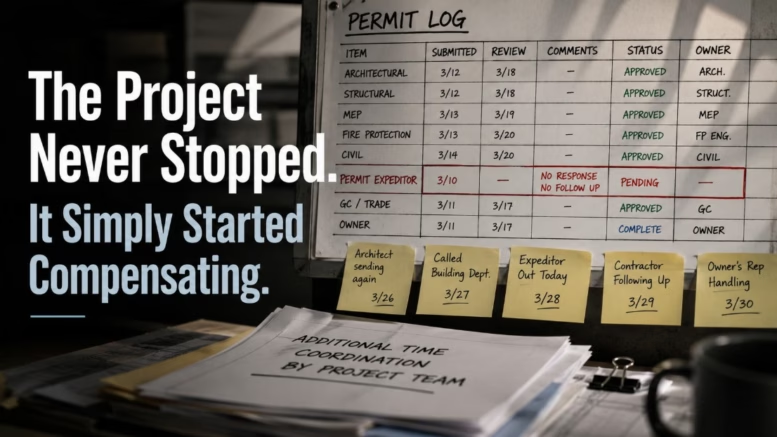
One project involved a permit expeditor the owner had worked with before. The recommendation made sense. The expeditor had previously worked in the local building department, knew many of the local officials, and had successfully worked with the owner before.
At the time, I had no reason to question the owner’s recommendation.
The project moved forward, and for a while everything seemed fine.
Then communication became inconsistent.
Our permit-related questions sat longer than they should have. Follow-up with the building department became sporadic. We found ourselves identifying paperwork requirements and next steps that should have been coming from the expeditor. There was no meaningful action list to keep everyone aligned, and too often we were the ones driving the process instead of the person we had hired to do exactly that.
I noticed the pattern early and worked directly with the expeditor to address the shortcomings and get things back on track.
Despite those efforts, the problems persisted. Before long, others on the project started noticing the same things I was.
What surprised me wasn’t that people noticed.
It was where the conversations happened.
An architect would catch me after a meeting. A contractor would quietly ask, “Are you seeing the same thing?” A consultant would bring it up while we were walking back from the site.
People weren’t trying to decide whether the expeditor was struggling.
They were trying to decide where it was safe to talk about it.
Everyone knew the expeditor was the owner’s guy.
The conversations weren’t disappearing.
They were happening everywhere except where the decision could be reconsidered.
People weren’t just deciding whether to raise the issue.
They were deciding whether raising it in the meeting would be heard as questioning the owner’s judgment.
That’s why the conversations happened privately first.
When the Concern Became a Project Risk
Those conversations usually found me because I represented the owner’s interests. Projects generate disagreements, politics, and personality conflicts. My responsibility wasn’t to relay every complaint. It was to determine whether I was hearing normal project friction or a legitimate project risk.
The concerns I was hearing from the rest of the team matched what I was seeing firsthand.
After working directly with the expeditor and seeing the same concerns emerge across the project team, I concluded the issue had become a legitimate project risk.
I brought it to the owner.
We discussed the missed milestones, the growing impact on the project, and whether it was time to replace the owner’s recommended expeditor.
The owner chose to stay the course.
That was the owner’s decision to make.
The project moved forward.
The conversations didn’t stop.
The work changed instead.
How the Team Adapted
I found myself making trips to the building department that should have been the expeditor’s responsibility. Other members of the team quietly absorbed work that wasn’t theirs. We found ways around obstacles and kept the project moving.
From the outside, everything still looked fine.
The permits eventually came through. The project hit its milestones. But the cost never showed up as a missed deadline or a formal complaint. It showed up as time and effort the team spent covering ground the expeditor should have covered himself.
The owner knew. That was the arrangement, whether anyone called it that or not.
Nobody wanted the project to stall. We did what project teams do. We adjusted, covered work that wasn’t ours, and kept moving forward.
In doing so, we also made it harder to recognize that the original decision deserved another look. The project wasn’t just compensating for a struggling consultant. It was changing how information reached the owner, and how the owner counted the cost of staying the course.
Projects often become better at compensating for decisions than reconsidering them.
What Changed—and What Didn’t
None of this means owners should stop bringing trusted people onto their projects.
Every experienced owner develops a trusted pool of consultants, contractors, and advisors. That’s part of experience. Good people earn repeat work.
Bringing trusted people onto a project was never the issue. What happens after they’re there is.
Concerns aren’t always raised in the meeting where decisions are made. They’re tested in the hallway, over coffee, and in private phone calls while people compare what they’re seeing.
Owners can only make decisions based on the information they receive. When the project starts compensating instead of reporting, even good decisions become harder to make.
Trusted recommendations should influence who gets selected. They should never influence how performance is evaluated.
If you’re the decision-maker, don’t assume the conversation starts when it reaches you. By then, the project may have been talking about it for weeks.
If it’s already been raised once and you chose to stay the course, that’s not the end of it. It goes back on the table at the next status meeting. Not to relitigate the decision — to ask whether it’s still the right one.
Ask yourself one question: am I defending my original decision, or am I making the best decision for the project today?
Shouldn’t your guy still have to earn it?
About the Author: Richard Neuman advises organizations on capital planning, project governance, and complex capital programs. He has overseen more than $2 billion in capital investments across commercial real estate, healthcare, utilities, industrial, broadcast, and development projects.
He writes candidly from an owner-side perspective about the executive decisions and organizational dynamics that shape capital project outcomes.
Leading a major capital program or facing a complex capital decision?
Contact Richard.
Subscribe for insights on capital planning, project governance, and the executive decisions that shape project outcomes long before construction begins.



Be the first to comment on "“Your Guy” Still Has to Earn It"