
What owners should resolve before the certificate is accepted and the move date takes over.
The drawings had been approved, the fire alarm tested, and the punch list started. The movers were scheduled, and the lease at the existing location was about to expire.
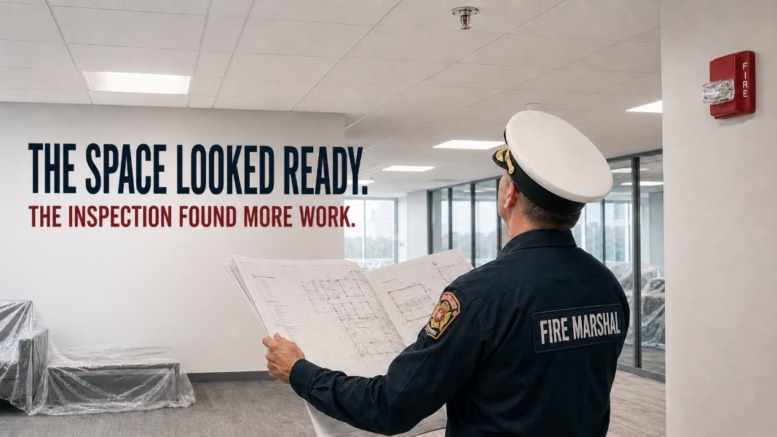
During the final inspection, the fire marshal required additional exit signs and several strobe heads that had not been identified during plan review.
The project team questioned why these requirements hadn’t been raised earlier. Regardless, the additional work had to be designed, priced, installed, tested, and reinspected before the owner could occupy.
What had been carried as one turnover date was actually four milestones:
Substantial completion under the contract
Governmental approval to occupy
The owner’s physical move
The owner’s readiness to operate the facility
Furniture installation, technology deployment, and move-in activities often occur between substantial completion and operational readiness. The schedule needs to recognize these milestones separately and allow time for the activities and approvals between them.
Plan Approval Isn’t a Final Sign-Off
A fire marshal or another authority having jurisdiction may identify requirements during a field inspection that were not raised during plan review. An inspector may interpret a requirement differently, encounter an unforeseen condition, or require additional measures based on the completed space.
The team can prepare by reviewing the work, testing systems, coordinating with authorities, and resolving previous comments. Approval on the first inspection is never guaranteed.
Depending on the jurisdiction, the required authorization may be a certificate of occupancy, temporary approval, final inspection, or another sign-off.
Where the contract defines substantial completion by the owner’s ability to lawfully occupy or use the work for its intended purpose, an outstanding approval may prevent substantial completion. The contract and applicable approval process control.
The Move Date Does Not Settle Responsibility
Owners cannot always postpone a move. An expiring lease, scheduled technology cutovers, and commitments to employees may leave little flexibility.
Sometimes the contractor is late. Sometimes the owner has advanced occupancy, made late decisions, or added scope. Responsibility may be shared.
In each case, the owner may occupy a space while work remains, but responsibility for overtime, remobilization, temporary measures, protection, and disruption can differ considerably.
The project record should establish what caused the condition and who is responsible for the consequences before those additional costs are incurred.
Unfinished Work Becomes Occupied Construction
Incomplete paint, damaged finishes, missing labels, or minor hardware adjustments may not prevent substantial completion. Completing them becomes more difficult once furniture installation and move-in activities begin.
Work that would have taken an hour in an empty room may require after-hours access, furniture protection, security escorts, and additional cleaning. Controls adjustments or fire-alarm work may interrupt operations.
Before occupancy, the owner needs a completion plan identifying each outstanding item, its responsible party, completion date, access requirements, and any additional costs or disruption.
The Certificate Changes the Owner’s Position
Under the standard AIA A201/G704 process, the architect determines whether the work is substantially complete and prepares the certificate establishing the date.
The certificate identifies the work, or designated portion, that has reached substantial completion. It addresses remaining work, the time allowed for completion, warranty commencement, and responsibilities for security, maintenance, heat, utilities, damage, and insurance. The G704 form also records the estimated cost of work to be completed or corrected.
When the owner and contractor sign, they accept the responsibilities assigned to them.
If one floor is ready and another is unfinished, the certificate should identify the portion being accepted. Limited occupancy should not inadvertently become acceptance of the full project.
The operating team must understand the responsibilities it is assuming. Where contractors will continue working after occupancy, access, protection, damage, and disruption arrangements should be established before acceptance.
The Attached List Matters Just as Much
Visible deficiencies are generally easy to identify. Less obvious issues may include incomplete testing and balancing, unresolved controls, open commissioning findings, unfinished training, missing O&M manuals, or pending approvals.
Under the AIA approach, omitting an item from the completion list does not eliminate the contractor’s contractual obligation. However, undocumented conditions can become difficult to resolve after the project team demobilizes.
Warranty commencement also requires attention. Applicable warranties under the standard AIA approach generally begin at substantial completion unless another date is established. Work listed for completion or correction may have a different commencement date under G704. Manufacturer warranties may begin at delivery or startup.
The owner should review the certificate and attachments together, identify which systems remain incomplete or untested, and establish the commencement and expiration dates of applicable warranties.
5% Retainage Limits the Owner’s Leverage
On qualifying New York private projects totaling $150,000 or more, retainage is capped at 5% of the contract sum. Public work and specified residential projects are governed differently.
The contractor may also submit its final invoice upon substantial completion, as defined or contemplated by the contract.
Five percent can be consumed quickly when remaining work requires multiple trades, after-hours access, repeated inspections, remobilization, and protection.
The owner may still have grounds to dispute or withhold payment for defective, disputed, or incomplete work, subject to the contract and applicable law. Those grounds need to be documented, along with a realistic estimate of completion costs.
As retainage becomes limited, the quality of that documentation becomes increasingly important.
Compliance Does Not Decide Who Pays
When the fire marshal requires another strobe head, obtaining approval is the immediate priority. Responsibility for the cost still needs to be determined.
The requirement may result from a design omission, incomplete contractor work, a field condition, an owner change, or an interpretation that was not communicated during plan review.
The owner may need to authorize the work promptly while reserving its position on cost responsibility. The urgency of occupancy should not turn every final-inspection requirement into an automatic owner-funded change.
Before the Owner Accepts Substantial Completion
The owner cannot eliminate every surprise at the end of a project, but six questions deserve answers before accepting the certificate:
Can the identified area legally be occupied and used for its intended purpose?
What remains unfinished, and what will it take to complete that work after occupancy?
Which operating, maintenance, utility, security, insurance, and damage responsibilities are transferring?
Which warranties are starting, and which items require different commencement dates?
What payment rights are being triggered, and is the remaining financial protection sufficient?
Who is responsible for the cost and disruption of completing the remaining work?
Substantial completion may be entirely appropriate while work remains unfinished. The owner needs to understand the contractual, financial, and operating responsibilities being accepted, along with the arrangements for completing that work.
The decision deserves its own review, independent of the pressure to meet the move date.
About the Author: Richard Neuman advises organizations on capital planning, project governance, and complex capital programs. He has overseen more than $2 billion in capital investments across commercial real estate, healthcare, utilities, industrial, broadcast, and development projects.
He writes candidly from an owner-side perspective about the executive decisions and organizational dynamics that shape capital project outcomes.
Leading a major capital program or facing a complex capital decision?
Contact Richard.
Subscribe for insights on capital planning, project governance, and the executive decisions that shape project outcomes long before construction begins.



Be the first to comment on "Substantial Completion Starts More Than the Closeout Clock"