
What an owner needs to preserve when a capital project is put on hold.
The project had been paused for eighteen months, with the design complete and the permit issued, but construction had yet to begin.
When leadership decided to restart, the direction seemed straightforward: reengage the design team, update the schedule, and prepare for construction.
The architect advised that the permitted documents would need to be reviewed against current requirements and building conditions. Several consultants would need to be reengaged, and the additional work would require a contract amendment.
As the team began preparing for the restart, other assumptions underlying the original project began to unravel.
The Team and Its Contracts Had Moved On
During those eighteen months, the original project manager had left the firm, and several consultants had moved to other assignments. Decisions that were familiar when the project stopped now had to be recovered from drawings, meeting minutes, and correspondence.
The remaining design fee had assumed a continuous schedule and the same project team. Subconsultants would need to return under new proposals, and the architect and engineers needed to confirm that the documents still reflected the owner’s requirements and existing conditions.
The restart also raised contractual questions. What work remained under the original agreements? What would require additional compensation? Had the suspension been formally documented, including the conditions for resuming services?
Those questions needed to be resolved before the team could reliably establish a new schedule and budget.
The Design and Estimate Needed Another Look
The permitted drawings reflected the organization’s requirements when the project stopped. Since then, staffing, equipment needs, technology, and building conditions had continued to change.
Several specified products had been discontinued. Others were available with different dimensions, connections, or lead times.
Substitutions required technical review, coordination with other disciplines, and updated pricing. Some affected work that had already been designed around them.
The construction estimate presented a similar problem.
It had been prepared for a particular design, bid date, contractor market, and procurement plan. Applying an escalation factor might account for general price increases, but it would not capture changes in availability, sequencing, or how contractors would now approach the work.
The owner needed an updated estimate based on the current design and a realistic construction strategy.
The Permit Had Expired
The permit had been issued before the pause, but no construction had begun. By the time leadership authorized the restart, it had expired.
The team first needed to determine whether the permit could be renewed or whether the project would require a new filing.
That determination depended partly on changes to the design, applicable regulations, and building conditions. Some revisions might have no permitting impact. Others could require updated drawings and another review.
The restart schedule would have to account for the approval process, including any uncertainty over how long it might take.
The Swing Space Was Gone
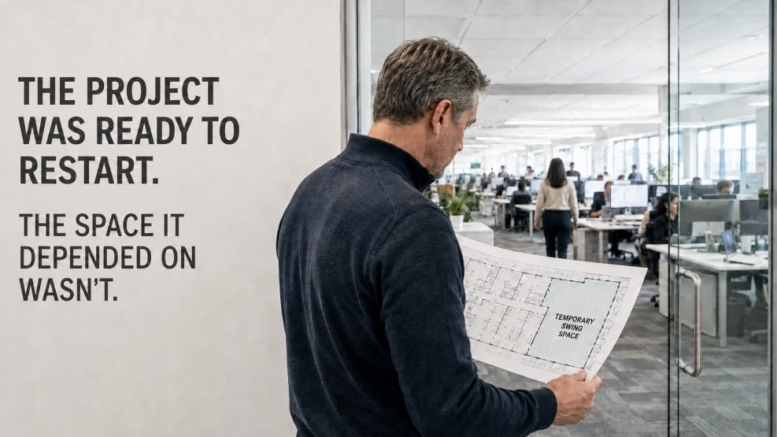
The original construction plan depended on moving occupants to a vacant floor while their space was renovated.
During the pause, another department had taken it.
Phasing the renovation around the occupants would extend the schedule, increase costs, and disrupt business operations. Leasing outside swing space would require additional funding and a new relocation plan.
The loss of swing space fundamentally changed the construction strategy, with cost, schedule, and operational implications that had never been considered when the project was paused.
Leadership now had to reconsider whether the original approach was still practical.
What Does It Cost to Preserve the Ability to Restart?
Pausing the project may well have been the right business decision. Capital priorities change, funding gets redirected, and sometimes the prudent choice is to stop spending. A pause still requires a decision about what the owner intends to preserve.
Keeping consultants engaged, maintaining permits where possible, monitoring product availability, and reserving swing space all have costs or operational consequences. Some may be worth maintaining. Others may be allowed to expire or change, provided leadership understands what that means for a future restart.
The owner should establish which conditions are critical to preserving the project, what it will cost to maintain them, and who is responsible for monitoring changes during the suspension.
That responsibility matters even when the project has no active design or construction team. Business requirements continue to evolve and building conditions change. Other departments also make their own decisions, and one of them, reassigning a vacant floor, can remove a condition the project depends on without anyone connected to the project knowing.
When leadership eventually authorizes a restart, the first step should be to reassess the project against current business needs, available resources, and the conditions required for construction.
In this case, the design could be updated, the contracts renegotiated, and the permit addressed. The loss of swing space forced a much broader reconsideration of how the project could proceed.
The owner had authorized an eighteen-month pause without establishing which conditions needed to remain in place.
About the Author: Richard Neuman advises organizations on capital planning, project governance, and complex capital programs. He has overseen more than $2 billion in capital investments across commercial real estate, healthcare, utilities, industrial, broadcast, and development projects.
He writes candidly from an owner-side perspective about the executive decisions and organizational dynamics that shape capital project outcomes.
Leading a major capital program or facing a complex capital decision?
Contact Richard.
Subscribe for insights on capital planning, project governance, and the executive decisions that shape project outcomes long before construction begins.



Be the first to comment on "“Paused” Is Not a Project Status"