

Relationships can identify good candidates. They shouldn’t replace the owner’s process for determining whether those candidates are right for the project.
Originally published September 2011. Updated September 2026 to reflect current owner-side project leadership and vendor selection.
There is a phrase that comes up surprisingly often when a project team is being assembled.
“We have a guy.”
The broker knows a contractor.
The architect has an engineer they like.
Someone in facilities has used a furniture dealer before.
An executive knows a technology firm.
The project manager has consultants they regularly work with.
There is nothing inherently wrong with any of that.
Good professional relationships are valuable. People who have worked successfully together may communicate better, understand each other’s expectations and already know how to solve problems together.
But I would still ask:
“Why is this firm on our project?”
The answer should be better than, “We’ve used them before.”
A Recommendation Is a Starting Point
A trusted recommendation can be an excellent way to identify potential team members.
It isn’t the same as qualifying them.
The contractor who performed well on a 20,000-square-foot office renovation may not be the right contractor for a complicated occupied project.
The engineer who works well with the architect may not have the specialized experience the owner’s building requires.
The furniture dealer with the strongest relationship may not have the installation capacity to support the schedule.
The technology vendor may know the owner’s existing systems extremely well but have limited experience coordinating with a major construction program.
The question isn’t whether the recommended firm is good.
It’s whether the firm is right for this project.
Understand Who Is Being Recommended
Company reputation matters, but projects are performed by people.
I want to know who will actually be assigned.
Who is the project executive?
Who is the day-to-day project manager?
Who will be on site?
Who prepared the proposal?
Are those the same people who will execute the work?
A firm may have extraordinary experience on its resume. That experience becomes much less relevant if none of the people responsible for it will be involved in your project.
The owner should evaluate the proposed team, not simply the logo at the top of the proposal.
Relevant Experience Means Relevant
“We’ve done projects like this” deserves another question:
“Show me.”
Similar square footage isn’t necessarily similar experience.
A headquarters renovation in an empty building is different from work performed around an operating business.
A standard office build-out is different from a project with unusual technology, security, infrastructure or phasing requirements.
A project in another market may have different permitting, labor, logistics and procurement conditions.
References are useful when they help the owner understand how the proposed team performed under circumstances that resemble the project being contemplated.
The objective isn’t to find the firm with the longest project list.
It’s to understand whether its experience addresses the risks you’re actually buying them to manage.
Capacity Matters Too
A highly qualified firm can still be the wrong selection if it doesn’t have the capacity to perform.
What else is the proposed team working on?
When does your project need them?
Are the key people available during the periods when their involvement matters most?
What happens if the schedule moves?
Who provides backup?
These aren’t secondary questions.
The project may last months or years. The owner isn’t simply purchasing expertise. The owner is purchasing access to that expertise when the project needs it.
Be Careful With Bundled Relationships
Project participants naturally develop preferred working relationships.
That can be beneficial.
It can also make the team selection process less visible to the owner.
If the architect recommends an engineer, the recommendation may be excellent. If the broker suggests a project manager, that person may be exactly right. If the project manager recommends a contractor or mover, prior experience may reduce coordination risk.
But the owner should still understand the relationship.
Why is this firm being recommended?
What alternatives were considered?
Who evaluated the proposal?
Are there financial relationships or contractual arrangements the owner should understand?
Does the recommended firm serve the owner’s interests independently, or is it primarily supporting another team member’s scope?
None of those questions assumes something is wrong.
They establish transparency before the project begins.
Price Doesn’t Answer the Question
Competitive pricing can help establish market value.
It doesn’t determine which team is best suited to execute the work.
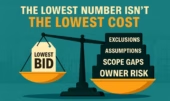
A low proposal can become expensive if important scope is missing.
A higher proposal may include resources, services or risk allowances that another bidder excluded.
Two firms may appear to be pricing the same assignment while making very different assumptions about staffing, schedule, deliverables and responsibility.
Before comparing the number at the bottom, I want to understand what each firm believes it is being hired to do.
That is often where the meaningful differences appear.
Interviews Should Test the Actual Team
Formal presentations can become polished sales exercises.
I prefer questions that force the proposed team to talk about the project in front of them.
What concerns you about our schedule?
Where do you see the greatest coordination risk?
What information do you need from us first?
What would you challenge in the current approach?
Who on your team would handle that issue?
Tell us about a similar project that didn’t go according to plan. What happened?
The objective isn’t to catch anyone with a difficult question.
It’s to hear how the people who may actually run the work think.
The Owner Should Know Why Each Firm Was Selected
The selection process doesn’t have to become bureaucratic.
A small project may require only a few proposals, reference calls and a conversation with the proposed team.
A major capital program may warrant a formal RFP, detailed evaluation criteria, interviews, financial review and documented recommendations.
The rigor should fit the risk.
But at the end of either process, the owner should be able to explain why a firm was selected.
- Relevant experience.
- The right people.
- Available capacity.
- Understanding of the assignment.
- Appropriate scope.
- Commercial terms.
- References.
- Ability to work with the rest of the team.
Those are reasons.
“Someone knows them” isn’t enough by itself.
Relationships Still Matter
I wouldn’t eliminate relationships from the selection process.
Quite the opposite.
A strong working history can be valuable evidence. If people have successfully delivered difficult projects together, that should count. But prior relationships should inform the owner’s decision, not make the decision automatically.
The distinction is important.
A recommendation says:
“You should consider these people.”
A selection process answers:
“These are the right people for this project.”
Those are not the same thing.
Leadership takeaway: Trusted relationships are a valuable source of project-team candidates. Owners should still understand who is being proposed, why they fit the assignment, whether they have the capacity to perform and what alternatives were considered before turning a recommendation into an appointment.
About the Author: Richard Neuman advises organizations on capital planning, project governance, and complex capital programs. He has overseen more than $2 billion in capital investments across commercial real estate, healthcare, utilities, industrial, broadcast, and development projects.
He writes candidly from an owner-side perspective about the executive decisions and organizational dynamics that shape capital project outcomes.
Leading a major capital program or facing a complex capital decision?
Contact Richard.
Subscribe for insights on capital planning, project governance, and the executive decisions that shape project outcomes long before construction begins.



Be the first to comment on "We Have a Guy.” But Is He Right for This Project?"