
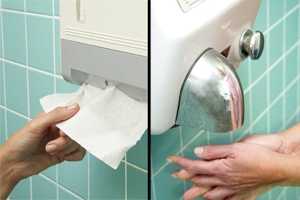
The better choice depends on the restroom, the building and what it takes to operate each option.
Are paper towels less costly to your facility than running and maintaining a hand dryer?
It sounds like a simple comparison. It isn’t.
The purchase price of a dispenser or dryer is only one part of the decision. An owner also needs to consider installation, electricity, paper supplies, waste removal, housekeeping, maintenance, restroom traffic and the experience of the people using the space.
Before choosing one over the other, ask a more useful question:
How will this restroom actually operate?
Start With the Full Cost
Paper-towel dispensers are generally simple to install, but the cost continues as long as the restroom operates.
Someone has to purchase the towels, stock the dispensers, empty the waste containers and clean up paper that ends up on counters and floors. High-use restrooms may require attention several times during the day.
Hand dryers eliminate most of that consumable stream, but they introduce other costs.
The equipment has to be purchased, powered and maintained. Depending on the dryer and the existing electrical infrastructure, installation may require new circuits or other electrical work.
If you’re renovating multiple restrooms, that should be understood before the equipment is selected.
Think About Peak Use
A restroom that serves ten people has a different operating requirement from one serving hundreds of employees, visitors or customers.
How many people may be trying to dry their hands at the same time?
A dryer may take longer per user than grabbing a paper towel. In a heavily used restroom, the number and location of dryers can therefore affect circulation and waiting time.
Paper dispensers have their own capacity issue. If they aren’t sized and replenished for the actual traffic, an empty dispenser quickly becomes an operating problem.
The decision should reflect the restroom’s real demand.
Look at the Restroom Layout
Equipment selection and placement matter.
- Where will people stand while using the dryer?
- Will they interfere with someone entering or leaving the restroom?
- Where does water from wet hands end up?
- Could the location create wet floors or require additional housekeeping?
Noise can also matter. Some high-speed dryers are loud, particularly when restrooms are adjacent to offices, conference rooms, healthcare spaces or other occupied areas.
Accessibility requirements also need to be considered when determining the type, location and operation of dispensers and dryers. Those requirements can vary with the facility and jurisdiction, so they should be coordinated with the project team and applicable authority having jurisdiction.
Don’t Make Hygiene Claims Too Simply
Paper towels and hand dryers have both been the subject of studies comparing hygiene and environmental performance.
The conclusions can vary based on the equipment, testing methodology, operating conditions and assumptions being evaluated.
I wouldn’t select one system for an entire facility based on a generalized claim that one method is universally more hygienic or environmentally responsible.
Look at the particular products being considered and how they will actually be used and maintained.
Consider Housekeeping
This is where the decision becomes very practical.
Paper towels create a supply and waste stream, while restroom fixtures also contribute to the facility’s overall water and resource use.
Dryers reduce that requirement, but the restroom still needs cleaning. Water can accumulate around dryer locations, and the equipment itself requires maintenance.
Ask the people responsible for operating the building what they are seeing today.
- How frequently are towels replenished?
- How much waste is being removed?
- Are existing dryers creating complaints?
- Are there recurring maintenance problems?
That information may be more useful than a theoretical product comparison.
Consistency Has Value Too
For an owner with multiple floors, buildings or locations, there may be another consideration: standardization.
Using the same equipment across a portfolio can simplify purchasing, replacement parts, maintenance and staff familiarity.
The theoretically optimal choice for one restroom may create unnecessary complexity when multiplied across dozens of locations.
That doesn’t mean every restroom needs the same solution. It means the exception should have a reason.
Make the Decision for the Facility
There is no universal answer to paper towels versus hand dryers.
For some facilities, reducing consumables and waste may make dryers attractive. For others, traffic patterns, electrical work, noise, user expectations or operating practices may favor paper towels. Some facilities may have a reason to provide both.
The right comparison is the total cost and operational impact over time.
Leadership Takeaway: A restroom fixture is a small capital decision that becomes an operating decision every day afterward. Before selecting paper towels or hand dryers, understand who will use them, who will maintain them and what the building has to support.
About the Author: Richard Neuman advises organizations on capital planning, project governance, and complex capital programs. He has overseen more than $2 billion in capital investments across commercial real estate, healthcare, utilities, industrial, broadcast, and development projects.
He writes candidly from an owner-side perspective about the executive decisions and organizational dynamics that shape capital project outcomes.
Leading a major capital program or facing a complex capital decision?
Contact Richard.
Subscribe for insights on capital planning, project governance, and the executive decisions that shape project outcomes long before construction begins.



For me, I could say that having paper towel is more effective and efficient in the rest room. Having a hand dryer is fine but I think it’s so costly when it comes to electricity and also paper towel probably has a greater environmental impact than hand dryers especially when you consider papers towel’s production.
Impact Hygiene Services
http://impacthygiene.com.au/
We had been using C-Fold paper towels in the restrooms. The problems with C-Fold towels is the dispenser which usually dispenses more towels than needed and sometimes a large wad of towels is received to your dismay. These C-Fold dispensers have been replaced with large roll, automatic dispensing towel units which are activated by proximity. The janitorial company replaced the C-Fold with the automatic dispensers for free since the paper was easier to install, easier to maintain lasted longer and was less expensive than the C-Fold. The automatic proximity dispensers have the added advantage of no-touch on the dispenser which is more hygienic.
I would like to see some back up on the “fecal matter” argument.
The Dyson Airblade is indeed very popular. http://www.restroomdirect.com/dyson-airblade.aspx
Thank you for your feedback Christopher.
There are many sites like Discovery http://dsc.discovery.com/tv-shows/mythbusters/mythbusters-database/fecal-matter-on-toothbrush.htm that discuss airborne fecal matter. While this example examines airborne fecal matter on toothbrushes, the same has been found for dryers. One example is http://www.wikihow.com/Use-a-Public-Restroom where it states “Dry your hands using the dryer or paper provided. Some places use cloth towels that circulate in a dispenser – be sure to move the towel onto the next clean space, otherwise you will be wiping your hands on the previous person’s space. Note that hot-air dryers are less sanitary because bacteria fester and thrive in the hot, moist vents. Use paper towels, if possible.”
Based on the many instances mentioned, I felt confident there was enough evidence to include it in the article.
I hope this answers your question.
RN
OK, so the myth busters piece shows that there is a tiny amount of fecal matter everywhere. But it is a leap to assume that there is more fecal matter on the inside of a hand dryer than there is on a paper towel, or that one is more sanitary that the other. (A wet paper towel that ends up on a counter is surely worse.)
The “How to use a Public Restroom” piece is sponsored by Kimberly Clark which makes, you guessed it, paper towels. The whole piece is about using more toilet paper and paper towels. It makes the statement that bacteria festers in hand dryers, but it does not back this up with any studies and it does not mention how much bacteria can be found on paper towels.
There is so much paranoia about something that we all do every day. It is really amazing. I heard on NPR 2 days ago that one of the places with the least amount of fecal matter is actually the toilet seat. This is because it is a smooth surface that is constantly cleaned. The kitchen sponge actually has a far greater amount of fecal matter in it!
Interesting discussion.
No arguments here. You are correct in your statements.
Primarily the choice for me has been one of hygiene,dryers that have been notoriously ineffective and causing people to avoid them or only partially dry their hands. I have experience with the new Dyson dryers and have found them to be more effective but still prefer paper believing it to be the more hygienically effective. I’ve enjoyed seeing the arguments above and will add them to my considerations when next I have to make the decision.