
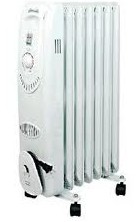
An electric space heater may be permitted in an office. That doesn’t mean the building has to allow it—or that plugging one in is a good solution to a workplace heating problem.
Originally published November 2011. Updated October 2026 to reflect current New York City requirements and owner-side workplace considerations.
Have you ever been told by building management that space heaters are illegal?
That was the question behind this article when I first wrote it in 2011.
The answer in New York City remains more nuanced than a simple yes or no.
Portable electric space heaters are not categorically prohibited in ordinary office space. But their use is regulated, the electrical system has to support them, and a building or employer may have its own rules prohibiting them.
And from an owner or facilities perspective, there is another question I would ask:
“Why does someone need a space heater in the first place?”
One heater under one desk may be personal preference.
Twenty heaters across a floor may be telling you something about the building.
Legal Doesn’t Mean Unrestricted
New York City’s Fire Code establishes requirements for portable electric space heaters.
Among them, the heater must be listed and labeled, connected directly to a receptacle rather than through an extension cord, and kept at least three feet from combustible materials. Its electrical requirements also cannot exceed the rating of the circuit and receptacle supplying it.
New York City requirements for electric space heaters offered for sale also include safety features such as thermostatic control and automatic shutoff protection for tip-over or overheating.
Those requirements address whether and how a heater can be used safely.
They don’t require a commercial building to permit employees to use one.
A landlord, employer or building operator may establish more restrictive rules. If building policy prohibits portable heaters, the fact that a compliant heater isn’t categorically prohibited by the Fire Code doesn’t override that policy.
The Electrical Load Is Real
The little heater under a desk may not look like much of an electrical load.
It can be.
A typical portable electric heater rated at 1,500 watts draws substantial current. Add computers, monitors, task lighting and other equipment sharing the circuit, and the electrical load can become significant.
That was one of the main points of the original article, and it remains relevant.
The FDNY warns against overloading electrical circuits and identifies high-current appliances such as space heaters as loads that warrant attention.
From a facilities perspective, a tripped breaker may be the first indication that the circuit is being asked to do more than intended.
And the operational consequence isn’t limited to the employee whose heater shut off.
A shared circuit can serve multiple workstations or pieces of equipment.
Don’t Use an Extension Cord to Solve the Problem
The outlet isn’t close enough, so someone reaches for an extension cord.
That isn’t the solution.
New York City’s Fire Code requires portable electric space heaters to be plugged directly into an approved receptacle. Extension cords aren’t permitted for that use.
I would treat that as a simple rule for an office:
If the heater can’t safely reach an appropriate receptacle with its own cord, don’t extend the cord to make it reach.
The same principle applies to placement.
Don’t put the heater where paper, boxes, furniture, clothing or other combustible material can encroach on the required clearance.
The Building Can Still Say No
This is where the original question sometimes gets confused.
“Is it legal?” and “Am I allowed to use one here?” aren’t necessarily the same question.
A building owner has to manage more than one heater.
Management has to consider the electrical distribution system, fire safety, tenant rules, insurance requirements, operational practices and what happens when dozens or hundreds of occupants make similar decisions.
A prohibition against personal space heaters may therefore be a building-management policy even where the Fire Code doesn’t impose a blanket prohibition.
If a building doesn’t permit them, employees shouldn’t quietly hide them under their desks.
But management should also pay attention to why people keep bringing them in.
The Space Heater May Be the Symptom
This is the part of the conversation I think is more important.
Suppose one employee says the office is cold.
That may be individual preference.
Suppose an entire perimeter of the floor has space heaters running every winter.
Now I want to know more.
Is cold air leaking through the façade?
Are perimeter heating systems operating properly?
Are thermostats or sensors located where they accurately represent occupied conditions?
Has the office layout changed without the HVAC system being rebalanced?
Are supply-air temperatures or volumes appropriate?
Are employees sitting in locations that weren’t originally intended to be workstations?
Has a building-system problem gradually become accepted as normal?
The heater may solve the employee’s immediate problem while allowing the underlying condition to remain unexamined.
Don’t Let Personal Heaters Become the HVAC Strategy
There can be legitimate temperature differences within an office.
People also experience temperature differently. A workplace isn’t going to provide every occupant with precisely the temperature they would choose at home.
But there is a difference between occasional individual discomfort and a recurring building condition.
If portable heaters start appearing throughout a workplace, I wouldn’t simply confiscate them and consider the problem solved.
I’d ask:
Where are they being used?
Is there a pattern?
What temperatures are we actually maintaining?
Are the HVAC and perimeter systems performing as intended?
Has anything changed in the space since the system was designed or balanced?
The answers may point to an operational issue, a maintenance problem, a controls problem or a capital need.
If Space Heaters Are Permitted
Where building and employer policies permit portable electric space heaters, establish clear requirements for their use.
At a minimum, the heater should comply with applicable listing and safety requirements, be plugged directly into an appropriate receptacle, maintain the required clearance from combustible materials and be operated in accordance with the manufacturer’s instructions and applicable building rules.
And employees should know whom to contact when their workspace is consistently uncomfortable.
Because a space heater may make one desk warmer.
It doesn’t tell you why the desk was cold.
The owner-side question isn’t only whether the heater is allowed. It’s whether the building is telling you something that needs attention.
About the Author: Richard Neuman advises organizations on capital planning, project governance, and complex capital programs. He has overseen more than $2 billion in capital investments across commercial real estate, healthcare, utilities, industrial, broadcast, and development projects.
He writes candidly from an owner-side perspective about the executive decisions and organizational dynamics that shape capital project outcomes.
Leading a major capital program or facing a complex capital decision?
Contact Richard.
Subscribe for insights on capital planning, project governance, and the executive decisions that shape project outcomes long before construction begins.


The space heater is very useful in winter heater. But it is very fire hazard. In this article, you shared the best guidelines to use space heater safely. Thank you for sharing this useful content. This instruction will help us to avoid firing hazard.
The questions “are space heaters legal?” Draw a significant parallel to “is driving 55 legal?”
It all depends where you are.
But the real question is: are they safe for the rest of the equipment in your office?
On systems furniture generally there are going to be 3 cubicles connected per 20 amp circuit.
On hard wall outlets there are usually six outlets per 20 amp circuit.
20 amp circuit has a sustain capacity for 15 – 16 amps maximum.
If you draw over 20 amps the breaker will trip, but if you are drawing between 16 and 20 the wiring will overheat and can cause a fire. With the overheating of the wiring the connections loosen up causing the voltage to drop. All equipment requires 110 volts. Operating under lower voltage will cause overheating on the equipment it self. For example some task light will operate with only 85 volts.
I have been in the office furniture business since 1979 and most (I would say over 90%) of electrical failures on systems furniture are due to space heaters.