
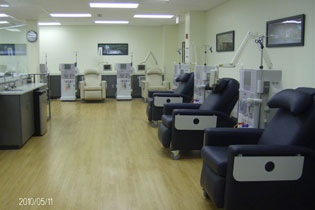
The answer depends on the clinical use, equipment, required clearances and the requirements governing the project.
Updated October 2026
In 2012, I wrote about healthcare requirements affecting the space around treatment chairs.
At the time, the discussion centered on specific dimensional requirements. Today, I would start with a different question:
How much space does this particular treatment chair actually need?
There is no single dimension that applies to every healthcare setting.
The answer depends on what happens in the space, the equipment being used, how clinicians need to work around the patient, accessibility and circulation requirements, and the codes and standards applicable to the project.
Start With the Clinical Use
Before deciding how much space to provide around a treatment chair, define what will actually happen there.
- What procedures or treatments will be performed?
- How many clinicians may need to work around the patient?
- What equipment will routinely be present?
- Will equipment move in and out?
- Where will supplies be stored?
Does the patient need assistance transferring or moving through the space?
What privacy provisions are required?
Those answers affect the physical requirements of the room or treatment station.
A generic square-foot allowance cannot answer them.
Test the Actual Layout
Healthcare planning requirements may establish minimum room areas, clearances or other criteria depending on the type of space and clinical use.
Minimum area and usable geometry are different things.
Consider a treatment chair shown neatly in the middle of a plan.
Now add:
- Required clearances
- Casework
- Handwashing facilities
- Medical equipment
- Mobile equipment
- Staff work positions
- Doors and door swings
- Privacy curtains or partitions
- Accessible routes
- Patient and staff circulation
The remaining space can look very different.
That is why I want to see the actual room laid out with the equipment and functions it is expected to support.
Show me how the room works when people and equipment are actually in it.
Know Which Requirements Apply
Healthcare design requirements are specific to the facility, room type, clinical use and jurisdiction.
The applicable criteria may involve state health department requirements, adopted building and accessibility codes, FGI Guidelines or other standards and regulations.
Requirements also change over time.
The edition used on another project may not be the edition governing this one. A requirement applicable in one state may be adopted or enforced differently somewhere else. Different types of treatment spaces may have different requirements.
That makes one question particularly important:
What requirement are we designing to, and who has confirmed that it applies?
The healthcare architect and code professionals should identify the applicable requirements for the project and coordinate with the authority having jurisdiction when appropriate.
Do not take a clearance or room dimension from an article, another project or a generic planning standard and assume it governs the current project.
Don’t Discover the Problem Late in Design
These issues become expensive when they are discovered after the room layouts have been repeated throughout the project.
A small adjustment to one treatment space may sound minor.
Multiply that adjustment across a department and it can affect corridors, adjacent rooms, plumbing locations, structural coordination, equipment layouts and the overall program.
If the footprint is fixed, gaining space in one room means taking it from somewhere else.
That is why representative rooms should be tested early.
For repetitive clinical spaces, a detailed room layout or mockup can expose problems before they are multiplied across the project.
Design for the Operation You Expect
Code compliance establishes important minimum requirements.
The owner still has to determine whether the space supports the intended operation.
A room may technically accommodate the required equipment and clearances while leaving clinicians with an awkward workflow. Storage may be located where staff constantly cross the room. Equipment may fit but interfere with access when it is in use. A door may comply on the plan while interfering with how the room actually functions.
Those are operational questions.
They belong in design before the drawings become difficult and expensive to change.
Bring clinicians, facilities personnel and other appropriate users into the review at the point when their input can still influence the layout.
Then ask them to test the room against a normal day rather than simply asking whether they like the floor plan.
Leadership Takeaway: Before approving repetitive healthcare room layouts, require the team to identify the applicable requirements and demonstrate how the actual equipment, staff, patient and circulation fit within the space. The required clearance is the starting point. The owner still needs to know whether the space will support the operation.
About the Author: Richard Neuman advises organizations on capital planning, project governance, and complex capital programs. He has overseen more than $2 billion in capital investments across commercial real estate, healthcare, utilities, industrial, broadcast, and development projects.
He writes candidly from an owner-side perspective about the executive decisions and organizational dynamics that shape capital project outcomes.
Leading a major capital program or facing a complex capital decision?
Contact Richard.
Subscribe for insights on capital planning, project governance, and the executive decisions that shape project outcomes long before construction begins.




Be the first to comment on "How Much Space Does a Treatment Chair Need?"