
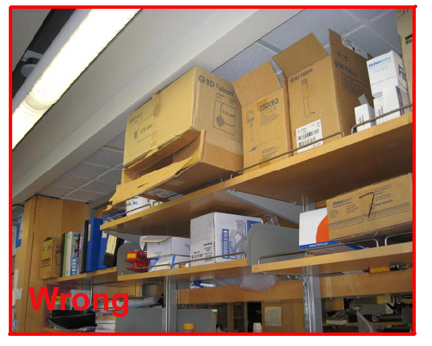
The familiar 18-inch rule is a good starting point—but sprinkler type, storage configuration and applicable requirements can call for more.
Originally published August 2011. Updated October 2026 to reflect current sprinkler-clearance requirements and owner-side operational considerations.
Storage rooms have a way of filling themselves.
A shelving unit that originally had plenty of clearance gets another box placed on top. Then another. Eventually someone notices that the storage is getting surprisingly close to the sprinkler heads.
So how much space actually needs to remain clear?
For many ordinary sprinklered storage conditions, the answer starts with 18 inches.
OSHA requires a minimum vertical clearance of 18 inches between sprinklers and material below. Importantly, OSHA has clarified that this isn’t simply an 18-inch bubble immediately beneath each sprinkler. The clearance is generally treated as a horizontal plane throughout the storage area or room. OSHA
But that doesn’t mean 18 inches is the answer for every situation.
Why Does the Clearance Matter?
A sprinkler doesn’t protect only the spot immediately beneath it.
When activated, the sprinkler needs to distribute water across its intended coverage area. Storage placed too high can interfere with that discharge pattern and prevent water from reaching the materials the system was designed to protect.
That is why the clearance requirement isn’t really about keeping boxes away from sprinkler heads.
It’s about protecting the sprinkler’s ability to do its job.
And this isn’t merely an old rule sitting in a code book. OSHA continues to cite facilities where storage encroaches on the required clearance. A 2024 OSHA citation, for example, involved boxes stored high enough to prevent the required minimum clearance in a storage room. OSHA
Eighteen Inches Is a Starting Point, Not a Universal Rule
The standard 18-inch clearance generally applies to many common sprinkler configurations. Current NFPA material also recognizes circumstances where different clearances apply.
Some specialized sprinkler and storage arrangements can require greater clearance. Other specifically permitted configurations may allow less than 18 inches. NFPA Document Information
That means I wouldn’t walk through every building with an 18-inch ruler and assume the question is settled.
The applicable requirement depends on the sprinkler system, storage arrangement, commodity or materials being stored, and other conditions.
For unusual or high-storage situations, confirm the requirement with the appropriate fire-protection professional and the authority having jurisdiction.
What About Shelving Against a Wall?
This is where the rule becomes more nuanced.
OSHA has specifically addressed storage on shelving against a wall. Its interpretation explains that such storage can be treated differently because it may not interfere with the overlapping sprinkler spray pattern in the same way as storage elsewhere in the room. OSHA
Current NFPA materials similarly recognize particular wall-shelving conditions in which shelving and storage may extend above the otherwise applicable 18-inch plane, provided the arrangement meets the applicable requirements. NFPA
That’s an important distinction—but I wouldn’t turn it into a blanket rule that anything against a wall is acceptable.
The actual sprinkler and shelving configuration still matters.
The Bigger Problem Is What Happens After Occupancy
Most project teams aren’t deliberately designing storage rooms with boxes interfering with sprinkler coverage.
The problem often develops later.
The building opens.
Shelves get filled.
Someone discovers unused space above the top shelf.
A few cartons get stored there.
Nobody thinks of it as a building modification because nothing was constructed.
Yet the operating condition of the room has changed.
That’s why this is as much an operations and inspection issue as a design issue.
A compliant room at turnover doesn’t necessarily remain compliant.
Don’t Design the Clearance Out of the Room
There is also a project lesson here.
If a storage room needs substantial capacity, don’t install shelving so tall that ordinary use practically invites people to violate the required clearance.
If the top shelf creates an attractive place to put boxes but those boxes shouldn’t be there, experience suggests that sooner or later someone will use it.
The better question during design is:
How much usable storage can this room actually provide while maintaining the required sprinkler clearances?
That may affect shelving height, layout, sprinkler coordination and ultimately whether the room is large enough for the intended storage requirement.
Make It Part of the Walk-Through
Storage areas are easy to overlook during routine facility inspections because they aren’t usually where the business happens.
I’d look anyway.
- Look above the shelving.
- Look at boxes placed temporarily on top of cabinets.
- Look at materials added after move-in.
- Look for signs, decorations or other objects that could interfere with sprinkler discharge.
And if something looks questionable, don’t rely on a remembered rule of thumb. Confirm the requirement applicable to that particular system and storage condition.
The basic rule remains remarkably simple:
Sprinklers need room to distribute water properly.
The owner-side responsibility is making sure that the way the building is actually being used doesn’t quietly take that room away.
About the Author: Richard Neuman advises organizations on capital planning, project governance, and complex capital programs. He has overseen more than $2 billion in capital investments across commercial real estate, healthcare, utilities, industrial, broadcast, and development projects.
He writes candidly from an owner-side perspective about the executive decisions and organizational dynamics that shape capital project outcomes.
Leading a major capital program or facing a complex capital decision?
Contact Richard.
Subscribe for insights on capital planning, project governance, and the executive decisions that shape project outcomes long before construction begins.

Life Safety is one of the most complicated regulations to maintain because there are so many entities that survey it (State Fire Marshall, OSHA, Local Fire Chief, Joint Commission, CMS). I would like to make mention that, though as you have stated, there is an exemption to the 18″ clearance rule in a fully sprinkled building it is under the consideration of NFPA 101 8.15 Special Situations and the described situation is 8.15.9 Library Stack Areas and Medical Records Storage. And it only applies to fixed open shelving against the walls with sprinklers within a certain distance. You may not, as in the case of a hospital (as interpreted by Michigan State Fire Marshall), store medical supplies on open fixed shelving up against the wall even if the sprinkler spacing is as required. Clearly each Authority Having Jurisdiction (AHJ) may interpret the code differently, so I would add that one should communicate in advance with the AHJ before considering that storing items within 18″ of the ceiling is allowed.
I did not know that you needed to have at least 18 inches of space under your sprinklers. It makes sense that allowing this can help you make sure they work properly and provide the protection and range you need. The way I see it, it is always a good idea to consult with a professional and make sure your system is properly installed as well as maintained.
what can a employee do when his company knowingly violates this?
Hi Tim-
I would recommend starting either with the Department of Buildings and/or Fire Marshal/Office of Fire Prevention in your local jurisdiction. Depending on the location, they are generally responsible for inspections and issuing violation notices.
Like the 2 exceptuons for the 18 in. rule in a room with a sprinkler system. Is there any exception to the 24 in. rule with non sprinkler system? I am reorganizing a church resource room and all the storage is against a wall and I don’t believery there is a sprinkler in the room. Also, it alsoon one side of the rooom, it serves as a kitchen as well if that changes anything.
Thanks!
What is the code-basis for the 24-inch clearance in a non-sprinklered building?
Hi Mike, see International Fire Code 315.2.1 Ceiling clearance.
Storage shall be maintained 2 feet (610 mm) or more below the ceiling in nonsprinklered areas of buildings or a minimum of 18 inches (457 mm) below sprinkler head deflectors in sprinklered areas of buildings.
Thank you
Great article on storage requirements and sprinkler heights. As a vendor who provides high density storage solutions this is always a concern. We have provided solutions in helping clients protect their assets from water damage if or when sprinklers are activated.
For example, on a powered high density movable system, it can be connected to your central fire alarm and if activated the system will automatically close to help prevent excess water or smoke damage. Other options have been installing rain gutters at the top of shelving to displace water way from items that would be damaged by water, such as museum artifacts or art work.
Please feel free to visit our website at http://www.caspacemangement.com to view sample project or obtain additional information.