
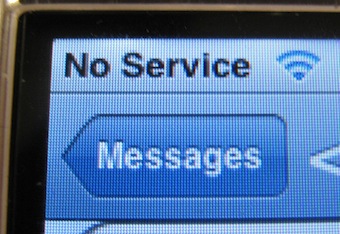
Poor cellular coverage can become a building infrastructure problem—and it is much easier to address before occupants move in.
You walk into a newly completed office and your phone drops to one bar.
Walk toward the windows and the signal improves. Move back into the center of the floor and calls start dropping again.
Someone asks:
“How can we spend this much on a new office and not have reliable cell service?”
It’s a fair question.
The building may have excellent Wi-Fi, new technology infrastructure and strong cellular coverage outside. That doesn’t mean the cellular signal will reliably reach people inside.
And by the time everyone discovers the problem, the ceilings may be closed, the walls finished and the office occupied.
The Building Can Be Part of the Problem
Cellular signals have to travel from an outdoor carrier network into the building and through whatever stands between the antenna and your phone.
Concrete, steel, below-grade spaces and the depth of a large floor plate can all affect coverage. Modern high-performance glazing can also reduce radio-frequency signals entering a building.
That creates an interesting conflict.
Some of the materials and systems that make a building perform better can make wireless connectivity more difficult.
From the owner’s perspective, the technical explanation matters less than the operational consequence:
Will people be able to use their phones where they actually work?
Wi-Fi Doesn’t Necessarily Solve It
The first response to poor cellular coverage is often: “We have Wi-Fi.”
That’s important, but I wouldn’t assume it eliminates the cellular issue.
Wi-Fi calling can substantially improve the experience for many users, but its performance depends on the device, carrier, network configuration and quality of the Wi-Fi environment. There may also be areas where reliable cellular service remains important for employees, visitors, vendors or building operations.
The question isn’t whether the project has Wi-Fi.
It’s whether the completed building provides the connectivity the operation expects.
Test Coverage Before Deciding on a Solution
I wouldn’t start by specifying a distributed antenna system or any other technology.
I’d start by testing the building.
- Where is coverage weak?
- Which carriers are affected?
- Is the problem limited to a few interior rooms or does it affect entire floors?
- What happens in elevators, stairs, conference rooms, below-grade areas and other spaces people actually use?
The answers determine whether the problem is minor or whether the building needs a more deliberate in-building wireless strategy.
Depending on the building and the requirement, solutions can include improved Wi-Fi calling, carrier-supported infrastructure, small cells or a distributed antenna system (DAS). Larger properties may also evaluate neutral-host systems that can support multiple carriers through shared infrastructure.
Those aren’t interchangeable solutions, and the right answer can depend on building size, carrier participation, user population, coverage requirements, cost and who will own and maintain the system.
That’s when the appropriate wireless specialist belongs in the conversation.
Ask the Question While You Still Have Options
This is where cellular coverage becomes a capital-project issue.
If a project may require in-building wireless infrastructure, discovering that during design gives the team options.
There may be pathways to coordinate, rooms or equipment locations to identify, power and cooling requirements to accommodate, antennas to place and carrier requirements to investigate.
Discover the same problem after construction and those decisions become much harder.
Now you’re trying to install infrastructure through finished ceilings and occupied spaces while explaining why connectivity wasn’t considered before turnover.
For a major renovation, new office, healthcare facility, industrial building or other property where mobile communication matters operationally, I would put the question on the technology agenda early:
“Have we tested cellular coverage, and do we know whether the finished building will meet the owner’s requirements?”
You may find that nothing special is needed.
That’s a perfectly good answer—as long as you actually checked.
Leadership Takeaway
Cellular coverage is easy to treat as somebody else’s utility until occupants move in and discover that their phones don’t work.
If reliable mobile connectivity matters to the operation, establish the requirement and test the building while the project still has options. The best time to discover an in-building coverage problem is before the ceilings are closed, not after everyone has moved in.
About the Author: Richard Neuman advises organizations on capital planning, project governance, and complex capital programs. He has overseen more than $2 billion in capital investments across commercial real estate, healthcare, utilities, industrial, broadcast, and development projects.
He writes candidly from an owner-side perspective about the executive decisions and organizational dynamics that shape capital project outcomes.
Leading a major capital program or facing a complex capital decision?
Contact Richard.
Subscribe for insights on capital planning, project governance, and the executive decisions that shape project outcomes long before construction begins.
Great information Richard as usual! I never heard of an M-Cell device either. I live and work in a high-rise as well so I will discuss this with Verizon. I try to make as many calls as I can on my computer, but the internet is not a sure thing for voice calls either and even with my phone, it is spotty at times.
After Hurricane Sandy, I had no AT&T service for several weeks. After service returned I still had a weak signal so AT&T gave me an M-Cell device. It basically plugs into my router and provides me and whomever I enter into the M-Cell web site with a strong signal at and near my home.