
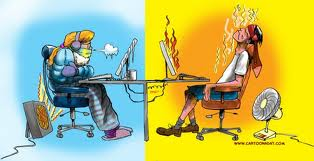
“I’m too hot! I’m too cold!” Does your office resemble both a tropical island and a tundra on the same floor?
Originally published November 2011. Updated October 2026.
Do the thermostats around the office seemingly do nothing? Is one cube-mate decked out in a down jacket pecking away at their keyboard through gloved hands while their colleague in the next cube is ready to strip down?
In fact, one of my colleagues called me the Polar Bear because I seemed immune to cold offices while she wore earmuffs.
And often the facility manager’s answer is simply to walk away.
Annual surveys by the International Facility Management Association (IFMA) have long found thermal comfort among the recurring sources of workplace complaints. Ask a facility manager, landlord or building engineer about hot and cold calls, and you’ll probably get a story.
Abraham Lincoln once wisely said, “You can please some of the people some of the time, but you can’t please all of the people all of the time.”
Facility managers know this quote all too well.
Go easy on them. They often have little control over individual preferences, building orientation and a host of other factors beyond their control. So while you’re complaining that it’s too cold in your area, others may be complaining it’s too warm.
It’s a lose-lose situation—and a never-ending struggle that puts the facility or office manager in an unenviable position that often leads to the quip:
“Dress warmer.”
Nobody wants to hear that answer, but there is more going on than the thermostat.
The Thermostat May Not Be the Problem
To appreciate the difficulties of thermal comfort, it helps to understand HVAC systems and how they contribute to the problem.
Unfortunately, simply adjusting thermostats doesn’t necessarily solve complaints because the thermostat may not actually control what people think it controls.
Have you tried turning the office thermostat dramatically higher or lower but seen little or no change in air temperature?
Many commercial systems operate within predetermined control parameters. The thermostat may allow only limited adjustment, while the building automation system monitors and adjusts HVAC operation based on temperature, occupancy, schedules and other conditions.
In other words, turning the thermostat to an extreme setting doesn’t necessarily make the system heat or cool the space any faster.
Comfort Is More Than Temperature
Thermal comfort isn’t determined by room temperature alone.
Humidity, air movement, radiant temperature, clothing, activity level, sunlight through windows, exterior exposure and even where someone sits within the space can influence whether that person feels comfortable.
That helps explain why two people sitting only a few feet apart can experience the same office very differently.
And sometimes the problem isn’t temperature at all.
The Infamous Cold-Air Dump
One frequent cause of complaints is what is often described as cold-air dumping.
Air is generally delivered to office spaces through ceiling diffusers or grilles. When the velocity or distribution isn’t right, cold supply air can fall directly into occupied areas rather than mixing properly with the room air.
The supply-air temperature may be perfectly reasonable.
Employees sitting underneath it may still feel as though they’re working inside a refrigerator.
Another common issue is cold-air bounce. This occurs when walls, furniture, partitions or other obstructions interfere with the intended air pattern and redirect supply air toward occupants.
Moving a partition or changing a workstation layout can therefore create a comfort problem even though nobody touched the HVAC system.
Before Blaming the Thermostat
If a particular area repeatedly generates hot or cold complaints, start by establishing what is actually happening.
Check the space temperature and humidity rather than relying solely on the thermostat display.
Look at where the complaints occur. Are they concentrated near windows? Under diffusers? Along an exterior wall? In one portion of an open office?
Check whether furniture, partitions or other changes are interfering with air distribution.
Review the thermostat or temperature sensor location and calibration.
If the problem persists, the HVAC contractor or building engineer may need to evaluate air balancing, controls, equipment operation or other system conditions.
The important point is simple:
Don’t assume the thermostat is the problem just because that’s where everyone is looking.
Sometimes the Building Is Doing Exactly What It Was Designed to Do
Warm early spring days can make interior spaces uncomfortable before seasonal cooling systems are fully operating. Likewise, unusually cold days can expose weaknesses around windows, exterior walls and perimeter zones.
Solar exposure matters too. An office facing south or west may behave very differently in the afternoon than a similar space elsewhere in the building.
Many people ask why their office can’t simply stay at exactly the same temperature throughout the entire day.
Buildings don’t work that way.
Occupancy changes. Sunlight changes. Outdoor conditions change. Equipment generates heat. People have different comfort preferences.
A properly operating HVAC system can manage those variables within reasonable limits.
It cannot make every person feel exactly the same.
So when the office or facility manager says out of desperation, “Dress warmer,” remember Abraham Lincoln’s quote and understand that in most instances everything has been done within their ability to please everyone.
And before turning that thermostat another ten degrees—
make sure the thermostat is actually the problem.
About the Author: Richard Neuman advises organizations on capital planning, project governance, and complex capital programs. He has overseen more than $2 billion in capital investments across commercial real estate, healthcare, utilities, industrial, broadcast, and development projects.
He writes candidly from an owner-side perspective about the executive decisions and organizational dynamics that shape capital project outcomes.
Leading a major capital program or facing a complex capital decision?
Contact Richard.
Subscribe for insights on capital planning, project governance, and the executive decisions that shape project outcomes long before construction begins.
This is just another rationalization for over powered HVAC systems that blast cold air at office occupants. Our office was just fine until operations came in and “adjusted” it. Now we all have to wear extra layers while the operations people insist that the system is now up to spec and we just have to get used to it. If employers cannot provide a comfortable work environment then they should allow their staff to work from home.