
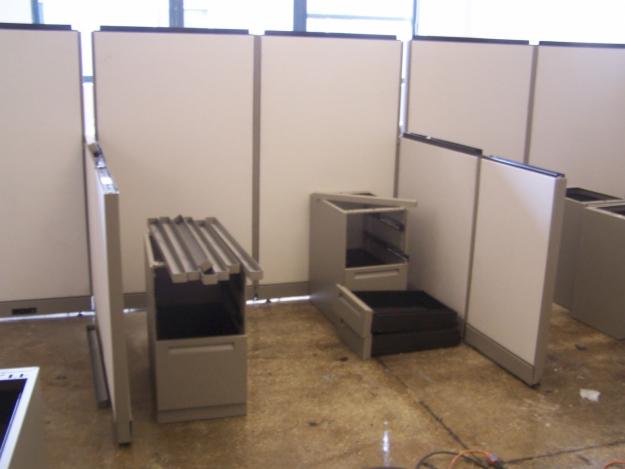
The lowest furniture price may look attractive until you account for reconfiguration, missing parts, logistics, schedule and what the workplace actually needs.
Updated October 2026
When a company moves or renovates an office, furniture can become a surprisingly large part of the project budget.
That usually leads to an obvious question:
Do we really need to buy everything new?
Maybe not.
Existing furniture can sometimes be reused. Pre-owned furniture may be available at a substantial discount. Refurbished or remanufactured furniture can provide another option between used and new.
The decision gets more complicated once you look beyond the purchase price.
Start With What You Already Own
Before shopping for furniture, understand the inventory you already have.
What is in good condition? What fits the new workplace? Which systems can be reconfigured? Are replacement components still available? Are the finishes and workstation sizes appropriate for the new design?
Modular furniture can be particularly useful because components may be disassembled and rearranged into different configurations.
But modular does not necessarily mean infinitely reusable.
A new floor plan may require different panel heights, worksurface sizes, storage components, electrical distribution or configurations. An older furniture system may also have discontinued parts that are difficult or expensive to obtain.
Before assuming the existing furniture represents free inventory, determine what it will actually take to use it again.
Understand the Choices
The decision is no longer simply used versus new.
Depending on the project, the options may include:
- Reusing existing furniture as-is
- Reconfiguring existing systems
- Refurbishing or remanufacturing existing furniture
- Purchasing pre-owned furniture
- Combining existing, pre-owned and new components
- Purchasing an entirely new furniture package
Each can make sense under the right circumstances.
Pre-owned furniture can be especially attractive when a large quantity of compatible product becomes available from another corporate relocation or liquidation. If the product fits your requirements and the quantities work, the savings can be significant.
The challenge comes when you need a specific product, finish, fabric, size or configuration.
The more specific the requirement, the smaller the available pre-owned inventory becomes.
Look Beyond the Furniture Price
A used workstation that costs considerably less than a new one may look like an easy decision.
Then the project team starts adding the other costs.
The furniture may have to be inventoried, disassembled, transported, stored, cleaned, refinished, supplemented with missing components, reconfigured and installed.
Some pieces may arrive damaged. Keys or hardware may be missing. Components that looked interchangeable may turn out to be from different product generations.
Existing furniture may also need to accommodate current power, data, technology and ergonomic requirements.
Those costs and risks belong in the comparison.
Are we saving money on the furniture, or just moving cost and risk somewhere else in the project?
The answer should come from the total installed cost and the effect on the project schedule, rather than the purchase price alone.
Consider the Schedule
Availability can work both ways.
Pre-owned furniture that is already sitting in a warehouse may avoid a long manufacturing lead time.
It can also introduce uncertainty if the required quantities, components or finishes are scattered among several inventories.
New furniture generally provides greater control over specification and quantity, but manufacturing and delivery lead times have to fit the construction and move schedule.
Furniture decisions should therefore be made early enough to test both cost and availability.
Waiting until the end of design can eliminate options that might otherwise have worked.
Decide How Much Consistency Matters
Some organizations have strong workplace standards. Others can tolerate more variation.
If brand consistency, finishes, workstation dimensions or furniture standards are important, the available pre-owned market may be too limiting.
A company may also be willing to use pre-owned furniture in back-office areas while purchasing new furniture for client-facing or executive spaces.
There is no requirement that the entire office follow one procurement strategy.
The furniture plan should reflect how the space will actually be used.
Include Sustainability in the Decision
Extending the useful life of furniture can reduce waste and avoid the material and manufacturing impacts associated with replacement.
That makes reuse and refurbishment worth evaluating even when they are not automatically the least expensive choices.
But sustainability should still be evaluated alongside condition, functionality, ergonomics, logistics and expected remaining life.
Keeping furniture that no longer supports the workplace simply because it already exists can create another problem.
Get the Furniture Vendor Involved Early
An experienced furniture dealer, consultant or installer can help determine whether existing furniture can be reused, what components are missing, whether compatible inventory is available and what the realistic installed cost will be.
Bring that expertise into the project before the furniture strategy is assumed in the budget.
The team should be able to compare the alternatives on a consistent basis:
What do we own? What can we reuse? What needs to be refurbished or supplemented? What will each option cost when installed? What does each option do to the schedule?
That gives the owner a decision instead of an assumption.
Leadership Takeaway: Treat furniture reuse as a project strategy, not simply a purchasing discount. Evaluate the complete cost, compatibility, logistics, schedule and remaining useful life before deciding that used furniture is the economical choice.
About the Author: Richard Neuman advises organizations on capital planning, project governance, and complex capital programs. He has overseen more than $2 billion in capital investments across commercial real estate, healthcare, utilities, industrial, broadcast, and development projects.
He writes candidly from an owner-side perspective about the executive decisions and organizational dynamics that shape capital project outcomes.
Leading a major capital program or facing a complex capital decision?
Contact Richard.
Subscribe for insights on capital planning, project governance, and the executive decisions that shape project outcomes long before construction begins.




Here is a piece of advice I provide all my clients who intend to use secondhand office assets.
In Canada, office furniture needs to be CSA approved, (Canadian Standards Association). This approval is mostly to ensure it is appropriately fire rated and does not contain any harmful chemicals in its production. I have heard of offices inheriting or purchasing non-CSA approved furniture that was brought in from outside Canada and then having to remove it… absorbing the initial cost of the assets and then also the disposal costs.
We are seeing companies that have come up with an 80 20 plan. They own 80 percent of their furniture and are renting 20 % to allow for changes as their business expands and contracts. This eliminates paying for storage of furniture when it is not needed.
We are partnered with a great source for quality pre-owned furniture and really have seen the value in being able to provide a “blending” of items to fit any budget and functionality for our clients. Being able to provide solutions with quality pre-owned products have really enhanced the new furniture solutions that we go to market with day-in and day-out. The circle of services that we are able to provide to our clients has really allowed us a great piece of the “pie” and has allowed us to be able to stay in front of our customers longer and has helped us continue to develop long standing relationships in our market.
If your organization does decide to purchase used or refurbished systems furniture, stick with a major line such as Herman Miller AO2, Haworth Unigroup, or Steelcase 9000. These lines are typically worth reusing since they were the high end quality when first purchased which means they were built well to begin with and likely worth reusing. A reputable refurbisher wouldn’t recommend refurbishing or reusing an entry level brand since the quality just isn’t there to justify reusing the furniture. The high end lines are more commonly found on the used market so it is typically easier to add on to in the future. When purchasing used systems furniture, make sure you are sticking with a high end manufacturer and a long running series of furniture (a series that was produced for a number of years because there is more of it out there than series that were only produced for a few years and phased out).
Whether you purchase new, used, or refurbished, there is always the risk that the fabric or laminate will be discontinued so don’t let that one factor alone determine whether you will purchase new or used because either way, you may end up in the same discontinued boat in the future when trying to match up to existing.
This is not a smart solution by any measure unless you are building a new facility have furniture on order for that environment and are in a temp space where you just need it furnished for really down and dirty and for a very short time. And if that is the case then just lease the furniture don’t buy it. Furniture is vital to the function of a company…how employees communicate, work is executed, and technology is integrated, it is far beyond just aesthetics. You can not achieve growth, flexibility and the need to meet constant demands and changes of the corporate market place by having tools that render limitations. And used product has the highest amount of limitations. The fact is not enough companies view furniture as a tool – but it is! And just like that computer on your desk, you wouldn’t buy up used laptops from the late 90’s running on an outdated operating system so why would you throw money at an inadequate furniture “solution?”
I caution companies from thinking that designers & architects are the source for fully understanding all aspects of furniture and especially how it will work on a detailed level with an organization. Additionally, dealerships are not much better as they are namely looking for a sale. (I can make both of these comments as in my career I have held equal time in both environments as a designer and in furniture sales –so please don’t be offended.) If you don’t have a learned facilities person within your organization you need to reach out to a true space planning firm. They can honestly help you determine the best route. Sometimes what looks financially viable up front can have very costly repercussions in the end. Just having a desk to sit at doesn’t mean you have a “working” environment.
You have to do it !
Than you make a open space with the focus on a work environment and not a workplace . Something like an ordinate chaos with a mission an vision…..You can restyle the old furniture !
I will do this projects with pleasure….Just look and feel before we go to work.
Suggestion is to search out the leading national new and pre-owned solution providers; most have spaceplanners, designers and architects on staff. Many will provide full 2 and 3-D renderings and provide state of the art pre-owned open plan solutions. My company TradeIn.com has 26 years of professional experience buying, selling, designing and offering complete turnkey solutions. We offer a program of zero cost relocation program as well. look forward to further conversation. Jon Driscoll, President, TradeIn.com
Great insight – I am often asked about used furniture as the client feels they are saving money. Another option is to move to an open plan environment. The per position cost is significantly lower than traditional cubicles. It also maximizes use of the space.
Agreed. We’re seeing more requests for open plan. However, there’s much hesitation due to fears of noise and distraction.