
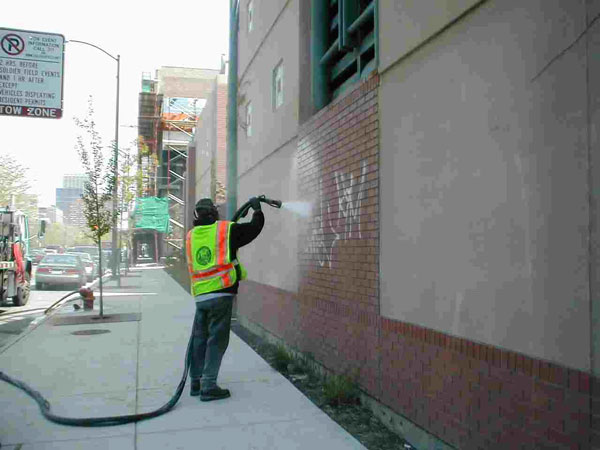
Quick removal matters, but the wrong cleaning method can leave the building with damage that lasts much longer than the graffiti.
Updated October 2026
Graffiti can appear overnight.
For a property owner or facility manager, the immediate reaction is usually straightforward:
Get it off the building.
Prompt removal makes sense. It restores the property quickly and can reduce the opportunity for graffiti to accumulate.
But before someone arrives with a pressure washer, solvent or abrasive cleaner, there is another question worth asking:
What is the surface, and what will the proposed removal method do to it?
Removing the graffiti while permanently damaging the building is not a successful repair.
Start With the Surface
Graffiti removal depends heavily on what was marked.
Painted drywall is very different from brick. Brick is different from polished stone. Metal panels, concrete, glass, historic masonry and coated surfaces can all respond differently to cleaning methods.
Porous materials can be particularly difficult because paint or ink may penetrate below the surface.
Before using a chemical cleaner, pressure washing, abrasive treatment or another removal process, understand what the substrate can tolerate.
When there is any uncertainty, test the proposed method on a small, inconspicuous area first.
For sensitive, historic or specialty materials, bring in someone who understands the surface rather than experimenting on the building.
Match the Removal Method to the Graffiti
The material used to create the graffiti matters too.
Spray paint, markers, paint pens and other materials may require different removal approaches.
The goal is to remove the unwanted material while minimizing changes to the underlying surface.
More aggressive is not necessarily more effective.
Excessive pressure can damage masonry or drive staining deeper into porous material. Strong chemicals can discolor finishes or affect coatings. Abrasive methods can permanently change the texture of a surface.
The cleaning method should be selected for the combination of graffiti material and building surface.
Plan for Recurring Locations
If a property is repeatedly targeted, responding to each incident as though it were the first one gets expensive.
Look at why the location is vulnerable.
Is the wall concealed from view? Is lighting poor? Is there easy access from a sidewalk, alley or adjoining property? Are there surfaces that repeatedly attract graffiti?
Depending on the property, prevention measures might include improved lighting, cameras, landscaping, access control or changes that increase visibility.
Protective coatings may also be worth considering.
Some systems are designed as sacrificial coatings that are removed along with the graffiti and then reapplied. Others provide a more permanent protective layer intended to make repeated cleaning easier.
The appropriate system depends on the substrate, appearance, expected exposure, maintenance requirements and cost.
Have a Response Plan Before You Need It
For properties with recurring exposure, decide in advance:
- Who should be notified
- Who documents the damage
- Whether security or law enforcement reporting is appropriate
- Who is authorized to order removal
- Which contractor or maintenance team will respond
- What removal methods are approved for different building surfaces
- Whether protective coatings should be restored after cleaning
That prevents a well-intentioned employee or contractor from attacking an unfamiliar surface with whatever cleaner happens to be available.
It also helps the facility respond quickly without improvising each time.
Check Local Resources
Some municipalities, business improvement districts and community organizations offer graffiti-removal assistance or other programs for eligible properties.
Those programs can change, and eligibility may depend on the location, property type or surface involved.
If graffiti is a recurring problem, it is worth checking what resources are currently available in the jurisdiction where the property is located.
The objective is straightforward: remove the graffiti promptly, protect the building and make the next incident easier to handle if it happens again.
Leadership Takeaway: For properties with recurring graffiti, establish the removal method before the next incident. Know the surfaces, identify who is authorized to respond and make sure quick action does not create permanent damage to the building.
About the Author: Richard Neuman advises organizations on capital planning, project governance, and complex capital programs. He has overseen more than $2 billion in capital investments across commercial real estate, healthcare, utilities, industrial, broadcast, and development projects.
He writes candidly from an owner-side perspective about the executive decisions and organizational dynamics that shape capital project outcomes.
Leading a major capital program or facing a complex capital decision?
Contact Richard.
Subscribe for insights on capital planning, project governance, and the executive decisions that shape project outcomes long before construction begins.


watch this product
http://youtu.be/ecNvD2epreg
The Graffiti Armor you mention, is it the one made by Evolution Surface Solutions?
Hi Dale, sorry for the delay in responding. Been out helping clients recover from the storm damage.
Yes, the product is Evolution Surface Solutions TruNano Graffiti Armor.
Thanks