Industrial buildings may still be functional while the surrounding business environment no longer meets what employers, employees and modern operations expect.
Originally published in November 2018 following an article for the Hauppauge Reporter. Updated October 2026 to reflect the broader owner-side capital and real estate implications.
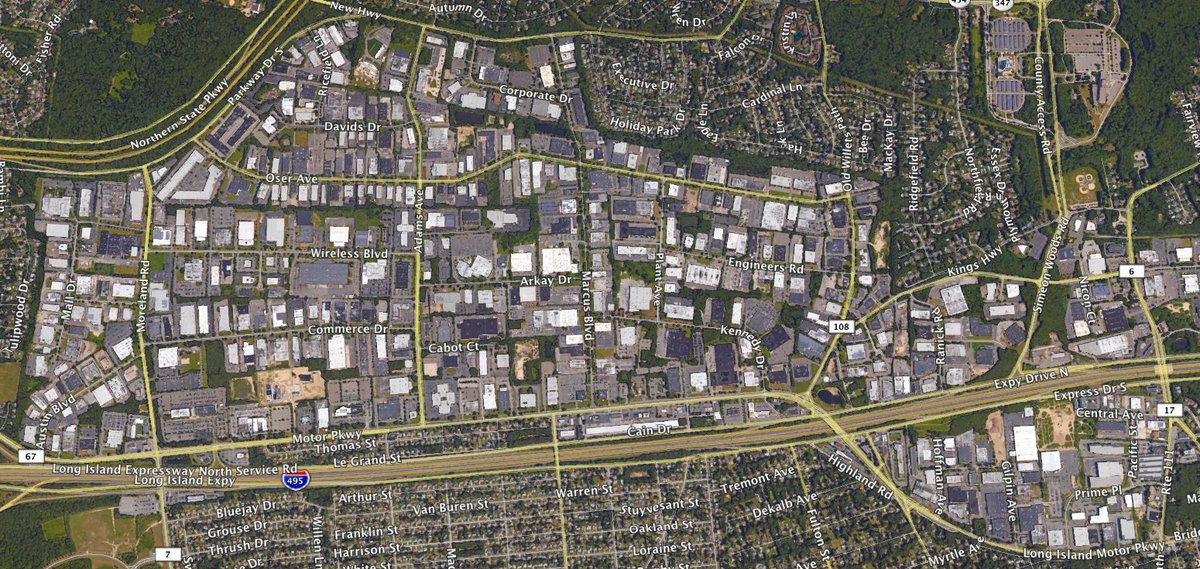
In 2018, I wrote about the Hauppauge Industrial Park on Long Island and an effort to reposition one of the largest concentrations of industrial businesses in the Northeast.
At the time, the concern was easy to understand.
Businesses and workers were increasingly attracted to environments that offered more than a building and a parking lot. Younger employees in particular were looking for restaurants, gathering places, services and other amenities associated with more connected communities.
The industrial park had something extremely valuable: an enormous concentration of businesses and jobs.
The question was whether the environment around those businesses could keep pace.
That question is even more relevant when owners evaluate older industrial properties today.
The Building Isn’t the Entire Real Estate Decision
An industrial property can have the square footage, loading, parking and location a company needs and still struggle against newer alternatives.
The reason may have little to do with the building itself.
- What surrounds it?
- Can employees get somewhere for lunch?
- Are there hotels nearby for visiting employees and customers?
- Are there places to meet outside the office?
- How difficult is the commute?
- What services are available to businesses and employees?
- Can the area support the type of workforce the tenant needs to recruit?
For companies making long-term real estate decisions, those questions become part of the location decision.
Older Industrial Areas Have an Infrastructure Advantage
Established industrial parks can also possess something very difficult to reproduce: infrastructure and zoning created specifically to support business activity.
Hauppauge is a good example.
The park developed into a major employment center because it could accommodate manufacturing, distribution, research, office and other commercial uses at considerable scale.
That existing concentration has value.
When industrial land becomes scarce and competing uses consume older industrial properties, preserving a functioning employment center can be strategically important to both businesses and municipalities.
The owner-side question becomes:
What needs to change so the existing asset remains competitive rather than becoming obsolete?
Sometimes the Investment Has to Extend Beyond the Property Line
Owners naturally concentrate capital planning on the property they control.
Roof. HVAC. Electrical capacity. Loading. Parking. Building envelope. Interior improvements.
But the competitiveness of an older industrial district may depend on issues that no individual building owner can solve alone.
Roads, zoning, public spaces, transportation, pedestrian access, restaurants, services and community amenities may require coordination among property owners, businesses and municipalities.
That was an important part of the Hauppauge discussion in 2018. The proposed revitalization effort looked beyond individual buildings and considered how the larger employment center could become a better place to work and do business.
You can renovate a building and still leave it in an environment that tenants increasingly find less attractive.
Modern Industrial Tenants May Need Very Different Buildings
There is another issue.
“Industrial” describes an increasingly broad range of operations.
A warehouse, pharmaceutical company, research laboratory, advanced manufacturer, food operation and last-mile distribution facility can have dramatically different requirements.
Power may matter more than office finishes.
Clear height and column spacing may determine whether an operation fits.
Loading configuration, floor capacity, ventilation, emergency power, utility service, temperature control, security and environmental requirements can eliminate an otherwise attractive property.
So before investing in an older industrial asset, I would want to understand more than whether there is demand for industrial space.
I would ask:
What kinds of tenants can this property realistically support?
And then:
What would have to change to support the tenants we want?
Those answers should drive the capital plan.
Scarcity Can Hide Obsolescence
A tight industrial market can make almost any available space look competitive, but that can be misleading.
Scarcity may keep an older property occupied without resolving the conditions that make it increasingly difficult to use.
Eventually, an owner can face a much larger decision: continue incremental improvements, undertake a substantial repositioning, or determine that the existing building no longer supports the market it is trying to serve.
That is why I would be cautious about using occupancy alone as evidence that an aging industrial property remains competitive.
The better test is whether the property—and the business environment around it—can support the next generation of users.
Leadership Takeaway: An older industrial property should not be evaluated only against today’s vacancy rate. Owners need to understand the tenants they want to attract, the building and infrastructure those tenants require, and whether the surrounding business environment supports the workforce and operations that will keep the asset competitive.
About the Author: Richard Neuman advises organizations on capital planning, project governance, and complex capital programs. He has overseen more than $2 billion in capital investments across commercial real estate, healthcare, utilities, industrial, broadcast, and development projects.
He writes candidly from an owner-side perspective about the executive decisions and organizational dynamics that shape capital project outcomes.
Leading a major capital program or facing a complex capital decision?
Contact Richard.
Subscribe for insights on capital planning, project governance, and the executive decisions that shape project outcomes long before construction begins.



Be the first to comment on "Can an Older Industrial Park Compete for Modern Tenants?"