
The knowledge may remain. Context and authority may no longer sit in the same place.
The Facilities Director is gone.
They may have retired, taken another job, or been walked out on a Tuesday morning.
The reason changes the handoff. It does not stop the projects.
The design team keeps working, contractor questions keep coming, and project meetings stay on the calendar.
The transition becomes visible when the project needs a Facilities answer.
The Engineer Can Explain the Options
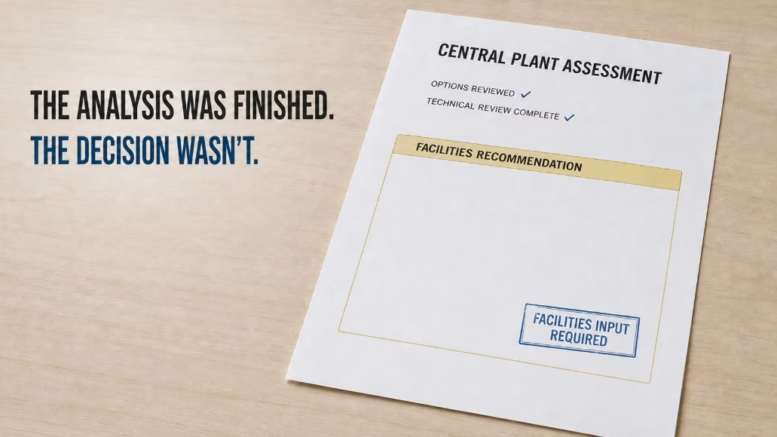
An engineer completes an initial central plant assessment.
There are three options: repair the existing plant, replace it in phases, or replace it all at once.
The engineer can compare cost, schedule, energy performance, and remaining service life. Choosing what matters most belongs to the owner.
Maintenance knows the failure history. Operations knows what shutdowns the business can tolerate. Finance knows what the capital plan can carry.
The capital leader can pull those inputs into the larger capital recommendation.
But someone still has to say what Facilities recommends.
Someone speaking for Facilities must recommend whether to keep repairing the plant, phase the replacement, or accept the disruption of replacing it all at once.
Before the Facilities Director left, that person would have helped turn the building history, maintenance concerns, and operating demands into an answer Facilities could stand behind.
Now the role may be vacant, covered temporarily, or already filled.
A Facilities Director hired from outside the organization may have the authority to answer while still learning the buildings, people, and decisions that came before them.
An internal successor may already know the equipment and operating history but still need leadership to make clear that they now speak for Facilities.
In one transition, authority moves faster than context.
In another, context moves faster than authority.
Until they come back together, the technical analysis may be finished while the owner is still not ready to answer.
Who Speaks for Facilities Now?
Most of what the organization knows is still there.
Maintenance has the equipment history. Operations understands the business constraints. Finance knows the competing demands for capital. The design team has completed the technical analysis. The capital leader may understand all of it.
The problem is finding someone with enough context to speak for Facilities and the authority to do it.
An experienced Facilities Director knows which maintenance concern matters, why a temporary repair became permanent, why a manufacturer fell out of favor, and which old promise still shapes today’s project.
They also know who needs to be involved before Facilities takes a position.
Most of that work is hard to see. The phone calls happen before the meeting, and conflicting concerns get worked through before they become agenda items. By the time Facilities gives the capital leader a recommendation, the operating history and internal debate have already shaped it.
The capital leader owns the overall recommendation. Facilities supplies the operating position behind it.
Without an authorized Facilities voice, that part of the recommendation remains open.
The position carried authority on paper. The person brought the relationships and judgment that made the authority useful.
When no one clearly owns that work, the project starts finding other routes.
The design team’s technical preference begins carrying more weight, an executive gets pulled into the operating decision, or the easiest option to fund becomes the default.
The decision returns at the next meeting because no one in the first meeting had the authority to close the Facilities question.
By then, the process is already different.
Before Design Moves On
When the project reaches an open Facilities decision, the capital leader or Owner’s Representative should ask:
Who owns the Facilities answer?
Ask for the person expected and authorized to give the answer.
That person needs the maintenance history, operating constraints, financial context, and technical analysis. They also need the authority to weigh those inputs and tell the capital leader what Facilities recommends.
If the Facilities Director also leads the capital program, the executive sponsor needs to ask the question.
If nobody owns the answer, assign an interim owner before design moves on. Keep anything that cannot be confirmed open instead of allowing an assumption to become the owner’s decision.
Put a name next to the Facilities decision and record what remains open.
Once the design team has explained the options and the capital leader has assembled the owner’s recommendation, someone in the meeting still needs to be able to say:
This is what Facilities recommends, and here’s why.
About the Author: Richard Neuman advises organizations on capital planning, project governance, and complex capital programs. He has overseen more than $2 billion in capital investments across commercial real estate, healthcare, utilities, industrial, broadcast, and development projects.
He writes candidly from an owner-side perspective about the executive decisions and organizational dynamics that shape capital project outcomes.
Leading a major capital program or facing a complex capital decision?
Contact Richard.
Subscribe for insights on capital planning, project governance, and the executive decisions that shape project outcomes long before construction begins.




Be the first to comment on "The Facilities Director Left. The Decision Process Got Exposed."