
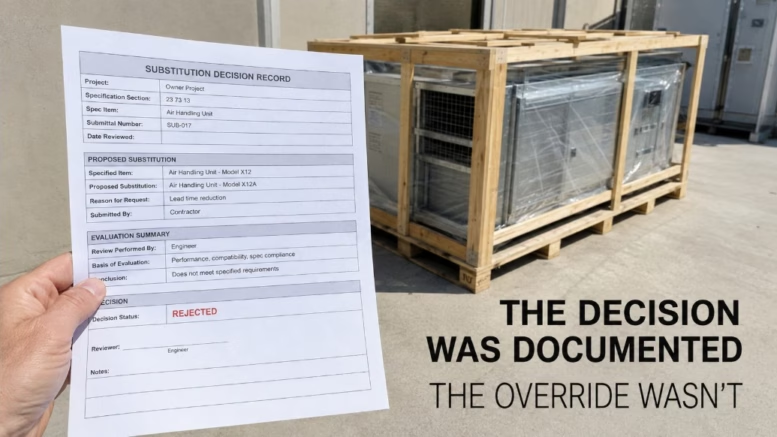
A vendor disagreed with a decision and took it to someone more senior. The owner is the one who has to live with what happened next.
The Decision That Didn’t Hold
The owner’s rep said no.
A vendor wanted to substitute a component. The owner’s rep reviewed it against the spec, checked it with the engineer of record, and documented the rejection in the log. Reasonable call. Defensible call. The kind of call an owner’s rep is on the project to make.
Three weeks later, the substitution shipped anyway.
Nobody told the owner’s rep it had been approved. She found out on a site walk, when she asked why the wrong part was sitting in the laydown yard. The GC shrugged. Said the owner signed off.
Not the owner’s rep. The VP of Real Estate.
The vendor believed the project team had made the wrong call and took the decision to someone more senior. A call through someone who knew the VP. A hallway conversation at a different building. A version of the story that did not include the engineer’s concerns or the reasoning behind the original rejection.
The VP said fine, go ahead.
No memo. No meeting. No record of what they were told or what the project team had considered before saying no.
The owner’s rep’s rejection still sits in the log. Officially, on paper, she reviewed the substitution and rejected it. Actually, in the field, the substitution shipped, and she will still be expected to answer for whatever follows.
The Appeal Nobody Called an Appeal
This happens more than owners want to admit. A decision gets made by the person the organization put there to make it. Then someone who disagrees with the outcome finds a side door to someone more senior.
It’s not a formal appeal or a documented escalation with the original rationale attached. It’s a private word. A text. A five-minute hallway conversation stripped of the context that produced the original decision.
The executive isn’t doing anything that feels wrong in the moment. They are being accessible and decisive. They hear from a vendor who believes the project team made the wrong call and settle the disagreement in thirty seconds instead of asking how the original decision was reached.
It reads as leadership.
The substitution may even turn out to be the better choice. That doesn’t make the way it was approved harmless.
The executive sponsor has every right to reconsider a project decision. Seniority carries that authority. The problem is that nobody treated the conversation as a reconsideration. The original decision was not presented. The reasoning behind it was not examined. The person who made it did not know it was being challenged.
The executive didn’t hear an appeal.
They heard one side of one.
What Wasn’t in the Room
The owner’s rep had the spec, the engineer’s input, and the history of how the decision was reached. The executive had the version delivered in the hallway.
That version may have been sincere. The vendor may have genuinely believed the substitution was the right move. The problem was not the vendor’s belief. It was that the executive had no way to see what had been left outside the conversation.
A formal reconsideration would have brought the decision back into view. What was rejected? Why was it rejected? What did the engineer say? What information had changed? Who would own the consequence of reversing it?
None of that requires a committee or a week of meetings. It requires recognizing that a decision already exists.
The executive sponsor did not simply answer a question. They replaced what the project documented with a call no one recorded.
Authority to make that call does not make every path to it equally sound.
A Second Place to Decide
This is different from giving someone responsibility without authority. The owner’s rep had authority. She used it.
The organization created a second place where the same issue could be decided using only the information that reached the executive.
The first place was visible. It had a spec, an engineer, a decision log, and a person responsible for making the call.
The second had access.
Once both exist, the project cannot tell where final decisions actually live. The decision matrix points to one place. Experience points to another.
The owner’s rep’s rejection remains in the log while the substituted component sits in the field. Both decisions exist. Only one is being built.
The project still has an org chart. It still has a decision matrix, probably laminated, probably in the kickoff deck. But underneath it, a second governance system is operating, the one built out of who has the VP’s cell number.
Nobody designed that system. Nobody approved it. It appeared the moment an informal conversation carried more authority than the documented decision it replaced.
The owner’s rep moves to another project eventually. So does the vendor. So, in a few years, does the VP. The substituted component doesn’t move anywhere. It stays in the wall, on the roof, or in the mechanical room for as long as the owner holds the asset.
Everyone who participated in the decision gets to leave it behind.
The owner inherits the consequence.
A Different Judge
The next time a vendor, a GC principal, or a design consultant asks to speak with you directly about a decision your team already made, notice what they’re actually asking.
They’re not asking for information.
They’re asking for a different judge.
The VP would say they were just being helpful. They weren’t trying to overrule anyone. They only made a call.
They’re right.
That’s exactly the problem.
About the Author: Richard Neuman advises organizations on capital planning, project governance, and complex capital programs. He has overseen more than $2 billion in capital investments across commercial real estate, healthcare, utilities, industrial, broadcast, and development projects.
He writes candidly from an owner-side perspective about the executive decisions and organizational dynamics that shape capital project outcomes.
Leading a major capital program or facing a complex capital decision?
Contact Richard.
Subscribe for insights on capital planning, project governance, and the executive decisions that shape project outcomes long before construction begins.



Be the first to comment on "The Executive Sponsor Is Not an Appeals Court"