

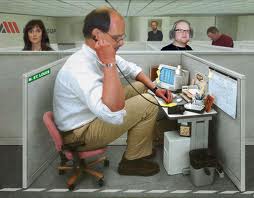
Centralized waste may make operational sense. But even a small workplace policy needs space, infrastructure and an implementation plan.
Originally published April 2014. Updated September 2026 to reflect current owner-side workplace planning and operational considerations.
A workplace project can spend months resolving major questions about layout, technology, furniture and building systems.
Then someone asks:
“Where are the trash cans?”
There aren’t any.
The new workplace will use centralized waste and recycling stations instead.
That may be a perfectly reasonable operational decision. Centralized waste collection can support recycling, reduce the number of containers being serviced and simplify portions of the custodial operation.
But the interesting question for the owner isn’t whether every desk needs a wastebasket.
It’s when the decision was made and whether the workplace was designed around it.
A Policy Can Become a Design Requirement
Removing individual waste bins changes how waste moves through the workplace.
Employees need convenient centralized locations.
Those locations need enough capacity.
Recycling and waste streams need to be clearly identified.
Food waste may need different handling from paper and ordinary office waste.
Housekeeping procedures may change.
And the stations themselves need somewhere to go.
If the policy is established during planning, those requirements can be incorporated into the layout.
If it appears late in the project, the team may discover that nobody provided an appropriate location.
That’s how a seemingly minor operating decision becomes a design problem.
Convenience Matters
A centralized system only works if people will reasonably use it.
Putting one waste station at the opposite end of a large floor may reduce the number of containers, but it may not produce the behavior the operating plan assumes.
The planning question is practical:
Where will people naturally encounter these stations during the workday?
Near pantries, print areas and circulation paths may make sense depending on the workplace.
The answer should reflect the size of the floor, employee population, work patterns and types of waste being generated.
Coordinate the Waste Streams
“Trash” is no longer necessarily one stream.
A workplace may separate recyclables, ordinary waste, food waste or other materials depending on the building and local requirements.
That means the project team should understand the operating plan before specifying millwork, cabinets or collection stations.
- How many streams are required?
- What size containers are needed?
- Who empties them?
- Where does the material go from there?
- Does the building have requirements that affect collection?
The front-end workplace decision has to connect to the back-of-house operation.
Don’t Discover the Policy at Move-In
A new workplace or relocation is often the easiest time to introduce a different operating model.
The physical environment is changing anyway.
But employees should understand what will be different before they arrive.
If individual bins are being eliminated, explain the new system, where collection points will be located and why the change is being made.
The project doesn’t need a major change-management campaign about trash cans.
It does need to avoid having hundreds of people discover an unexplained operating change on their first morning.
Test the Operational Assumption
Centralized collection is sometimes justified by expected savings in custodial labor or improvements in waste separation.
Those assumptions should be tested rather than simply repeated.
How is cleaning currently performed?
Will the new approach actually change labor requirements?
Does the building’s cleaning contract support the operating model?
Are recycling practices consistent with what happens downstream?
A policy doesn’t create savings merely because it sounds more efficient.
The operating process has to support it.
Small Decisions Still Need an Owner
This is a small example of a much larger project issue.
Workplace projects contain hundreds of decisions that don’t rise to the level of executive attention but still affect how the completed space operates.
Waste collection is one.
Mail and deliveries are another.
Storage, supplies, visitor handling, food service and shared equipment can create similar gaps.
Someone needs to connect those operating decisions to the project while there is still time to design for them.
Leadership takeaway: Even minor workplace policies can create physical and operational requirements. Decide how the space will operate early enough for the project team to design around it.
About the Author: Richard Neuman advises organizations on capital planning, project governance, and complex capital programs. He has overseen more than $2 billion in capital investments across commercial real estate, healthcare, utilities, industrial, broadcast, and development projects.
He writes candidly from an owner-side perspective about the executive decisions and organizational dynamics that shape capital project outcomes.
Leading a major capital program or facing a complex capital decision?
Contact Richard.
Subscribe for insights on capital planning, project governance, and the executive decisions that shape project outcomes long before construction begins.



We tried this at a University and got slammed. We had central recycling, but picked up trash when we cleaned offices. The result was that even though 95 – 99% of the waste being generated in the offices was recyclable the actual recycling rate was abysmal. Since about the only waste generated in private offices that can’t be recycled is food waste, and it really shouldn’t sit until our weekly cleaning, we thought there was a good argument to switch and collect recycling at the desk and garbage centrally. We dominated the faculty listserv for weeks. “I didn’t go to college to haul trash” was one of the printable comments. The compromise was we would pick up both. Recycling rates jumped to about 40%, but most of the trash was still recyclable if the occupant had cared. Post sorting was not feasible within available staffing.