
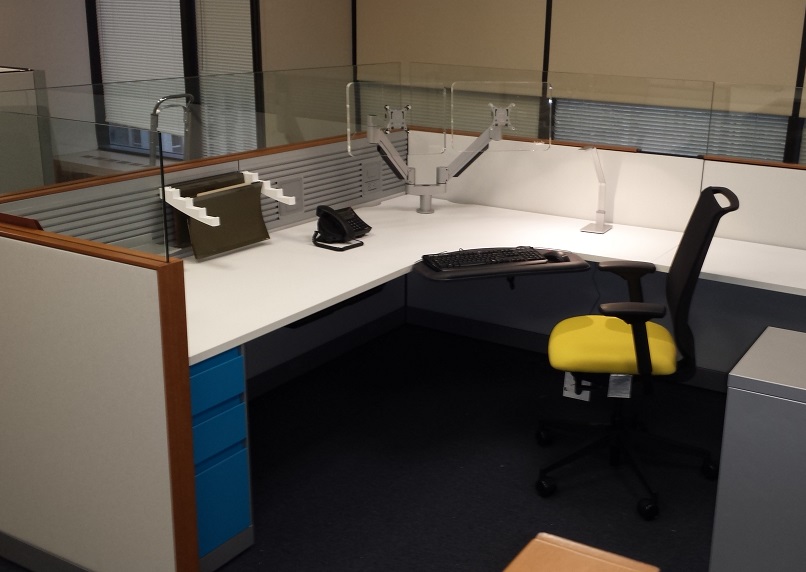
Let employees use the proposed workstation, ask structured questions, and learn what works before the furniture order is locked.
A workstation can look perfectly reasonable on a furniture plan.
The dimensions work. The chair fits. The storage is shown. The manufacturer has provided specifications and finishes. Everyone reviewing the drawings may agree that the proposed standard looks good.
Then an employee sits down at the actual workstation.
The monitor feels too close. The work surface isn’t deep enough. The storage is awkward. The panel height creates too much—or too little—privacy.
Those are much better discoveries to make before ordering furniture for an entire office.
On one project, we built full-size workstation mockups and asked employees to evaluate them through a structured survey before we finalized the furniture standard.
The mockups let employees experience the proposed workstations.
The surveys told us what they thought about them.
We needed both.
A Drawing Isn’t the Same as Sitting at the Workstation
Most employees aren’t accustomed to reading furniture plans and specifications.
Tell someone that a workstation will be a certain width and depth, with a particular panel height and storage configuration, and they may understand the dimensions without really understanding what the finished space will feel like.
A full-size mockup changes that.
Employees can sit in the chair, use the work surface, reach the storage and see how the different components relate to one another.
Instead of asking them to imagine the proposed workstation, we could let them experience it.
The photos from this project show several of the configurations and components we were evaluating. The particular furniture products are less important today than the process we used to evaluate them.
The Survey Made the Mockup More Useful
Simply putting a mockup in the office and asking, “What do you think?” would have produced plenty of opinions.
It wouldn’t necessarily have produced useful project information.
We wanted feedback on specific decisions.
Employees were asked to evaluate elements of the workstation and compare alternatives. The survey addressed features such as the work surface, storage, privacy, accessories and other components that would affect how they used the space.
Someone may dislike the color of a workstation while finding the configuration highly functional. Another employee may like how it looks but discover that the storage doesn’t accommodate what they actually use.
A structured survey helps separate general reaction from feedback the project team can act on.
What the Employees Told Us
The survey gave us something more useful than a collection of comments. It showed where employees had clear preferences and where opinions were more divided.
Rather than treating the workstation as one decision, we could evaluate its individual components.
Workstation Configuration
Employees were asked to consider:
- Overall workstation layout and work surface
- Amount and location of storage
- Panel height and privacy
- Accessibility of frequently used items
Workstation Accessories
We also asked employees to evaluate individual features and accessories, including:
- Monitor support
- Task lighting
- Coat storage
- Organizational accessories
- Seating and other components they would use every day
The important part was that employees weren’t answering these questions in the abstract.
They had seen the alternatives.
They had sat at the workstations.
They could open the storage, reach the accessories and experience the differences between the proposed configurations.
That gave the responses context.
If employees showed a strong preference for one alternative, we had useful information before making the purchase. If responses were divided, that told us something too. The project team could investigate why rather than assuming that the design shown on the drawings was acceptable.
The survey wasn’t a vote that automatically determined what we would buy.
It was another piece of information available to the owner before making a decision that would be repeated throughout the office.
Employee Feedback Doesn’t Mean Employee Design
Employees may disagree with one another.
A preferred feature may have cost, space, ergonomic, maintenance or procurement implications. Some requests may conflict with company standards or other project requirements.
The owner still has to make the decision.
But now the decision can be made with better information.
If a large percentage of employees identifies the same problem after physically using a mockup, I want to understand why before we order hundreds of them.
That’s useful feedback.
Cost, ergonomics, space, maintenance, procurement and company standards still have to be considered. Employee experience becomes another input into that decision.
Show People What They’re Actually Being Asked to Evaluate
The quality of the survey depends partly on the quality of the mockup.
If employees are being asked about panel heights, show them the alternatives.
If the question involves storage, let them open the drawers and cabinets.
If work-surface configuration is being evaluated, let people sit at it and understand how their equipment and materials would fit.
If you’re asking about an accessory, install it where it would actually be used.
The closer the mockup represents the proposed workplace, the more useful the feedback becomes.
That’s the real value of combining the physical mockup with the survey:
We weren’t asking employees what they imagined they might like. We were asking them to evaluate something they had actually used.
Do It While You Can Still Change Something
Timing matters.
There isn’t much value in conducting a furniture survey after the furniture order has been released.
The mockup and survey need to happen early enough that the results can influence the design and procurement decision.
That means deciding what you want employees to evaluate, setting up realistic mockups, developing questions that produce useful feedback, reviewing the results and resolving any changes before the furniture package is finalized.
Otherwise, the exercise becomes a presentation of a decision that has already been made.
The Cost of Learning Goes Up Later
Building workstation mockups requires time and effort.
So does developing a survey and reviewing the results.
But compare that with discovering after move-in that a workstation component doesn’t work as expected across an entire office.
Before procurement, changing a component may be a design decision.
After installation, the same issue may involve replacement furniture, labor, disruption and additional cost.
That’s why I wouldn’t look at the mockup and employee survey as separate exercises.
Together, they answer a much more useful owner-side question:
What do we need to learn before we commit to the final furniture standard?
Build the mockup around the decisions you need to test.
Build the survey around the questions you need answered.
Then use the results while there is still time to do something with them.
Leadership Takeaway: Furniture mockups let employees experience the proposed workstation. Structured surveys turn that experience into usable project information. Test the alternatives, ask specific questions and collect the feedback before the furniture standard—and the cost of changing it—is locked.
About the Author: Richard Neuman advises organizations on capital planning, project governance, and complex capital programs. He has overseen more than $2 billion in capital investments across commercial real estate, healthcare, utilities, industrial, broadcast, and development projects.
He writes candidly from an owner-side perspective about the executive decisions and organizational dynamics that shape capital project outcomes.
Leading a major capital program or facing a complex capital decision?
Contact Richard.
Subscribe for insights on capital planning, project governance, and the executive decisions that shape project outcomes long before construction begins.



Thanks Richard for giving me credit for my contribution in your success in the questionnaire and article.
A must read for every company looking for systems furniture.
Love the idea, maybe a PDF checklist as a downloadable would be cool too! Hope you share with us over at tBL!! Good job Richard, as always.
Thanks Linda. I performed the survey using Adobe FormsCentral, a great tool to collect and analyze the results. I’ll modify a .pdf version and send over.
Linda, I uploaded the sample survey at the bottom of the article. Please let me know if this was what you were inquiring about.
Mock-ups with options settled alot of discussions on our last remodel. Not only does a mock-up increase employee satisfaction inthe long term, it also gives the employee empowerment and buy-in as part of the process. If you are afforded the opportunity to present a mock-up do it!
Thanks Colleen. Employee buy-in is crucial. When management makes furniture decisions without input from the users, it often doesn’t make for a pleasant post-move when they sit in the cubes for the first time.