
Some capital projects arrive with executive backing. Others wait until failure makes the decision.
Executive-sponsored projects often advance with open questions while infrastructure replacements are sent back for more justification. When a documented risk is deferred, someone should explicitly accept the exposure and set a point to revisit the decision.
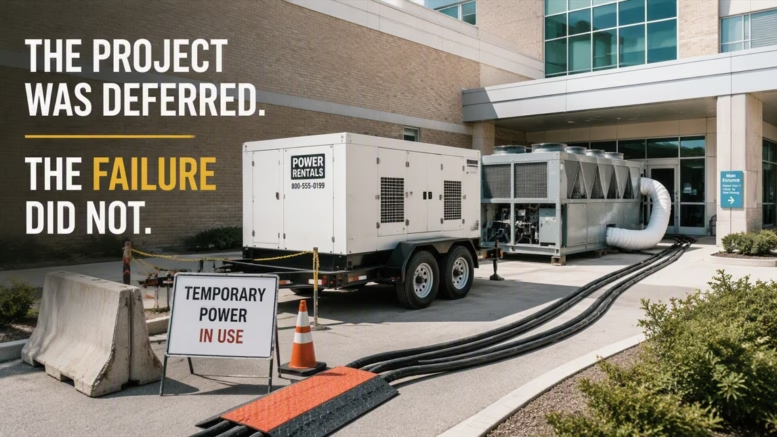
The temporary generator was keeping the building operating after an electrical infrastructure failure.
Facilities and Engineering had warned about the aging equipment. The replacement had appeared in capital planning discussions, but funding had been deferred.
Other projects had moved forward, including improvements with visible business benefits and executive support.
Now the organization was paying for temporary power while trying to address an infrastructure problem it had already known about.
Nobody had to agree that the electrical project should have been funded ahead of everything else. Capital is limited, and there are legitimate reasons to prioritize business initiatives.
There was still a question worth revisiting.
When the infrastructure project was deferred, did leadership knowingly accept the cost and operational exposure of a failure? Or did it simply lose the competition for funding?
That’s where capital prioritization gets political.
Who Gets the Benefit of the Doubt?
Consider two projects competing for the same capital dollars.
One is a renovation championed by a senior executive. The proposed improvements support a business initiative, the executive wants the work completed, and the project team has developed a preliminary budget.
The other is an electrical infrastructure replacement. Facilities has documented recurring problems, Engineering recommends replacement, and the estimated cost has been updated for the annual capital review.
The renovation discussion focuses on how soon the work can begin and whether the schedule can meet the executive’s expectations.
The infrastructure discussion goes differently.
Can the equipment last another year? Have we considered another repair? Can we get a second engineering opinion? What happens if we reduce the scope?
Those are reasonable questions. The renovation deserves equally rigorous examination of its scope, estimate, benefits, and assumptions.
Yet the executive-backed project may advance with questions still unresolved, while the infrastructure project returns to Facilities for another round of justification.
Both projects are competing for capital. They aren’t necessarily competing under the same rules.
The Influence Behind the Ranking
Every capital plan reflects organizational priorities. Business growth, customer experience, employee needs, infrastructure reliability, and regulatory obligations all compete for limited funding.
Executive sponsorship is part of that process. Leaders are expected to advocate for investments they believe will benefit the organization.
The difficulty arises when sponsorship begins to substitute for evidence.
A senior executive can make a compelling case for a renovation because the benefits are visible. People can picture the completed space and understand what the investment is intended to accomplish.
Facilities often has a harder assignment. Its proposed investment may prevent an interruption that hasn’t happened yet. The equipment is still running, the building remains occupied, and last year’s warning hasn’t become this year’s emergency.
The longer the asset survives, the easier it becomes to question the urgency of replacing it.
Meanwhile, the sponsored project has momentum. Departments are anticipating improvements, schedules are being discussed, and expectations are forming before funding is formally approved.
By the time the capital committee reviews the competing proposals, some projects may already carry commitments that make them difficult to defer.
A priority ranking alone won’t reveal those influences.
What Happens to the Project That Loses?
Returning to the electrical infrastructure project, deferring replacement may have been a reasonable decision at the time.
Perhaps the condition assessment supported continued operation. Perhaps interim repairs could reduce the risk. Perhaps the organization had a more urgent business investment.
But what did leadership understand about the consequences?
Was there an estimate for temporary power if the equipment failed? Had the potential operational disruption been evaluated? Was there a defined point at which continued deferral would no longer be acceptable?
Those questions matter because Facilities is often left managing the condition after the funding decision has been made.
The project remains on the list, the equipment continues aging, and the department keeps it operating.
Then something fails.
Temporary equipment is brought in, emergency work begins, and leadership wants to know why an identified problem wasn’t addressed sooner.
The repair history and capital requests may provide a clear answer. The project had been proposed, evaluated, and repeatedly deferred.
What may be harder to establish is who accepted the exposure and whether that decision was revisited as conditions changed.
Making the Priorities Defensible
No capital committee can eliminate organizational influence, nor should it try. Executives have responsibilities, business priorities matter, and capital allocation requires judgment.
The process becomes more credible when that influence is visible and the competing proposals receive comparable scrutiny.
If an executive-backed renovation is advancing with a preliminary estimate, the committee should understand what remains unresolved before committing funds.
If an infrastructure replacement is being deferred, the committee should understand the condition, available alternatives, potential consequences, and how long the deferral can reasonably continue.
A documented decision also needs an accountable owner and a point for reconsideration. Otherwise, an unfunded project can remain on the list year after year without anyone explicitly deciding whether the growing exposure is still acceptable.
The objective is to ensure that leadership understands what it is choosing, including the consequences for the projects left behind.
Leadership Takeaway
At the next capital review, examine the projects receiving funding alongside the significant projects being deferred.
Are executive-sponsored initiatives being challenged with the same rigor as infrastructure proposals? And when a documented risk is deferred, who is accepting that exposure?
The project list will always reflect organizational influence. Capital leadership’s responsibility is to make that influence visible, test the assumptions behind the priorities, and ensure that the decisions can withstand scrutiny long after the meeting ends.
About the Author: Richard Neuman is an independent owner’s representative for office build-outs, relocations, and capital programs in New York City and Long Island. He has overseen more than $2 billion in capital investments across commercial real estate, healthcare, utilities, industrial, broadcast, and development projects.
He writes candidly from an owner-side perspective about the executive decisions and organizational dynamics that shape capital project outcomes.
Planning a renovation, relocation, or new building, or leading a major capital program?
Talk through your project with Richard.
Subscribe for insights on capital planning, project governance, and the executive decisions that shape project outcomes long before construction begins.




Be the first to comment on "The Project List Is a Political Document"