
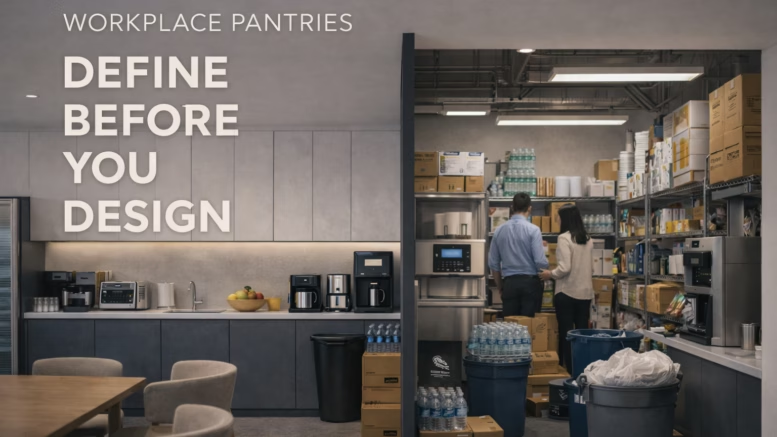
Workplace Pantries Are Designed.
They’re Rarely Defined.
That assumption doesn’t hold up once the space is in use.
The issue isn’t that these spaces lack design—it’s that the right decisions aren’t made early enough. The consequences only appear after occupancy, when congestion, restocking pressure, and inefficient layouts start to impact daily operations.
Most workplace pantries still follow a basic formula—microwave, coffee, water, refrigerator, maybe a freezer. Something that fits neatly into a plan and checks a box.
But that model rarely reflects real use.
“These spaces end up doing more than they were ever planned for. The problem is no one really defines that upfront.”
— Lou Giordano, Director of Sales, US Coffee
Who This Is For
This applies to workplace strategists, design teams, operations leads, and corporate real estate—anyone responsible for how workplace amenities actually function.
Because the gap isn’t design.
It’s definition.
Diagnosis: Pantries Are Doing More Than People Think
Pantries have long served as multi-purpose spaces.
In practice, they become:
- A peak-period grab-and-go hub
- A quick meeting spot
- Overflow collaboration space
- A casual social zone
These uses are almost never defined upfront—so the pantry becomes the default landing spot for everything that doesn’t fit anywhere else.
Operational Reality: The Hidden Demands
Once the space is active, the gaps show up quickly.
What looks like a simple pantry starts behaving like an operational system:
- Bulk beverages requiring storage and constant replenishment
- Snacks needing both display space and back stock
- Fresh food programs requiring additional refrigeration
- Equipment that doesn’t match cabinetry or clearances
- Waste streams far exceeding what was planned
At the same time, expectations continue to rise.
Wellness and workplace programs introduce:
- Healthier food options
- Fresh offerings
- Refrigerated vending and advanced grab-and-go systems
But these expectations are defined at a program level—not translated into what the space actually needs to support.
So the pantry absorbs them anyway—just not efficiently.
Leadership Insight: This Isn’t a Design Issue
This is a decision-making and translation issue.
Design teams work within the parameters they’re given. If leadership hasn’t defined:
- What the pantry must support
- How it will operate day to day
- What level of service the workplace expects
…the design defaults to a generic solution.
At the same time, there’s often a disconnect between:
- What employees actually use
- What gets communicated upward for decision-making
By the time those realities surface, the space is already built—and already constrained.
What Actually Needs to Be Considered
The underestimated part of a pantry isn’t the counter—it’s everything behind it.
In practice, today’s pantries are supporting:
- Beverage programs (bottled, tap, specialty equipment)
- Fresh food requiring multiple refrigeration points
- Snack programs with heavy back stock needs
- Rapidly growing waste and recycling volumes
- Technology layers such as vending, sensors, or accountability systems
And these all require:
- Storage and staging
- Overflow or back-of-house capacity
- Power, drainage, and infrastructure
- Maintenance and service access
- A layout that handles simultaneous users
Most pantries are built for consumption—not for how they stay stocked.
“Most people focus on what’s on the counter. What drives the space is everything behind it—how it gets stocked, where it’s stored, and how often it needs to be replenished.”
— Lou Giordano
Equipment is advancing faster than planning standards.
You’re now seeing:
- In-table sparkling water systems
- Bean-to-cup coffee machines
- Under-counter refrigeration
- Cold brew systems
- Ice machines
Some reduce reliance on packaged products—but introduce infrastructure requirements that must be planned early.
If they’re not, they show up later—usually as constraints, workarounds, or retrofits.
A Simple Framework: Define Before You Design
Every pantry should be defined through three lenses:
1. Use Case
What will people actually do here?
(Grab-and-go, socializing, short meetings, peak morning demand)
2. Operations
What’s required to keep it running?
(Replenishment cadence, storage, vendor requirements, waste flow)
3. Infrastructure
What physical systems support the above?
(Power, drainage, clearance, equipment footprint, service access)
Most projects begin with infrastructure.
They should begin with how the space must function.
That reversal is where most problems start.
Grab-and-Go: Simple in Concept, Complex in Reality
Grab-and-go is becoming a workplace staple—but it introduces operational complexity many teams underestimate.
Beyond refrigeration and shelving, it requires:
- Frequent replenishment
- Equipment built for constant use
- Clear product visibility
- A defined accountability method (POS, honor system, camera coverage)
Once product is involved, it’s no longer just a pantry.
It’s an operation.
Why This Matters
When decisions aren’t made early, the problems aren’t theoretical—they’re operational:
- Congestion and poor flow
- Continuous restocking pressure
- Equipment retrofits
- Space inefficiency
- Ongoing friction for employees and support teams
And more importantly:
It introduces avoidable cost and inefficiency into the capital program.
Once issues surface:
- Changes become reactive and expensive
- Infrastructure may require rework
- Operations must compensate for design gaps
Pantries may look minor on a floor plan—but they have real impact on both employee experience and capital performance.
To function effectively, they need:
- Clear scope definition
- Alignment between user needs and leadership decisions
- Early translation of program into physical requirements
Without that, the project absorbs risk—not during bidding, but during operation.
Closing Thought
Pantries don’t struggle because of what’s missing.
They struggle because of everything added later—without being defined upfront.
Success isn’t determined by what gets installed.
It’s determined by whether the right decisions are made before design ever begins.
About the Author: Richard Neuman advises organizations on capital planning, project governance, and complex capital programs. He has overseen more than $2 billion in capital investments across commercial real estate, healthcare, utilities, industrial, broadcast, and development projects.
He writes candidly from an owner-side perspective about the executive decisions and organizational dynamics that shape capital project outcomes.
Leading a major capital program or facing a complex capital decision?
Contact Richard.
Subscribe for insights on capital planning, project governance, and the executive decisions that shape project outcomes long before construction begins.


Be the first to comment on "Most Workplace Pantries Don’t Fail at Design. They Fail in Operation."