
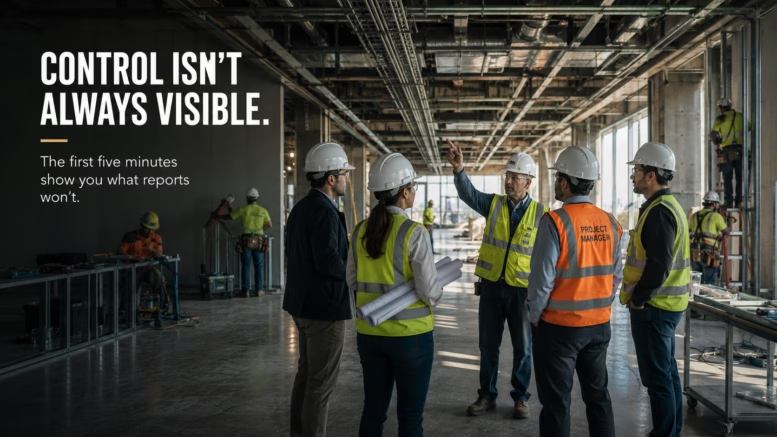
Experienced owners and tenants aren’t just checking progress. They’re reading whether the project still feels controlled — or whether the field has already started quietly compensating for unresolved issues.
Most people walk onto a job site looking straight ahead.
I don’t.
After years as an Owner’s Rep in New York, I’ve learned that the first few minutes often tell you more than most schedule updates and OAC meetings combined.
Is the Job Progressing — or Constantly Compensating?
I start by reading the flow of the work.
Are crews moving through areas in clean sequence?
Or are multiple trades stacked on top of each other, constantly negotiating space and working around one another?
Does the execution feel deliberate, or does it feel like the team is managing around problems instead of through them?
That single distinction reveals more about the real health of a project than almost anything else.
What the Overhead Tells You First
My eyes usually go up next.
Above-ceiling spaces don’t lie:
- Tight routing and last-minute field adjustments
- Trades competing for the same real estate
- Areas that should be closing but remain wide open
- Decisions that clearly landed too late
A clean, finished corridor downstairs can still hide major coordination instability above the grid.
Activity and control are not the same thing.
Listening to How the Work Is Actually Being Managed
Then I listen.
How does the superintendent speak to the subcontractors?
Do the foremen sound confident about the next two weeks of work?
Are people solving problems — or just working around them?
Friction in the field almost always appears long before it shows up in reports or change orders.
When Temporary Conditions Become Permanent
Every project has temporary lighting, power, protection, and access.
That’s normal.
The warning sign is when “temporary” stops being temporary.
That’s when you know the field is absorbing unresolved design decisions, coordination gaps, and procurement pressure instead of flowing through the planned sequence.
Once that pattern sets in, owner leverage starts to quietly erode.
When Space Stops Being Conceptual
This is one of the most important moments in any fit-out — especially for less experienced owners and tenants seeing the space take shape for the first time.
What looked right on the drawings often feels very different once framing goes up.
Corridors tighten.
Offices feel smaller.
Sightlines change.
That’s when the project stops feeling conceptual and starts feeling real.
It’s also when many owners and tenant teams realize that what made sense on paper doesn’t always translate at full scale.
That’s when the real conversations with the architect begin — and when walls start moving.
The problem?
By then, procurement and sequencing are often already committed.
One small adjustment can quickly ripple through lighting, sprinklers, diffusers, devices, ceilings, and finishes — triggering coordination revisions, rework, material impacts, and schedule disruption far beyond what initially felt like a simple layout tweak.
Where Less Experienced Owners and Tenants Gain the Most
If you’re newer to construction, bring the architect, superintendent, and contractor’s project manager on the walk together.
Let the architect speak to design intent.
Let the superintendent explain field conditions and sequencing.
Let the PM address coordination, procurement, and execution strategy.
Even without deep technical knowledge, repeated site walks will train you to spot the patterns that matter:
- Are areas progressing cleanly or constantly being reworked?
- Do the same issues keep resurfacing?
- Do the teams sound coordinated or defensive?
- Are temporary conditions contained — or multiplying?
- Does the project still feel stable, or is it constantly adjusting?
You don’t need to understand every trade to sense when a project is no longer operationally settled.
Site walks also help verify that the work continues to align with the approved Tenant Work Letter (TWL/TIW) and scope expectations.
Small substitutions, compromises, or deferred items are much easier to catch and address early.
What Hasn’t Changed Since the Last Visit
Every project has bad days.
What matters more is what hasn’t improved.
When the same areas remain unsettled visit after visit, something deeper is usually broken.
Those issues should be owned and driven in the OAC — not left living in the field while the schedule quietly adjusts around them.
Strong OAC meetings surface problems early.
Weak ones document them after the damage is done.
Site Walks Are Operational Diagnostics
The best site walks aren’t inspections.
They’re operational diagnostics.
They reveal where sequencing, coordination, procurement, or decision-making may be drifting.
For owners and tenants, they deliver something even more valuable: real visibility into how the space is actually evolving and where timely intervention can prevent small issues from becoming expensive changes.
Most of that reality becomes visible surprisingly fast — often within the first five minutes on site.
Capital programs rarely drift all at once.
The field usually starts signaling it first.
About the Author: Richard Neuman advises organizations on capital planning, project governance, and complex capital programs. He has overseen more than $2 billion in capital investments across commercial real estate, healthcare, utilities, industrial, broadcast, and development projects.
He writes candidly from an owner-side perspective about the executive decisions and organizational dynamics that shape capital project outcomes.
Leading a major capital program or facing a complex capital decision?
Contact Richard.
Subscribe for insights on capital planning, project governance, and the executive decisions that shape project outcomes long before construction begins.


Be the first to comment on "What Owners Really See in the First 5 Minutes of a Construction Site Walk"