
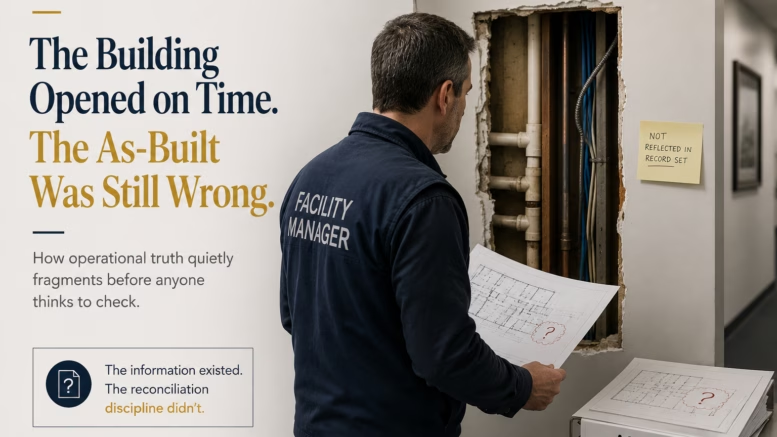
How operational truth quietly fragments before anyone thinks to check.
At turnover, most owners and facility managers believe the drawings reflect what was actually built.
Often, they don’t.
What gets delivered is usually assembled from fragmented project information that never fully reconciled into one coordinated set of As-Built drawings. The information existed. The reconciliation discipline didn’t.
The building opens. The inspection passes. The turnover package gets delivered.
Nothing feels broken yet.
The Moment Experienced Facility Teams Recognize
Experienced facility teams recognize the moment later:
- A valve isn’t where the drawing says it is.
- You drilled through a water pipe that was not on the drawings.
- A shutoff was rerouted in the field with no update.
- A system shifted during construction and quietly disappeared from the operational record entirely.
The problem rarely surfaces at turnover. It shows up months or years later — during maintenance, an outage, a renovation, or an emergency — when someone finally needs the drawings to describe what actually exists behind the wall or above the ceiling.
That’s usually the moment the drawings stop feeling trustworthy.
Jason Lackner, Senior Facilities Manager at JM Family Enterprises in Deerfield Beach, Florida, described the downstream reality directly:
“What may look efficient today can become a costly burden down the road if your drawings don’t reflect reality.”
When Operations Inherits the Problem
Facility teams end up manually rediscovering information the project was expected to reconcile before turnover occurred:
- Ceilings get opened.
- Systems get traced.
- Infrastructure gets rediscovered in the field because operational certainty was never fully captured before concealment.
- The cost lands almost entirely on the operational side — long after the project team has moved on.
As Lackner observed:
“Regardless of who made the mistake, our team bore the responsibility of fixing it.”
How Operational Truth Quietly Fragments
The breakdown rarely happens because information never existed.
It happens because operational truth fragments gradually during construction while schedule pressure accelerates toward closeout.
Some field changes get incorporated unevenly across disciplines.
Some never make it back into the record set at all.
Some remain trapped in superintendent field adjustments, subcontractor markups, vendor coordination sketches, fire alarm routing revisions, plumbing reroutes, ceiling conflict workarounds, or individual trade knowledge that never fully resolves back into coordinated operational documentation.
Projects still reach turnover appearing administratively complete.
Operationally, they often aren’t.
And the uncertainty usually didn’t originate with operations.
The Exposure Forms Long Before Turnover
The exposure forms quietly — well before turnover:
- Ceilings close before concealed conditions are fully reconciled.
- Final documentation gets pushed toward completion when coordination capacity is already thinning.
- Operational review happens late, after procurement, sequencing, and installation decisions have largely hardened.
The reporting may still appear stable.
The operational certainty underneath it often isn’t.
Jason Lackner further identified another pattern experienced operators immediately recognize:
“Late-stage field changes are an inevitable reality of construction. However, when those changes are ego-driven rather than project-focused, they rarely benefit the organization.”
Those decisions don’t disappear.
They migrate downstream — into maintenance, future renovations, troubleshooting, and institutional uncertainty long after the original decision-makers are gone.
Where Experienced Owners Intervene Differently
Experienced owners usually recognize the risk earlier.
Not because the drawings look incomplete.
Because they understand operational certainty degrades the moment reconciliation becomes a closeout activity instead of an active execution discipline.
Once ceilings close, field conditions evolve, teams disperse, and final payment leverage begins narrowing, reconstruction becomes slower, more expensive, and increasingly dependent on memory instead of verification.
That’s why experienced organizations force reconciliation earlier than most projects naturally want to.
Field conditions must be documented where they occur, and the design team can only update the record drawings based on timely, accurate field information.
Before concealment.
Before turnover.
Stopping the cash bleed caused by incomplete As-Builts requires moving from passive acceptance to aggressive contract enforcement. Owners who want operational reality to match their documentation must deploy four specific levers during execution:
Hold the Purse Strings (Monthly As-Built Audits): Do not wait until the 11th hour to ask for record drawings. The contract must dictate that the general contractor’s monthly progress payments are strictly contingent upon verifying that redlines and BIM models reflect that month’s actual field changes. If the drawings aren’t current, the pay application is held. Period.
Define Granularity in the Contract: GCs often think “As-Built” simply means slapping a red stamp on the original design PDFs. Spell out the expectations explicitly in Division 1 of your specs: exact dimensions of concealed main utility runs, rerouted conduits, structural field-fixes, and critical valve locations must be geometrically accurate.
Mandate Pre-Concealment Reality Capture: Once the drywall is up, verification becomes a forensic (and destructive) nightmare. Mandate the use of 360-degree continuous photo capturing (like OpenSpace) or LiDAR scanning immediately before insulation and drywall are installed. This creates an unarguable digital twin of what is actually behind the wall.
Give Operations Gatekeeper Power: The facility management team inherits the building; they should help guard the exit. Give operational leaders final sign-off authority on project closeout. If the facility team doesn’t have verified, searchable, and accurate drawings to maintain life-safety and MEP systems, the project is not complete, and final retention is not released.
After that, trust in the building record usually starts eroding one field discovery at a time.
About the Author: Richard Neuman advises organizations on capital planning, project governance, and complex capital programs. He has overseen more than $2 billion in capital investments across commercial real estate, healthcare, utilities, industrial, broadcast, and development projects.
He writes candidly from an owner-side perspective about the executive decisions and organizational dynamics that shape capital project outcomes.
Leading a major capital program or facing a complex capital decision?
Contact Richard.
Subscribe for insights on capital planning, project governance, and the executive decisions that shape project outcomes long before construction begins.



Be the first to comment on "The Building Opened on Time. The Drawings Were Still Wrong."