
The problem isn’t the schedule—it’s when it’s treated as a commitment
Most early project schedules aren’t wrong.
They’re imagined — built before procurement, sequencing, and market realities are fully understood.
That’s not a flaw.
It’s how projects start.
The issue is what happens next.
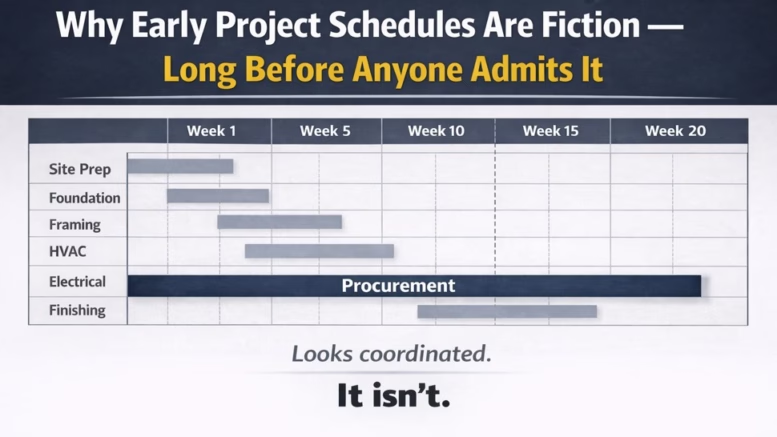
If procurement isn’t driving the schedule, the schedule isn’t real.
Long-lead components—switchgear, HVAC systems, specialty equipment—don’t follow the schedule. They define it.
Yet early schedules are often built before those inputs are fully validated.
Early schedules exist to create direction.
What matters is whether they are understood as directional—or treated as commitments before they’re fully informed.
The Schedule Looks Complete. The Inputs Are Not.
Early schedules are persuasive because they look complete.
Dates are filled.
Milestones are connected.
Logic is structured.
They create a sense of progress.
But underneath that structure, the inputs are still forming:
- Scope is evolving
- Equipment is not fully selected
- Procurement paths are undefined
- Market conditions have not been validated
A clean Gantt chart shows sequence.
It does not show whether the assumptions behind that sequence are real.
The Pattern Mot Teams Recognize
This dynamic shows up consistently—especially in design–bid–build.
The schedule used to procure the work
is rarely the same schedule used to build it.
Not because the schedule is flawed.
But because the inputs arrive at different times.
The schedule is created early, when information is limited.
It is tested later, when information is more complete.
The shift is inevitable.
The problem is when the early version is treated as fixed.
Procurement Doesn’t Follow the Schedule—It Defines It
Most schedules are built around activities.
The project is driven by decisions—specifically, when equipment is selected and released.
The schedule doesn’t control procurement.
Procurement determines whether the schedule is achievable.
Switchgear, HVAC systems, and specialty equipment are not line items.
They are often the critical path.
Without validated procurement inputs:
- Lead times are estimated instead of confirmed
- Delivery dates are assumed
- Order-release timing is unclear
- Fabrication constraints are not reflected
At that point, the schedule is not fully informed.
It is still developing.
Where Construction Input Actually Matters
Construction involvement at this stage isn’t about building the project.
It’s about validating the assumptions before the schedule is used to procure and price the work.
Because once an unvalidated schedule is issued:
- It sets owner expectations
- It shapes contractor proposals
- It begins to carry contractual weight
A schedule issued without construction input isn’t aggressive.
It’s unvalidated.
The Other Hidden Driver: Owner Held Vendors
Another common disconnect sits outside the core construction contract.
Owner-held vendors—AV, security, specialty systems—are often shown on the schedule months before they are engaged.
But until contracts are in place:
- Submittals don’t start
- Coordination doesn’t begin
- Fabrication slots aren’t secured
The schedule reflects activity.
The decisions enabling that activity may still be catching up.
The Moment the Scheduling Becomes a Liability
Every project reaches a point where the schedule stops being directional
and starts creating real cost and risk.
That moment is not during construction.
It’s the day the schedule is used to procure or price the work.
From that point forward, assumptions are no longer internal.
They are embedded in contracts, pricing, and expectations.
Example:
A 50-week lead time carried as 20 weeks because procurement inputs weren’t validated early.
The schedule looked right.
Until it wasn’t.
At that point, the issue isn’t schedule slippage—
it’s cost, resequencing, and recovery.
Make the Schedule Earn Its Credibility
A credible schedule is not built on formatting.
It is built on validated inputs.
That requires:
- Bringing construction perspective in early enough to inform the schedule
- Allowing procurement realities to shape the critical path
- Defining order-release dates—not just delivery milestones
- Aligning owner-held contracts with the schedule
- Making assumptions visible, not implied
Final Thought
Early schedules don’t fail.
They mature as better information becomes available.
The issue isn’t uncertainty.
It’s whether the schedule acknowledges it before it’s relied upon.
Because if procurement isn’t driving the schedule,
the schedule is still a guess.
About the Author: Richard Neuman advises organizations on capital planning, project governance, and complex capital programs. He has overseen more than $2 billion in capital investments across commercial real estate, healthcare, utilities, industrial, broadcast, and development projects.
He writes candidly from an owner-side perspective about the executive decisions and organizational dynamics that shape capital project outcomes.
Leading a major capital program or facing a complex capital decision?
Contact Richard.
Subscribe for insights on capital planning, project governance, and the executive decisions that shape project outcomes long before construction begins.




Be the first to comment on "Why Early Project Schedules Are Fiction — Long Before Anyone Admits It"