
When Everything Looks Done—but Nothing Is Easy to Build
The drawings look complete.
The budget is approved.
The schedule is moving.
Then construction starts—and no one can agree on how to build what’s been issued.
RFIs stack up almost immediately.
Trades begin interpreting intent instead of executing defined scope.
The general contractor asks for direction just to keep crews productive.
Before long, someone says the line every owner hates hearing:
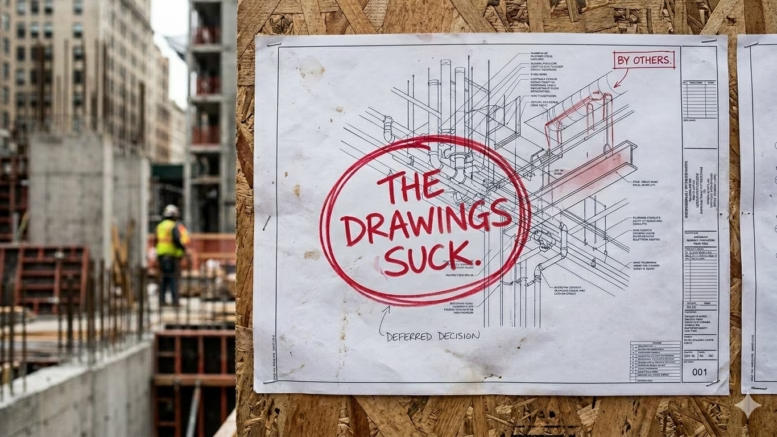
“The drawings suck.”
Contractors don’t say that lightly. They say it when they’re forced to make assumptions, interpret intent, or finish decisions that were never fully closed during design.
Most of the time, the issue isn’t missing information.
It’s unresolved decisions embedded in drawings that appear complete.
Owner Behavior Is Where Coordination Breaks First
Before pointing to BIM (Building Information Modeling—a 3D modeling tool used to coordinate building systems), clash reports, or discipline coordination, there’s a harder reality experienced teams recognize:
Design teams cannot fully coordinate a project if owners do not fully close decisions.
Owners don’t delay decisions by accident.
They delay them to preserve flexibility—and then act surprised when that flexibility shows up as cost.
Owners often fall into a state of financial delusion—pushing teams to “just get it out for bid” to hit a theoretical loan closing or board date. They knowingly trade document quality for a calendar milestone, forgetting one critical fact:
The field always collects the debt.
Coordination unravels upstream when owners:
- Allow scope to evolve late without formal review
- Delay decisions to accommodate internal committees
- Advance milestones without locking criteria
- Introduce “just one more requirement” outside the process
When this happens, design does not stop.
To protect the schedule, design teams carry uncertainty forward:
assumptions replace commitments.
placeholders stand in for decisions.
That uncertainty doesn’t disappear.
It hardens into ambiguity in the drawings.
The Math of Indecision
Owners often delay decisions to “keep options open.”
But flexibility has an expiration date.
After that, you’re not preserving options—you’re buying change orders.
At 50% Design:
A decision is a pencil stroke.
It costs ten minutes of focused attention.
At 90% Design:
A decision is a redraw.
You’re paying architectural, structural, and MEP teams to unravel work already coordinated.
In the Field:
A decision is a disruption.
You’re paying for demolition, rework, remobilization, specialist travel, and acceleration—just to recover a schedule you already compromised.
Same decision. Radically different cost.
Where 50% and 90% Page Turns Actually Break Down
Most teams believe coordination is being validated during these milestones.
In reality, they are reviewing drawings—not enforcing decisions.
At 50% — Where Coordination Is Either Created or Lost
If these items are not resolved here, they will surface later as change orders:
Architectural
- Are dimensions fixed—or still “to be verified”?
- Do wall types reflect real penetrations and systems?
MEP
- Are routing paths defined—or left for “field coordination”?
- Are equipment access and service zones final?
Structural
- Are penetrations designed—or assumed to be field-cut?
Treat 50% as a progress milestone instead of a decision checkpoint,
and risk is already embedded.
At 90% — Where Incomplete Decisions Get Exposed
At this stage, unresolved coordination becomes visible—if anyone is looking.
Watch for:
- Details that don’t reconcile across disciplines
- Specifications that don’t match what’s drawn
The clearest signal:
If coordination is still being discussed at 90%, it was never decided.
If you’re issuing at 90% and still coordinating, you’re not finishing design—you’re scheduling change orders.
What BIM Is—and What It Cannot Do
BIM is excellent at showing where systems collide.
It is a tool—not a referee.
It does not decide:
- Which system has priority
- Who owns contested space
- How systems will be installed or serviced
A model can be visually coordinated and still rely on assumptions.
When those assumptions persist, coordination hasn’t failed—
it has been outsourced to the contractor, at a premium price.
The “By Others” Trap
One of the most dangerous phrases in any set of drawings is “By Others.”
Designers use it to move a problem.
Owners treat it as minor.
Contractors treat it as risk.
That means contingency—or a future change order.
“By Others” transfers risk.
It does not complete coordination.
If a reasonable contractor can argue over who owns a penetration, sleeve, or support pad, the design has a gap.
Constructability Is a Coordination Requirement
A system that fits in the model but cannot be installed, accessed, serviced, or replaced is not coordinated.
Coordination must account for:
- Installation sequence and space for labor and tools
- Access for maintenance
- Replacement without demolition
If a system cannot be reasonably built as drawn, it will be redesigned in the field—at your expense.
What “The Drawings Suck” Actually Means
That phrase is rarely about drafting competence.
“The drawings suck” means the field is finishing decisions that should have been closed months earlier.
It reflects a governance failure.
The owner’s mandate is simple:
If you are the owner, your job isn’t to draw.
Your job is to decide.
If you leave the design open to preserve flexibility,
you are choosing to pay for that flexibility in change orders.
Design teams must enforce closure.
Owners must enforce discipline.
If either side fails, the field finishes the design.
Once construction starts, every missing decision gets priced.
By the time the phrase is said out loud,
the project has already paid for it.
About the Author: Richard Neuman advises organizations on capital planning, project governance, and complex capital programs. He has overseen more than $2 billion in capital investments across commercial real estate, healthcare, utilities, industrial, broadcast, and development projects.
He writes candidly from an owner-side perspective about the executive decisions and organizational dynamics that shape capital project outcomes.
Leading a major capital program or facing a complex capital decision?
Contact Richard.
Subscribe for insights on capital planning, project governance, and the executive decisions that shape project outcomes long before construction begins.


Be the first to comment on "What Design Teams Must Enforce So the Field Doesn’t Say “The Drawings Suck”"