Capital projects don’t fail loudly at the beginning. They fail quietly—while everything still looks under control.
Schedules are issued. Meetings recur. Design advances. Budgets take shape. Teams are engaged.
From the outside, the project looks structured.
That’s exactly when experienced leaders ask a different question:
Who owns the decisions guiding the work?
No one can answer it.
That absence doesn’t stop the project.
It fills the gap—and gets mistaken for progress.
The Illusion of Control
Most troubled projects don’t feel chaotic. That’s what makes them dangerous.
On paper, everything exists:
- Scope documents are drafted
- Milestones are defined
- Estimates are issued
- Design keeps advancing
The machinery is active.
But governance—the authority that determines what must be decided before work proceeds—never takes hold.
Decision ownership was never established.
No one is accountable for locking priorities, defining acceptable risk, or resolving tradeoffs before production depends on them.
So the project adapts—by defaulting.
When Decisions Go Unmade, Substitutes Take Over
Projects don’t pause when decisions are missing. They substitute.
Assumptions replace decisions.
Early placeholders harden because nothing interrupts them.
Momentum replaces direction.
Work continues because it’s already in motion.
Participation replaces accountability.
Consensus forms because no one is responsible for deciding.
Scope forms around early alignment—not leadership intent.
Budgets get accepted before they’re challenged.
Design advances before priorities are locked.
The project doesn’t slow down.
It accelerates.
Why the Cost Shows Up Later
This is not an execution failure.
It is a sequencing failure.
When decision ownership is unclear, production accelerates against unresolved questions:
- Design keeps advancing
- Estimators keep pricing
- Schedules keep moving
But all of it is based on assumptions—not decisions.
By the time misalignment becomes visible:
– Design is expensive to unwind
– Budget assumptions are already embedded
– Procurement reflects unresolved priorities
What should have been leadership decisions now show up as downstream “issues.”
Change orders begin resolving what governance never addressed.
Every correction becomes a transaction instead of a decision.
Why Adding Structure Misses the Point
When problems surface, most teams respond the same way:
- More meetings
- More reporting
- More coordination
But the project was never short on activity.
It was short on decision authority.
Tightening execution doesn’t fix a governance gap.
It reinforces it—by keeping work moving without confirming what was ever decided.
What Strong Capital Programs Do Differently
Strong capital programs do something most projects don’t.
They separate decision-making from production.
Before design advances, pricing hardens, or schedules commit, they establish:
- Who owns each core decision
- When that decision must be made
- What work is allowed to proceed once it is
This is governance.
Not oversight.
Not bureaucracy.
Sequencing decisions before execution depends on them.
When decisions lead, execution follows.
When they don’t, activity fills the void—and calls it progress.
Why the Warning Signs Are Missed
Projects with unclear decision ownership don’t look broken.
They look:
That appearance creates confidence—right up until the cost shows up.
By then:
- Design is difficult to slow
- Budgets are expensive to rework
- Field teams inherit unresolved questions
At that point, leadership isn’t setting direction.
They’re paying to correct it.
The Leadership Lesson
Activity creates momentum.
Clarity creates control.
The best-performing capital programs aren’t the most active.
They’re the ones where decisions are visible, owned, and made on time.
Because in capital programs, failure rarely announces itself.
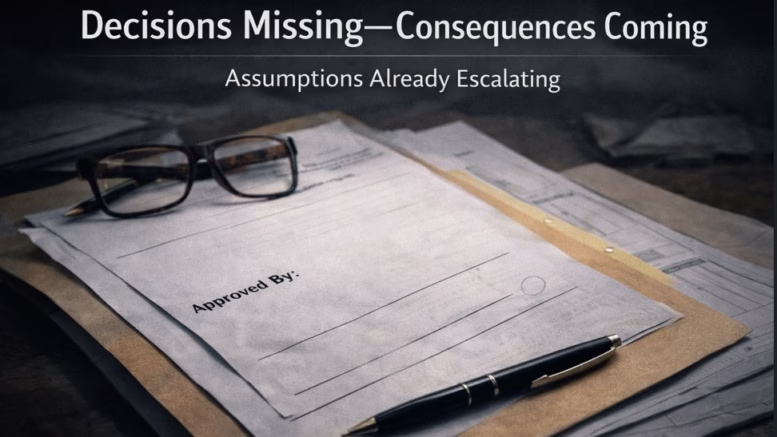
It signs off quietly—by never being signed at all.




Be the first to comment on "Why Capital Projects Feel Organized—but Keep Producing Surprises"