
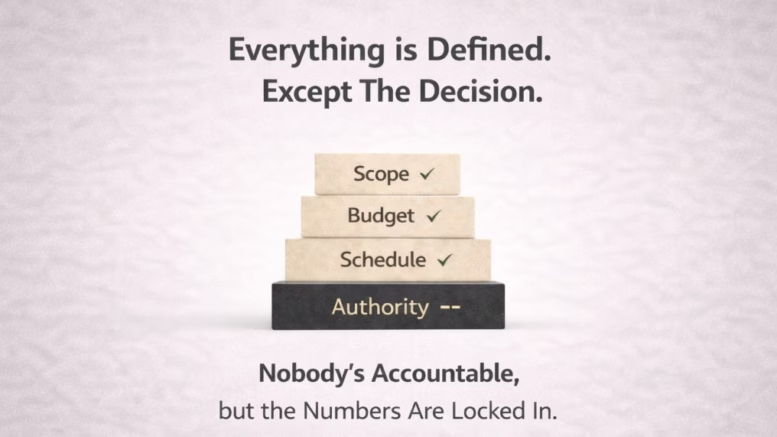
Most capital projects become harder to control long before construction starts.
Not because teams stop working hard.
Not because consultants or contractors suddenly become ineffective.
Projects begin drifting when execution starts advancing around decisions leadership hasn’t fully resolved yet.
By the time organizations force the difficult conversations, design has already advanced around assumptions, budgets have started hardening, and procurement pressure begins limiting flexibility. At that point, decisions are no longer shaping the project.
They’re correcting momentum that already exists.
Experienced capital leaders recognize this pattern early. The project appears active and coordinated on the surface, but execution is already inheriting unresolved leadership decisions.
That is not primarily an execution problem.
It is a governance problem.
Strong projects tend to lock three decisions early – not because the expect certainty, but because they understand how quickly uncertainty becomes operationally expensive once work starts advancing.
Decision One: Who Owns the Scope
Scope rarely drifts because teams are careless.
It drifts because ownership becomes distributed while accountability remains unclear.
On many projects, scope is broadly understood but not formally controlled. Stakeholders assume priorities are shared. Design teams continue interpreting intent. Additions enter incrementally because nobody clearly established the operational boundary between “identified,” “desired,” and “approved.”
Over time, the project quietly accumulates obligations that were never fully evaluated against budget, schedule, procurement strategy, or execution impact.
Someone must hold explicit authority over scope boundaries and prioritization—not simply coordinate discussions around them.
That includes defining:
- What is included
- What is excluded
- What remains optional
- What requires new decision before proceeding
- What level of change triggers reevaluation of budget or schedule assumptions
When scope ownership is clear, design advances intentionally.
When it is not, design advances by accumulation.
The downstream impact usually appears later:
late redesign,
procurement instability,
competing stakeholder expectations,
compressed decision making,
and growing pressure to “make it work” after commitments have already formed.
Decision Two: Who Validates the Budget Assumptions
Budgets rarely fail all at once.
They mature around assumptions that were never rigorously challenged early enough.
Every early-stage capital budget contains judgment:
- Unit pricing
- Quantity
- Escalation outlooks
- Risk coverage
- Allowances
- Utility assumptions
- Procurement timing assumptions
- Constructability expectations
None of those are inherently problematic.
The risk forms when preliminary assumptions begin behaving like operational commitments before anyone with authority has fully validated them against actual project conditions.
Without that discipline:
- Ranges begin getting interpreted as certainty
- Procurement inherits unresolved exposure
- Financial optimism quietly becomes embedded into executive reporting
- Leadership visibility narrows as assumptions harden beneath the surface
Estimates alone do not create confidence.
Validation does.
Because once procurement activity begins, assumptions stop behaving like planning tools.
They become pricing realities.
 Decision Three: Who Owns the Trade-Off Decisions
Every capital eventually reaches competing priorities.
- Cost versus schedule
- Speed versus flexibility
- Operational continuity versus construction efficiency.
- Long-term performance versus short-term budget pressure.
Experienced teams rarely struggle to identify the trade-off itself.
Projects drift when nobody is clearly authorized to absorb the consequence of choosing one priority over another.
In many organizations, difficult decisions remain suspended too long because leadership hopes additional coordination will eliminate the need for compromise entirely.
Usually, it does not.
Instead:
- Teams optimize within their own discipline
- Procurement timelines compress
- Decisions escalate later under greater pressure
- Field coordination absorbs unresolved conflicts
- Change orders become the mechanism that finally forces prioritization
The field eventually collects the debt created by unresolved decisions upstream.
Strong projects establish this authority early and visibly.
Everyone understands:
- Who makes the final call when priorities conflict
- What criteria governs those decisions
- Which issues require escalation
- What level of impact changes the approval path
That clarity does not create rigidity.
It creates operational stability.
Why These Three Decisions Matter Together
These decisions reinforce each other operationally.
Scope ownership without budget validation creates optimism disconnected from financial reality.
Budget authority without trade-off authority creates friction without resolution.
Trade-off authority without scope discipline creates churn disguised as progress.
When all three are established early:
- Design advances with clearer intent
- Budget exposure becomes more visible
- Procurement decisions become more disciplined
- Schedules reflect actual decision readiness
- Executive visibility improves
- Teams spend less energy compensating for governance gaps later
Execution becomes cleaner not because projects become easier—but because organizations stop forcing execution teams to absorb uncertainty leadership never fully resolved upstream.
Where Governance Actually Begins
Many organizations define governance through reporting structures, approval gates, dashboards, and review meetings.
Those mechanisms matter.
But capital governance begins earlier than most organizations realize.
It begins when leadership establishes:
- Who owns decisions
- When decisions must be finalized
- What level of uncertainty is acceptable before work advances
- Which assumptions require formal validation
- Who carries authority when priorities inevitably conflict
Once those structures are established early, projects become significantly more stable operationally.
When they are not, uncertainty migrates downstream until procurement, construction, and field execution are forced to absorb it under greater cost and schedule pressure.
The Leadership Reality
Capital projects can tolerate uncertainty remarkably well.
What they struggle to absorb is unresolved authority.
Most organizations don’t fully recognize these gaps until execution teams are forced to compensate them.
About the Author: Richard Neuman advises organizations on capital planning, project governance, and complex capital programs. He has overseen more than $2 billion in capital investments across commercial real estate, healthcare, utilities, industrial, broadcast, and development projects.
He writes candidly from an owner-side perspective about the executive decisions and organizational dynamics that shape capital project outcomes.
Leading a major capital program or facing a complex capital decision?
Contact Richard.
Subscribe for insights on capital planning, project governance, and the executive decisions that shape project outcomes long before construction begins.



Be the first to comment on "The Three Decisions Every Capital Project Must Lock Early"