Some construction budget decisions don’t save money. They decide what the next capital project has to undo.
Every capital project starts with more ideas than money. Bids come in high, budgets get cut, and scope gets reduced. That’s normal.
“We outgrew the building before the shovels hit the ground.”
A General Manager said that to me as Operations prepared to move into a new facility.
From his perspective, it looked like poor planning.
Neither of us had been involved when those decisions were made.
By the time we joined the project, the building had already been through visioning, design, pricing, redesign, and value engineering.
The original building had been larger. When the bids came back over budget, executive leadership reduced the program so the project could move forward.
The building wasn’t poorly designed. It was built exactly to the budget that had been approved.
As Operations prepared to move in, the consequences were already obvious. There weren’t enough offices. Parking had been reduced. People were already figuring out how to make the building work before it even opened.
Those weren’t design mistakes.
They were budget decisions.
The Decision After the Budget Cut
On another project, EV charging was part of the original site plan. As the electrical design progressed, it became clear the electrical service couldn’t support the full EV build-out.
Deferring some of the chargers made sense.
From the project team’s perspective, it was a relatively minor redesign.
Reopening the design wasn’t something the owner wanted to do.
The project team recommended installing the conduit while the trenches were still open, reserving space for future switchgear before the building was finished, completing the utility study while the engineers, utility company, and permitting agencies were already engaged.
Everyone knew those decisions would cost less and disrupt far less while the project was still under construction.
Those recommendations weren’t accepted.
They were left behind.
The project moved forward.
A future project team may now have to complete work that this project chose not to prepare for.
The Second Decision
I’ve watched similar conversations around future expansions, structural capacity, shell space, electrical rooms, utility corridors, and countless other projects.
The organization couldn’t afford to build everything immediately.
Nobody questioned that.
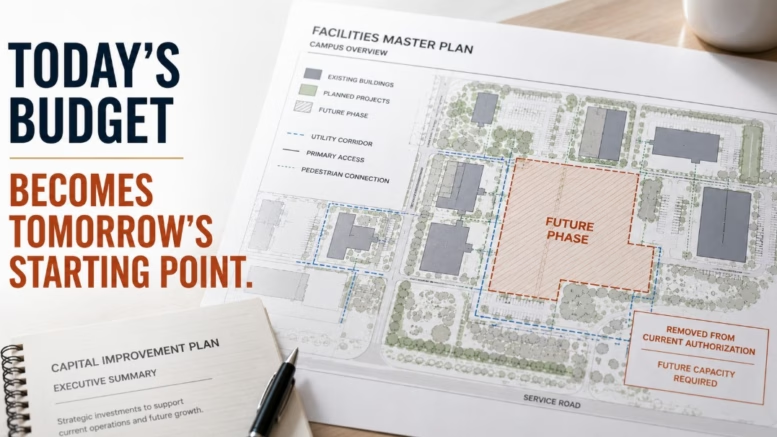
The real decision was whether to leave the next project with foundations already sized, conduit already installed, utilities already positioned, and space already reserved…
…or leave those problems for someone else to solve later.
That’s the decision many organizations never realize they’re making.
Every budget meeting decides two things.
What gets built today. And what the next project inherits.
Sometimes the budget still says no.
That’s part of capital planning.
But before the discussion ends, make sure one question has been answered.
For Your Next Project
What will the next project have to undo because of the decision we’re making today?
If the answer is “nothing,” the discussion is probably over.
If not, today’s decision may leave the next project to:
- Break concrete that didn’t need to be broken.
- Strengthen foundations that could have been designed for future expansion.
- Relocate utilities that once had room to grow.
- Install infrastructure that could have been prepared during the original project.
- Cut into finished walls and ceilings.
- Shut down occupied buildings or active operations.
- Delay future expansion that could have started much sooner.
- Re-enter the permitting process for work that could have been addressed the first time.
- Relocate departments, equipment, or occupants during construction.
- Spend money twice for work that could have been prepared once.
The answer may still be no.
The mistake is never asking the question.
Because today’s budget decision may determine whether tomorrow’s project begins with an advantage…
…or a demolition plan.



Be the first to comment on "The Cost Wasn’t Eliminated. The Options Were."