
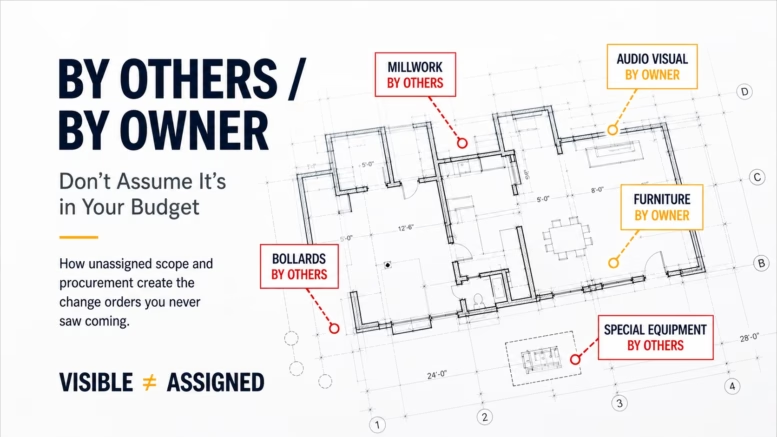
How fragmented scope ownership and procurement create the change orders you never see coming
The Moment
Every owner has the same conversation.
A cost appears mid-project for something everyone assumed was included.
You didn’t miss it.
It was on the drawings the whole time.
It just didn’t belong to anyone carrying it in their number.
That’s where projects quietly begin losing control.
The Mechanism
“By Others” and “By Owner” are two of the most expensive phrases in construction documents.
Not because the work is hidden.
Because the work is acknowledged without ever being fully assigned.
The notation looks legitimate.
It passes coordination reviews.
The project continues moving forward.
But something critical never actually happens:
No one is forced to fully own the scope operationally, commercially, and contractually before the project goes to bid.
That’s how “complete” budgets get approved while still carrying unresolved exposure.
Not because the budget is intentionally wrong.
Because portions of the project were never fully converted into assigned, priced, coordinated responsibility.
The Assumption
Many owners understandably assume:
If it appears on the drawings, it’s included in the bid.
In practice, that often isn’t true.
There is an entire category of scope that exists in plain sight — partially defined, referenced across disciplines, discussed repeatedly — and still never fully carried by anyone responsible for delivering the work.
Visible doesn’t mean assigned.
- Millwork appears on plans, but no trade fully owns it.
- Furniture requires power and data, but infrastructure coordination never fully closes.
- Equipment requires blocking, venting, drainage, or electrical capacity, but supporting requirements remain fragmented across consultants and vendors.
On the owner side, the lines are often even less clear.
The owner may purchase AV systems, specialty lighting, security systems, signage, or operational equipment or specialty technology directly.
But critical questions still remain unresolved:
Who integrates it into the base building?
Who carries supporting infrastructure?
Who coordinates installation sequencing?
Who verifies the building is actually ready to receive it?
In many projects, no one clearly tells the owner that they are the party responsible for procuring certain specialty consultants, vendors, or systems in the first place.
The drawings may identify AV, IT, lighting, security, acoustics, signage, furniture, specialty equipment, or operational technology requirements.
But identifying the scope is not the same as assigning responsibility for procuring it.
As a result, owners often assume someone else is carrying those decisions forward operationally.
Meanwhile, the project continues moving through design, pricing, and procurement without the necessary inputs ever being fully integrated.
By the time the gap becomes visible, infrastructure assumptions, sequencing, and pricing have already hardened around incomplete information.
Critical questions still remain unresolved:
- Who integrates it into the base building?
- Who carries supporting infrastructure?
- Who coordinates installation sequencing?
- Who verifies the building is actually ready to receive it?
If multiple parties touch the scope and no one is accountable for forcing integration early, the coordination hasn’t been solved.
It’s been deferred.
The “By Owner” Trap
If “By Others” hides scope through ambiguity,
“By Owner” often hides it behind a false sense of control.
The owner is directly procuring the scope.
But procurement and integration are not the same thing.
Specialty vendors and owner-retained consultants frequently enter the process later, operate outside the primary consultant structure, or develop independently from the core building documentation.
In many modern projects, significant portions of operational scope now sit outside the traditional architect / engineer / contractor structure.
- AV / IT systems
- Lighting consultants
- Security integrators
- Furniture consultants
- Acoustical specialists
- Specialty technology systems
These parties are often retained directly by the owner.
That doesn’t reduce coordination risk.
It fragments it across separate contracts, timelines, design assumptions, procurement cycles, and installation responsibilities.
The building still has to support all of it.
- Power and data pathways still require routing.
- Electrical loads still need capacity validation.
- Ceiling space still requires coordination.
- Blocking, backing, venting, cooling, and access still affect the surrounding building systems.
None of those requirements disappear simply because the owner purchases the equipment separately.
They migrate downstream.
And downstream is where projects lose leverage.
Where It Breaks
By the time these gaps surface:
The drawings are largely complete.
Procurement is already underway.
The GC has already priced the work.
Trade sequencing has already formed around earlier assumptions.
Now coordination becomes corrective instead of planned.
Field teams begin solving conditions the project should have resolved months earlier.
That is when projects start paying construction pricing for unresolved design and procurement decisions.
Where Advice Misses
When these gaps surface later, the response often sounds familiar:
“The owner or tenant should have reviewed the drawings more carefully.”
“It was identified in the documents.”
“They should have been tracked in a log.”
“The scope was always shown.”
And technically, those statements may be true.
But they overlook something important.
Most owners are not construction professionals managing specialty consultant procurement, infrastructure coordination, or sequencing risk every day.
They rely on the project team to help identify not only what the drawings show, but what decisions, consultants, vendors, and procurement actions the owner is actually responsible for driving — and when those actions need to occur to influence the design.
That guidance responsibility often becomes fragmented as scope crosses organizational boundaries:
- Between architect and vendor.
- Between vendor and contractor.
- Between owner procurement and contractor infrastructure.
- Between design intent and installation responsibility.
The drawings may fully identify the condition.
Consultants may note it repeatedly.
Coordination meetings may discuss it for months.
But none of that forces someone to carry it, procure it, integrate it, or price it before bid.
If no one is accountable for forcing those decisions closed early enough, the gaps remain open — even while the project appears to be moving forward normally.
The Fix
Experienced capital organizations handle this differently.
They do not treat scope ownership as a coordination exercise.
They treat it as a governance requirement before capital is committed.
During design development — before procurement and before bid — mature organizations force clarity around every “By Others” and “By Owner” condition.
That means identifying what the owner is actually responsible for procuring, which specialty consultants or vendors must be engaged, and which decisions need to occur early enough to influence the design and infrastructure assumptions.
Because once procurement timing slips past critical design milestones, coordination stops being proactive.
It becomes corrective.
Not meeting notes.
Not informal coordination lists.
A formal Scope Ownership Register.
For every identified item, it answers:
- What is the scope?
- Who owns procurement?
- Who carries installation?
- Who provides supporting infrastructure?
- Who budgets it?
- Who coordinates integration?
- When must decisions be finalized to avoid downstream disruption?
If those answers do not exist clearly before bid, the scope is not fully resolved yet.
It is simply moving downstream unresolved.
The Rule
No bid goes out until every one of those items has:
a name, a number, and a date.
If it doesn’t—
It’s not resolved.
It’s deferred.
Closing
The work was always there.
The accountability wasn’t.
“By Others” delays responsibility.
“By Owner” disguises unintegrated scope.
Neither removes the work from the building.
They simply defer accountability until the project reaches the most expensive point possible to solve it.
And deferred accountability is where budgets unravel.
The time to fix a gap is when it’s a line on a page—
not a conflict on the job site.
About the Author: Richard Neuman advises organizations on capital planning, project governance, and complex capital programs. He has overseen more than $2 billion in capital investments across commercial real estate, healthcare, utilities, industrial, broadcast, and development projects.
He writes candidly from an owner-side perspective about the executive decisions and organizational dynamics that shape capital project outcomes.
Leading a major capital program or facing a complex capital decision?
Contact Richard.
Subscribe for insights on capital planning, project governance, and the executive decisions that shape project outcomes long before construction begins.




Be the first to comment on "If It Says “By Others” or “By Owner,” Don’t Assume It’s in Your Budget"