
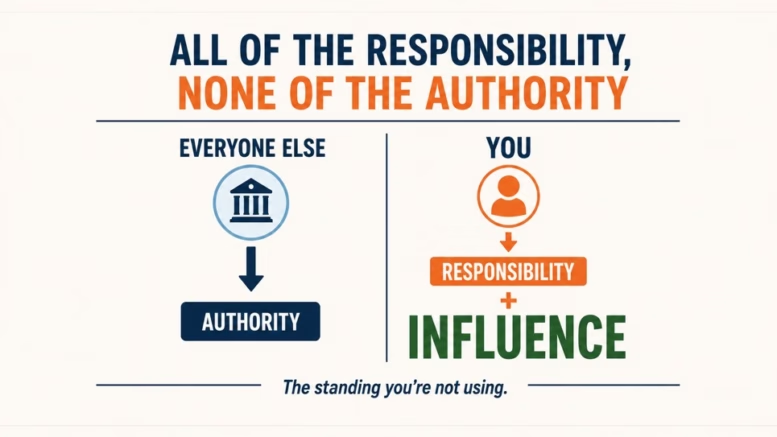
The Hidden Structural Failure
The program manager who cannot approve a change order.
The project executive who cannot release contingency.
The construction director who escalates every material decision into a leadership calendar that moves slower than the schedule.
Accountability has been assigned.
Authority hasn’t.
This is one of the most common structural failures in owner-side capital programs—and it rarely shows up clearly in governance documents. Because governance documents describe authority that is assumed to exist, not authority that has actually been delegated.
Most organizations don’t create this condition intentionally. Authority delegation is left incomplete—implied rather than codified, and never tested under real operating pressure. Programs launch with reporting lines and escalation paths, but once execution accelerates to field speed, decision rights blur.
That gap is where programs start losing leverage.
How It Starts (and Why It’s Easy to Miss)
It shows up quietly at first—the change order that sits for days, the procurement release that slips a window, the field team waiting on direction that never quite arrives.
Each delay feels temporary. Then they compound.
Contractors start pricing uncertainty instead of work. Sequencing shifts around missing decisions. The field begins compensating for direction that hasn’t formally been given.
Most reporting doesn’t catch this early. The schedule still looks recoverable. Dashboards still trend green. But underneath, the program is already reorganizing itself around missing authority.
When Behavior Begins to Shift
This is when the problem becomes harder to reverse than the structure that caused it.
Program managers stop making calls they’re technically empowered to make because the last decision they made was revisited and overridden above them. Escalation stops being situational and becomes reflexive.
Not because capability is lacking—but because the system has trained risk avoidance into the way work gets done.
Decision-making confidence erodes—and the program becomes dependent on leadership bandwidth that was never designed to carry day-to-day execution.
The Most Common Misdiagnosis
Leadership often reads the rising volume of escalations as a capability gap.
Sometimes it is. More often, it’s a downstream effect of unclear authority—and those require entirely different interventions:
- One is a personnel decision
- The other is a governance decision
Organizations that get this wrong don’t just misdiagnose the problem—they reinforce it.
When accountability is assigned without authority, the organization does not get accountability. It gets someone absorbing consequences for decisions they were never empowered to make.
What Experienced Operators See First
This condition shows up in patterns before it shows up in reports.
You hear it in the language:
- “Pending leadership review”
- “Awaiting alignment”
- “Under executive discussion”
You see decisions that should take hours stretch into weeks.
You see field teams sequencing around uncertainty instead of executing against clear direction.
And you see leverage disappearing in places leadership may still interpret as isolated friction.
What Strong Programs Do Differently
Organizations that manage this well make authority explicit—not because they are bureaucratic, but because unclear authority is not neutral.
It creates a vacuum.
And in capital programs, vacuums fill quickly—with delay, ambiguity, defensive behavior, and cost.
Clear authority looks like:
- Defined decision thresholds tied to scope, cost, or risk
- Delegated approval rights at the program level
- Fewer decisions waiting on calendar availability
In strong programs, authority is not only defined—it is tested. Teams know what they can approve, and more importantly, they have exercised that authority without it being quietly pulled back.
Leadership reinforces this by backing decisions at the level they were delegated. Overrides are explicit and rare, not a shadow system that retrains the organization to escalate everything.
The objective is not perfect decisions. It is clear, timely decisions made at the right level—consistently enough that the program can move at the speed execution requires.
A program manager who can approve a defined scope adjustment within a clear threshold—without escalation or committee review—changes how the entire program operates.
Not recklessly. Decisively.
The Difference
The difference is rarely the talent on the team.
It’s whether authority was actually delegated—or merely assumed.
About the Author: Richard Neuman advises organizations on capital planning, project governance, and complex capital programs. He has overseen more than $2 billion in capital investments across commercial real estate, healthcare, utilities, industrial, broadcast, and development projects.
He writes candidly from an owner-side perspective about the executive decisions and organizational dynamics that shape capital project outcomes.
Leading a major capital program or facing a complex capital decision?
Contact Richard.
Subscribe for insights on capital planning, project governance, and the executive decisions that shape project outcomes long before construction begins.

Be the first to comment on "All of the Responsibility. None of the Authority."