
Why the lowest number rarely reflects your real project cost.
Most capital projects don’t fail because of bad construction.
They struggle because risk isn’t translated into business terms early enough for leadership to make informed decisions.
That’s when the familiar symptoms appear:
- Schedules slip
- Budgets creep
- “Unforeseen conditions” get blamed
- Teams scramble to renegotiate scope
The truth is simple:
Most of these outcomes were predictable—they just weren’t surfaced early enough, or in language decisions-makers could act on.
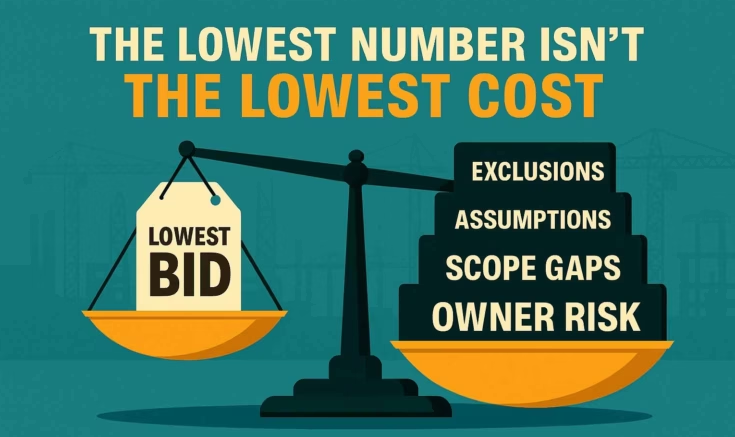
The Lowest Bid Isn’t the Lowest Cost
One of the most common misunderstandings in capital projects is assuming a low bid equals a low-cost project. It doesn’t.
A low number often means:
- Key risks have been excluded
- Assumptions lean overly optimistic
- Uncertainty has been deferred into construction
None of this removes cost.
It simply changes when and how the organization pays for it.
Projects don’t unravel because a contractor “missed something.”
They unravel because leadership didn’t understand the assumptions embedded in the number.
Exclusions Are Business Decisions – Not Technical Footnotes
Exclusions often appear as small bullet points buried in a proposal. They’re waved off as minor or technical.
But every exclusion introduces a business question:
- If the scope becomes necessary, who pays?
- What is the impact on schedule?
- How does this alter financial exposure?
Ignoring exclusions doesn’t neutralize them.
It guarantees the owner absorbs the risk at the worst possible moment – during construction, when leverage is limited and options are narrow.
Early awareness preserves control.
Late discovery triggers crisis management.
Construction Risk Is Business Risk
Every capital project has ripple effects far beyond the jobsite. Construction decisions directly impact:
- Cash flow and capital planning
- Lending covenants and financing
- Staffing and operational readiness
- Market timing
- Credibility with internal and external stakeholders
A delay isn’t just lost time – it’s a business interruption.
A change order isn’t just an added line item – it might signal a structural weakness in contracting strategy.
When risk is discussed in construction language, executives are forced to react.
When it’s framed in business language, they can steer.
Risk Appetite Isn’t Technical – It’s Strategic
Every organization has a risk appetite, spoken or unspoken.
Some accept variability to keep upfront costs low.
Others invest more upfront to achieve predictability.
Problems arise when:
- Risk tolerance is assumed instead of articulated
- Decisions are made piecemeal instead of systemically
- Optimism replaces strategy
High-performing organizations deliberately choose which risks to retain and which to transfer.
That choice can’t be outsourced – it has to be led.
Most of the Project’s Fate Is Set Before the Contract
By the time construction begins, 80-90% of cost and schedule are already locked in.
The greatest leverage exists earlier, when:
- Numbers are still negotiable
- Assumptions can be challenged
- Tradeoffs can be evaluated calmly
- Leadership still has full optionality
This is when uncertainty can be converted into informed choice rather than expensive surprise.
Once construction starts, you’re no longer managing risk – you’re managing consequences.
The Takeaway
Successful capital projects aren’t the ones with the least risk.
They’re the ones where risk is:
- Visible
- Owned by the right party
- Aligned with business priorities
Organizations that deliver consistent project outcomes share one common behavior:
They treat early construction decisions as strategic business choices – not technical formalities.
Risk will always exist.
The difference between a controlled project and a chaotic project comes down to one simple question:
Are you choosing your risks — or inheriting them?


Be the first to comment on "What Your Construction Bid Price Isn’t Telling You"