
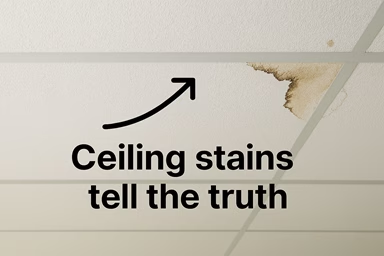
A Small Stain With a Big Story Behind It
First published 2011 | Rebuilt (and upgraded) for 2026
This was the very first article I ever published back in 2011 — and yes, it was about stained ceiling tiles. Not exactly viral material setting the internet on fire. I figured maybe a handful of people would read it.
Instead, it quietly became the most consistently visited page on my site for the next 15 years. Month after month, people kept showing up trying to answer one simple question:
“Why does my ceiling tile suddenly look like it’s trying to tell me something?”
It turns out, it usually is.
Ceiling stains are one of the simplest early‑warning signals a building gives you. They’re small, subtle, and easy to ignore until they escalate into something far more expensive. This updated 2026 version reflects hundreds of on‑site investigations showing that a simple stain often represents the building’s first attempt to get your attention.
Ceiling Tiles Don’t Keep Secrets
Most people see a stain and replace the tile.
Experienced owners ask:
Why did this happen?
When a ceiling tile stain appears, it’s rarely a cosmetic issue. It’s the building quietly pointing upward and saying:
“Something above me isn’t operating the way it should.”
Ignore it long enough, and the building eventually stops hinting and starts insisting.
Why Ceiling Tiles Stain (Still the Same Three Reasons)
1. Water Intrusion
Roof leaks, plumbing failures, flashing defects, or envelope breaches allow water to travel downward.
As water moves through the tile, it drags dust and debris with it. This process leaves behind:
- rings
- blotches
- halo patterns
These patterns often signal recurring or unresolved moisture.
2. Condensation From HVAC or Mechanical Systems
Sweating pipes, uninsulated ductwork, or poor vapor control allow condensation to build above the ceiling. This moisture creates:
- cloudy marks
- diffuse discoloration
- irregular shading
Condensation‑related staining usually points to insulation gaps or mechanical performance issues.
3. Contact or Transfer From Adjacent Materials
Not all stains form because of moisture.
Sometimes the tile simply touches nearby surfaces such as dusty grid systems, lighting fixtures, structure, or vibrating equipment. This contact produces:
- linear marks
- sharp edges
- geometric patterns
In these cases, the tile becomes a record of how nearby systems interact.
The Pattern Is the Message
The pattern of a ceiling tile stain often reveals exactly what’s happening in the system above it. A stain’s shape usually points to the cause:
- Circle → repetitive dripping
- Halo → wet–dry cycling
- Line → alignment with pipes, ducts, or framing
- Diffuse patch → humidity or vapor conditions
A ceiling tile might be inexpensive, but the information it reveals can be extremely valuable. It’s often the first visible sign of underlying system behavior.
Replacing the Tile Doesn’t Fix the Problem
A new tile improves appearance, but it doesn’t fix the cause.
If you don’t address the source, the stain will return. Worse, the hidden damage continues to grow behind the ceiling:
- mold
- corrosion
- insulation decay
- electrical exposure
- indoor air quality issues
- rising repair costs
Replacing the tile without fixing the issue simply starts the cycle again.
The Right Process: Investigate First, Replace Last
The correct workflow is straightforward:
- Remove the tile
- Inspect above the ceiling
- Identify the source
- Determine whether the issue is isolated or systemic
- Correct the root cause
- Then replace the tile
This is preventive maintenance — not cosmetic maintenance.
What’s Changed Since 2011
The mechanics of staining haven’t changed.
What has changed is how we interpret these early signals.
Staining may indicate:
- early leak conditions
- HVAC performance problems
- envelope movement or exposure
- humidity control issues
- future maintenance or capital risks
Moisture and staining issues are widely recognized across building science as early indicators of system behavior. For a plain‑English explanation of these concepts, Building Science Corporation provides a broad set of guides and resources.
The signals appear early — if you know where to look.
Sometimes that signal is a single ceiling tile quietly reminding you to look up.
Be the first to comment on "What a Stained Ceiling Tile Is Really Trying to Tell You"