
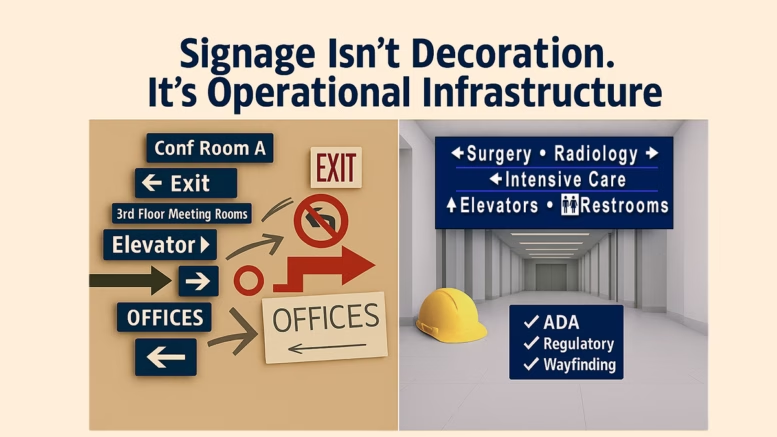
Signage rarely creates problems.
Poor integration does.
And when integration is deferred, the consequences rarely stay small.
In disciplined capital programs, signage is not a finishing touch.
It is operational infrastructure.
It supports:
- Life safety and regulatory compliance
- ADA requirements
- Circulation and wayfinding
- Operational zoning
- Equipment identification
- Customer and employee experience
When integrated early, surprises decrease.
When deferred, ambiguity compounds — often surfacing later as rework, change orders, and leadership frustration.
Integration Changes the Risk Profile
In mature programs, signage is treated as scope development — not fabrication.
Instead of asking,
“How much will signage cost?”
High-performing teams ask,
“How should signage support how this building functions?”
Early integration allows teams to:
- Coordinate infrastructure
- Surface regulatory obligations
- Reflect operational logic in layouts
- Stabilize pricing through scope clarity
Predictability improves — and predictability is what capital leadership ultimately values.
A minor equipment-room numbering change during schematic design can eliminate dozens of downstream revisions.
Small decisions compound.
When they aren’t resolved early, they compound into cost.
Alignment Across Disciplines
Architects bring spatial intent.
Signage consultants bring operational and ADA expertise.
Fabricators bring constructability insight.
High-performing projects align these perspectives early — not sequentially.
As Vincent W. Piña, Director of Business Development at Precision Signs in Amityville, NY notes:
“When signage is treated as part of the building’s operational planning — not just branding or aesthetics — the entire process changes. Scope becomes something developed with purpose and not assumed. When alignment happens early between owner, architect, and signage consultant, pricing stabilizes, expectations are clearer, and fabrication becomes far more predictable.”
Predictability is not a fabrication outcome.
It is a governance decision made upstream.
Translating Strategy Into Procurement
Integration must be reflected in the RFP.
High-performing capital programs ensure signage RFPs communicate intent — not fragmented requirements.
Strong RFPs define:
- Scope categories (ADA, life safety, circulation, branding, regulatory)
- Required deliverables
- Process expectations
- Pricing structure and assumptions
The RFP is where planning discipline becomes executable discipline.
When integration is clear, proposals reflect clarity.
When it is not, ambiguity migrates — and vendors begin protecting themselves.
That’s when friction begins.
Presentations Reveal Judgment
High-performing projects evaluate how teams think — not just what they submit.
Strong presentations:
- Address the specific project
- Respond directly to requirements
- Clarify assumptions
- Demonstrate applied understanding
Portfolio slides show capability.
Applied thinking shows judgment.
Owners are not selecting a portfolio.
They are selecting judgment applied to their building.
Why This Matters Beyond Signage
Signage may be a small line item.
But small line items generate outsized friction when governance is weak.
Organizations that define small systems clearly tend to experience fewer surprises in larger ones.
Organizations that do not often see the same pattern repeat — in AV, interiors, technology infrastructure, and beyond.
Clarity upstream reduces volatility downstream.
Predictability compounds across a portfolio.
Small ambiguities scale.
So does discipline.
Closing Thought
Signage is not decorative.
It is operational infrastructure.
High-performing capital programs recognize that early — and the results show.


Be the first to comment on "How High-Performing Capital Programs Integrate Signage Into the Building Strategy"