In capital projects, when someone says “just get it built,” alignment has usually already broken down.
Every phase has a failure point when alignment is skipped.
| The lease was expiring.
| The leadership team was out of patience.
| The owner looked across the table and said:
| “Just get it built.”
| Six months later, the steel was on site—and the drawings were still changing.
Sound familiar?
It’s one of the most common—and most costly—project triggers.
How “Just Get It Built” Disrupts Capital Projects
Capital projects aren’t just construction. They’re a series of layered decisions made in sequence—each one either reducing uncertainty or compounding it.
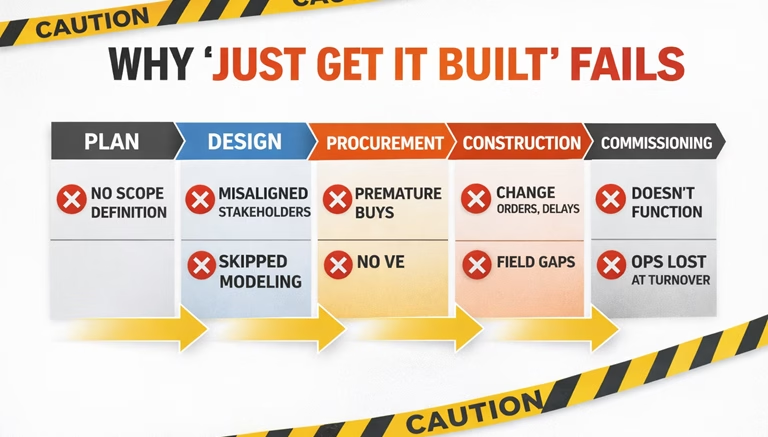
Plan -> Design -> Procurement -> Construction -> Commissioning / Turnover
Here’s the same idea in a quick visual:
Notice what tends to get the least patience early—and costs the most when it goes wrong.
The mistake isn’t that owners want speed.
It’s that they try to buy speed by skipping alignment.
And you can’t out-build misalignment.
 Urgency Bypasses Controls
(Planning + Design)
When “go go go” becomes the leadership mantra, governance is the first casualty.
That can look like:
- Budgets released before scope is defined
- Design started before users and operators align
- Risk modeling, options analysis, and contingency planning skipped
From the outside, it looks like momentum.
Internally, it’s a gamble.
Because planning and design aren’t paperwork—they’re the only time you can change direction cheaply.
This isn’t acceleration.
It’s malpractice.
Then come the symptoms:
Redesigns. Change orders. Schedule whiplash. Stakeholder friction.
What felt like a sprint becomes drag.
 Speed Without Clarity Buys the Wrong Project
(Design + Procurement)
Fast-tracking can be a legitimate strategy—when the “what” and “why” are stable.
But “just get it built” often means fast-tracking without definition.
And the question becomes:
| You fast-tracked… what, exactly?
That gap shows up as:
- Drawings that don’t support long-term operations
- Value engineering that sacrifices business objectives
- Procurement made too early—or off incomplete documents
The building may go up—
but it’s not the building the business actually needs.
| You didn’t move faster—you locked in the wrong outcome sooner.
 Rushing Execution Creates Downstream Chaos
(Construction)
Once shovels hit the ground, upstream ambiguity becomes expensive.
Construction doesn’t “just build it.”
Construction amplifies every decision made before it.
When a project enters construction with unresolved scope, shifting priorities, or incomplete design, it usually turns into:
- Change orders based on unclear scope
- Delays from design gaps and field conflicts
- Claims driven by compressed schedules or evolving direction
| You can’t command your way out of decisions you postponed.
 A Building Isn’t “Done” If It Doesn’t Work
(Commissioning + Turnover)
Projects that sprint through construction often stumble at the finish line.
Because the last mile isn’t “punch list.”
It’s performance.
This is where the true cost of “just get it built” shows up:
- Systems that don’t integrate
- Workflows that don’t match how people actually operate
- Ops teams inheriting a “finished” building that isn’t actually ready
Now the organization is solving operational problems with capital dollars—the most expensive way to fix them.
 What Disciplined Owners Do Instead
The best owners aren’t slower. They’re deliberate at the moments that matter.
They understand that urgency and discipline aren’t opposites— they’re co-pilots.
Disciplined owners don’t eliminate pressure.
They convert pressure into clarity.
They push for fast alignment, not reckless execution.
Early in the project—before commitments harden—they ask:
- What problem are we solving—and why now?
- What does success look like for users, finance, and operations?
- What guardrails cannot be traded, even under schedule pressure?
- Who owns which decisions—and when must they be made?
- What risks are we accepting—and what risks are we paying to avoid?
They don’t just want it built.
They want it right.
Because “just get it built” only works when everyone—from the C-suite to the trades—knows exactly what “it” is.
 Owner’s Alignment Checklist
Use this before accelerating any capital project.
 Planning
- Problem is clearly defined
- Success metrics aligned across users, finance, and operations
- Constraints and guardrails documented and agreed
- Decision-makers and authority levels clear
Design
- User groups have validated requirements
- Operational workflows reflected in the design
- Assumptions tested—not guessed
- Risks modeled and reviewed
Procurement
- Long-lead items identified and sequenced
- Materials not purchased off incomplete drawings
- Value engineering aligned with business goals
- Procurement matches the most current design
Construction
- Scope is clear, stable, and documented
- Schedule realistic—not aspirational
- Design gaps closed before major activities
- Change-order process defined and active
Commissioning & Turnover
- Systems integration planned—not left to the end
- Ops teams trained and ready
- Turnover documentation requirements known early
- Space functions as intended—not just “looks complete”
The Real Instruction That Protects Speed
If “just get it built” is risky, here’s the disciplined version:
| “Align fast. Decide early. Protect the guardrails.”
That’s how projects move quickly—without moving sideways.
Because the projects that succeed under pressure aren’t the ones that rushed at the start.
They’re the ones that slowed down just enough to avoid slowing down later.
“Just get it built” only works when alignment, scope clarity, and decision sequencing are already in place — not when they’re missing.

Be the first to comment on "“Just Get It Built” Might Be the Most Dangerous Instruction an Owner Can Give"