
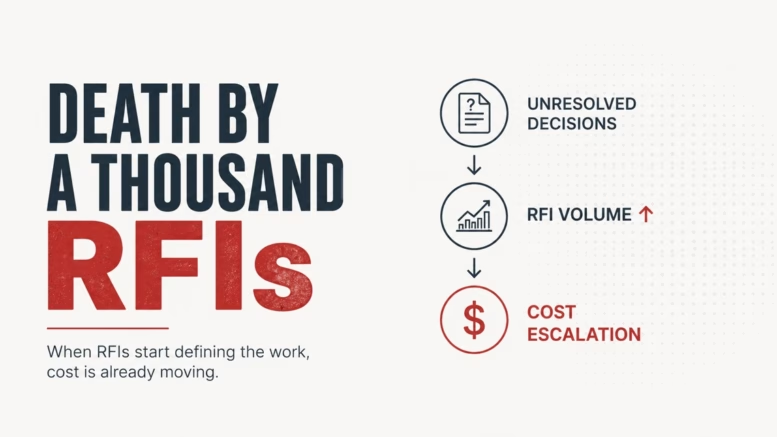
Projects rarely look dangerous when RFI volume first starts climbing.
The schedule still appears recoverable.
The budget may not yet show visible distress.
Meetings continue. Reporting continues. The project still appears controllable.
But experienced capital leaders recognize the pattern early.
Once RFIs begin defining the work instead of clarifying it,
the project has already started losing leverage.
Projects don’t go over budget because teams ask too many questions.
RFIs are a necessary part of getting the work right.
They go over budget because those questions are being answered after the owner has already lost the ability to price the answers competitively.
When RFI volume spikes, it is rarely just a “bad consultant” problem.
It is usually a governance failure—one that converts unresolved decisions directly into cost, delay, and change orders.
The Moment RFIs Change Character
Every project has RFIs.
On healthy projects, they are a tool for confirmation.
On troubled projects, they become a tool for definition.
Healthy RFIs (Confirming Intent)
- “Is this dimension to face of stud or finish?”
- “Can we substitute a local equivalent valve?”
- “Clarify the bolt pattern for this bracket.”
Troubled RFIs (Defining Scope)
- “What is the wall assembly in this condition?”
- “How are these two systems supposed to interface?”
- “Who is responsible for supports in this zone?”
The pivot point is unmistakable.
When RFIs stop confirming the work and start defining it,
the project isn’t being built from a plan anymore.
It’s being decided in the field—at construction pricing, under schedule pressure.
Why Uncertainty Survives Long Enough to Become Expensive
We often blame “poor documentation.”
And sometimes that’s justified.
But even then, it’s a symptom—not the root cause.
RFIs exist because the person building the work cannot proceed with confidence.
That uncertainty survives because of three systemic failures:
1. The “Fast-Track” Illusion
Accelerated schedules don’t eliminate work.
They defer it.
Incomplete coordination gets pushed forward with the assumption that unresolved issues can be solved later.
Construction is the moment when later becomes expensive.
2. The Governance Vacuum
When decision authority is unclear, the RFI becomes the fastest mechanism available to force an answer.
If an owner hasn’t assigned a clear decision owner, the field will assign one instead—usually through the most expensive path available.
Mature capital programs understand that unresolved decisions do not disappear.
They migrate—into procurement, into construction, and eventually into cost.
3. The Protection Gap
Many RFIs are not about design clarification.
They are about contractual protection and liability exposure.
If trade interfaces remain ambiguous—penetrations, supports, tolerances, temporary conditions—
sequencing responsibilities— the contractor will RFI aggressively to protect contract position and downstream exposure.
That’s not confusion.
It’s rational behavior.
RFIs are doing exactly what they’re supposed to do in this moment—protect the parties performing the work.
The problem is the environment they have been forced into.
The Financial Reality: Why Budgets Break
RFIs don’t create overruns.
Delayed decisions do.
Each major RFI tied to unresolved scope creates a predictable chain reaction:
- Work slows while answers are chased
- Productivity drops as sequencing breaks down
- Procurement and installation logic begin shifting in the field
- Risk premiums appear once teams realize the documents are fluid
- Leverage disappears—answers that would have cost little during design are now priced at construction rates, with markup and schedule impact
By the time major RFIs reach active construction, the owner is no longer buying scope competitively.
They are buying certainty under schedule pressure.
Executive reporting often remains deceptively stable during this phase because the operational damage forms faster than formal cost reporting cycles can expose it.
Here is the uncomfortable reality:
High RFI volume is often the first operational signal that decisions have slipped out of governance and into the field.
Mature organizations treat rising RFI volume as an early-warning indicator—not just a documentation metric.
By the time the problem fully surfaces in a cost report, the money is usually already gone.
What Mature Capital Programs Do Differently
The goal isn’t to eliminate RFIs.
The goal is to constrain what RFIs are allowed to decide.
Mature capital programs force major interface, sequencing, and ownership decisions closed before construction pricing begins.
They establish explicit authority for scope, operational, and coordination decisions before ambiguity reaches procurement or the field.
They distinguish drafting errors from governance failures.
They do not excuse poor documentation, but they also recognize that unresolved owner decisions cannot be delegated downstream and solved economically later.
The One Question That Actually Matters
When RFI volume starts climbing, most teams ask:
“Why are there so many RFIs?”
Experienced capital leaders ask something different:
“What decision is the field being forced to make right now that we should have settled six months ago?”
That question usually reveals far more than the RFI log itself.
Because if the field is still defining scope during construction,
the project is no longer operating from certainty.
It is operating from reaction.
Closing Thought
RFIs do not kill projects.
They are a necessary part of executing complex work—and they are not going away.
But they do reveal something important very early:
what the project still does not know.
Because once RFIs begin defining the work instead of confirming it,
the project is no longer simply being built.
It is still being decided.
And once a project reaches “Death by a Thousand RFIs,”
it usually is not failing loudly.
It is failing quietly—
while cost, schedule certainty, and leverage erode at the same time.
About the Author: Richard Neuman advises organizations on capital planning, project governance, and complex capital programs. He has overseen more than $2 billion in capital investments across commercial real estate, healthcare, utilities, industrial, broadcast, and development projects.
He writes candidly from an owner-side perspective about the executive decisions and organizational dynamics that shape capital project outcomes.
Leading a major capital program or facing a complex capital decision?
Contact Richard.
Subscribe for insights on capital planning, project governance, and the executive decisions that shape project outcomes long before construction begins.




Be the first to comment on "Death by a Thousand RFIs: Why High-Volume Projects Always Bleed Cash"