

It’s deciding which projects deserve capital.
That decision sits at the heart of effective capital project planning.
Most people think capital projects get difficult once construction starts.
Contractors.
Schedules.
Change orders.
Construction management.
But in large organizations, the hardest part of a capital program happens long before the first shovel hits the ground.
It happens when leadership must decide which projects deserve capital investment — and which ones have to wait.
One reality becomes clear when managing a large facility portfolio:
The challenge isn’t a lack of ideas.
It’s the opposite.
Every department has projects they view as essential.
Some are genuinely necessary.
Some clearly improve operations.
Some are preferences supported by thoughtful reasoning.
But in almost every organization, one reality shapes the entire capital program:
Capital demand always exceeds available capital.
The hard part isn’t determining whether projects can be built.
It’s determining which ones should be funded.
And no decision exists in isolation.
Each project competes within a portfolio of infrastructure needs, operational improvements, and strategic initiatives.
And every business unit or project owner believes their project should come first.
The Reality of Capital Planning
In most organizations, capital programs are shaped by two major forces.
1. Baseline Capital Needs
Some projects originate from Facility Condition Assessments (FCAs) and long-term infrastructure planning.
FCAs evaluate the physical condition of buildings and major systems — roofs, HVAC, electrical infrastructure, and life-safety systems — identifying renewal needs based on lifecycle and remaining useful life.
In well-managed portfolios, these assessments form the backbone of a five- to ten-year capital plan, allowing organizations to anticipate renewal needs instead of reacting to failures.
But that only works when organizations consistently invest in those assessments and fund lifecycle maintenance.
When they don’t, deferred OPEX becomes emergency CAPEX.
What should have been predictable renewal work turns into a capital fire drill.
Instead of planning ahead, organizations find themselves reacting to system failures.
2. Business-Driven Projects
The second stream of projects comes directly from the business units.
Departments request capital to support:
- growth and expansion
- operational improvements
- technology upgrades
- workflow and productivity changes
These needs are often legitimate and aligned with operational goals.
But they introduce a more complex challenge.
Every business unit believes its project should move forward — and many have strong justification.
Yet capital budgets are finite.
Capital planning isn’t about deciding whether projects are good ideas.
It’s about determining which good ideas should be funded — and which must wait.
Where the Real Decisions Happen
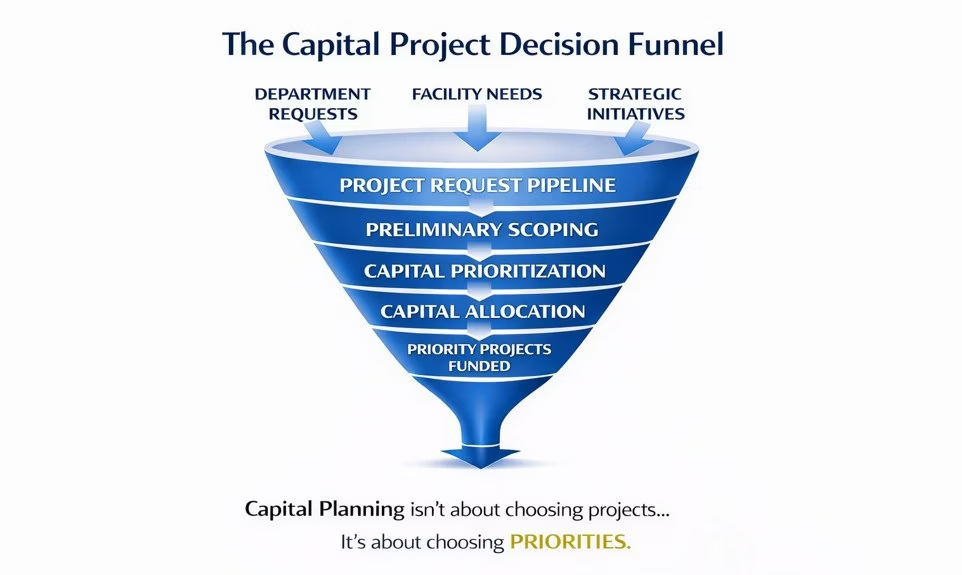 Inside most capital programs, a predictable dynamic emerges.
If a project is already included in the approved capital plan, it typically proceeds.
If it isn’t, the business unit faces a choice:
- fund the project through its own operating budget
- defer it to a future capital cycle
These trade-offs aren’t always comfortable.
Some departments evaluate cost versus benefit pragmatically.
Others struggle with the reality that not every request can be approved immediately.
Occasionally, the entire capital plan shifts.
A regulatory requirement, major operational need, or strategic initiative may suddenly become the top priority — displacing projects that once seemed certain to move forward.
Capital plans are not static.
They are living documents that evolve with organizational needs.
And that tension isn’t dysfunction.
It’s how capital governance works.
Why Early Scoping Changes the Entire Conversation
One of the most effective improvements any capital program can introduce is scoping and budgeting projects before they enter the design process.
Without this step, projects may receive conceptual approval and move straight into design. Only later — after significant design and consultant fees — does the organization begin to understand the true cost.
Sometimes the design aligns with expectations.
Often it doesn’t.
A common pattern looks like this:
A department has an idea for a renovation and asks:
“What will this cost?”
In some cases, organizations try to answer that question through quick exercises like test fits or conceptual layouts.
Architects may produce these early studies — sometimes without compensation, particularly in tenant improvement situations where landlords are evaluating potential layouts.
These exercises can be useful for visualizing potential layouts.
But without defined scope, program requirements, or systems considerations, they rarely provide enough information to establish a reliable project budget.
Without early scoping, the only way to answer that question becomes starting the design process.
The project receives a small amount of seed funding to begin design so the team can “see where it lands.”
As drawings develop and consultants become involved, the scope begins to take shape.
Only then does the organization start to understand the likely construction cost.
By that point, a significant amount of money may already have been spent simply to discover whether the project is viable.
Early scoping changes that dynamic.
Instead of using design to discover the cost, organizations establish a planning-level budget first through early scoping.
This often relies on:
- internal capital planning resources
- historical cost data
- comparable projects
That level of clarity is enough for departments to make informed decisions:
- move forward
- adjust scope
- defer to a future cycle
The impact is immediate:
- fewer abandoned designs
- fewer surprise overruns
- faster, clearer prioritization
- shorter approval cycles
- more predictable capital programs
Early scoping doesn’t just improve planning.
It prevents organizations from using the design process as an expensive way to discover a project’s budget.
Capital Programs Are Trade-Offs, Not Wish Lists
No organization can fund every project in a single capital cycle.
Priorities evolve.
Some initiatives accelerate.
Others are deferred.
Occasionally, strategic projects move ahead faster than planned.
That isn’t dysfunction.
That’s capital planning.
Capital planning isn’t about choosing projects.
It’s about choosing priorities.
The goal isn’t to approve every request.
It’s to advance the right projects at the right time — with full clarity of cost and impact.
Why This Matters
Capital programs rarely struggle because they lack ideas.
They struggle because organizations attempt to prioritize projects before they understand what those projects will really cost.
Conceptual ideas always sound reasonable.
Real scope and cost bring clarity.
And the earlier that clarity exists, the better the decisions become.
Final Takeaway
Capital projects rarely struggle because of construction.
They struggle because decisions were made before anyone understood the true cost, scope, or impact.
Early scoping doesn’t just improve capital planning.
It strengthens every capital decision an organization makes.


Be the first to comment on "The Hardest Part of Capital Projects Isn’t Construction"