
Closing the Gap Between Legal Language and Construction Reality
Most owners assume an AIA contract protects them.
It doesn’t.
At least, not from the problems that actually blow up budgets: scope gaps, sequencing failures, documentation delays, warranty disputes, and safety-related shutdowns.
Here’s the part people don’t say out loud:
Attorneys understand legal risk — but they don’t live in construction risk.
They don’t see how a missing submittal quietly derails the critical path.
They don’t see how undefined coordination becomes a six-figure exposure.
They don’t see how unclear responsibility leads to months of finger-pointing.
That’s not a knock on counsel — it reflects the division of roles. Attorneys ensure enforceability. They don’t operate the project.
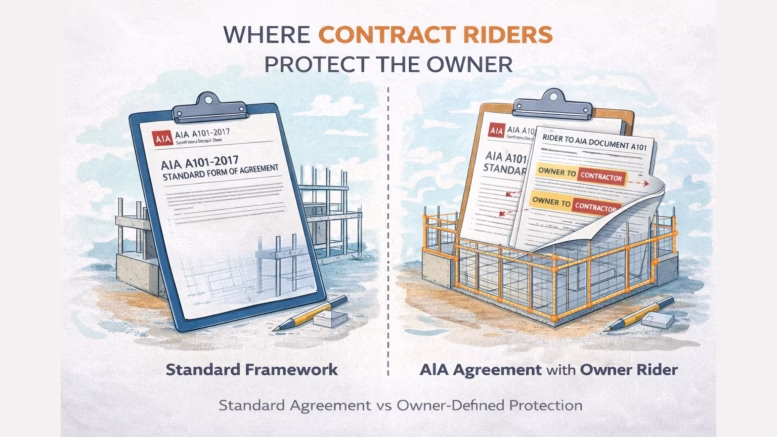
This is why meaningful protection doesn’t come from the AIA document alone. It comes from a project-specific rider—an addendum developed by experienced operational leaders, PM’s, and contract counsel to address exposure the standard framework cannot anticipate.
That responsibility typically falls to the Capital Project Leader — or the Owner’s Rep operating at that level.
If operational exposure isn’t identified early, the AIA contract may remain legally sound — but still leave the owner financially unprotected.
Owners Lose Six Figures Before Construction Begins
It happens the day the contract is signed — when the owner assumes the AIA form is “balanced,” and therefore protective.
Balanced does not equal protective.
And soon, risk begins to surface:
- “Not in our scope.”
- “We’ll need a change order.”
- “We haven’t received the submittal.”
- “That’s a warranty issue, not a defect.”
None of these failures originate in the field.
They originate in contracts that leave responsibility open to interpretation.
The AIA agreement provides the framework.
The rider is where risk allocation is clarified — and protection is defined.
A rider is a project-specific contract addendum that modifies and clarifies responsibilities beyond the standard AIA language.
No standard form can anticipate the operational realities of every project.
That clarification happens through the rider.
The AIA Agreement Establishes the Framework — But It Cannot Eliminate Operational Risk
The AIA’s standardized agreements form the most widely used contractual framework in the industry, spanning more than 200 contract types across the full project lifecycle.
Learn more: AIA Contract Documents – Official Site
The AIA A201 General Conditions address important execution responsibilities:
- Contractors must review contract documents and report errors, inconsistencies, or omissions (AIA A201 §3.2.2).
- They are not responsible for design adequacy (AIA A201 §3.2.3).
- They control construction means, methods, sequencing, and procedures (AIA A201 §3.3.1).
These provisions are appropriate and necessary. They reflect the AIA’s purpose: establishing a balanced contractual structure.
But they do not:
- assign clear responsibility for scope completeness
- anticipate coordination and integration requirements
- define accountability for documentation discipline
- clarify expectations around sequencing, trade support, or vendor integration
- address warranty responsiveness beyond basic obligations
No standard form can anticipate the operational realities of every project.
That clarification happens through the rider.
Riders Don’t Begin With Legal Language. They Begin With Operational Visibility.
AIA contract riders aren’t automatically generated. They emerge when someone spots exposure early and ensures it’s addressed before execution.
In practice, the process looks like this:
1. Bid leveling reveals risk.
Contractors interpret scope differently. Some include coordination effort. Others exclude it. This is already risk allocation.
2. Operational leadership recognizes exposure.
The Capital Project Leader or Owner’s Rep sees where responsibility is unclear — and where ambiguity could become change orders, schedule delays, or financial impact.
3. Risk is elevated to counsel.
Attorneys can only protect against risks they know about. Operational visibility makes meaningful protection possible.
4. Counsel converts operational risk into enforceable rider language.
The rider clarifies responsibility in ways the standard form cannot anticipate.
5. The GC negotiates risk allocation.
This is expected. Clarity affects execution responsibility and commercial assumptions.
6. Clarity exists before construction begins.
The contract now reflects operational reality — not assumptions.
This is where protection actually begins.
Where Riders Most Often Clarify Responsibility
In real-world capital projects, riders strengthen clarity in recurring areas:
Scope completeness
Ensuring the contractor delivers complete and functional systems — including the coordination and integration effort needed to do so.
Trade coordination and sequencing
Clarifying responsibility for cross-trade integration, vendor coordination, and sequencing required to deliver a complete project.
Documentation and change-order substantiation
Defining expectations around required backup for schedule impacts and scope changes.
Warranty and completion accountability
Clarifying responsiveness expectations beyond simple one-year obligations.
Safety and site responsibility
Reinforcing responsibility for maintaining safe site conditions and correcting deficiencies promptly.
These provisions don’t redefine the scope.
They clarify responsibility.
And that clarity protects both the owner and contractor by reducing ambiguity.
Not Every Provision Will Be Accepted — and its a Two-Way Decision
It’s the point of negotiation.
- The owner decides how much risk they want to transfer or retain.
- The GC and their counsel determine which obligations they can reasonably accept based on scope, pricing, and delivery method.
- The attorney ensures whatever is agreed upon is enforceable.
- The Capital Project Leader ensures the risks are visible and clearly understood before decisions are made.
The key is this:
If operational leadership doesn’t surface exposure, the owner never has the opportunity to make an informed risk decision — and neither does the GC.
A well-developed rider forces clarity early, allowing both sides to:
- identify obligations,
- acknowledge risk transfer,
- negotiate responsibility, and
- price the work appropriately.
That clarity benefits everyone.
The Most Expensive Change Orders Are Created Before Construction Begins
Most people think cost overruns originate in the field.
They don’t.
They originate in contracts that leave responsibility open to interpretation — contracts where the standard AIA language was left untouched, and the rider was never developed.
Once construction begins, the contract governs everything.
And the contract only protects what it clearly defines.
AIA provides the structure.
The rider defines the protection.
And the Capital Project Leader plays a critical role in ensuring operational reality is translated into contractual clarity before execution.
Because once the contract is signed, the risk allocation is already decided.
Final Thought
AIA contracts are balanced.
But capital projects don’t need balanced — they need clarity.
A rider doesn’t replace the AIA framework.
It strengthens it.
And while attorneys write the language, operational leadership identifies the risks that must be addressed.
This isn’t legal advice — it’s experience.
Experience from representing owners where contract clarity directly influenced financial outcomes.
If you want the contract to protect the owner, the conversation starts long before legal drafting — it starts when operational leadership identifies risk and ensures it is addressed.
And it starts with the rider – before the contract is signed.

Be the first to comment on "GCs Won’t Love This, Owners Will: The Rider Every CapEx Leader Must Drive Before Signing an AIA Contract"