Before replacing a worn chair, find out what failed, what can be repaired and whether the chair is worth keeping.
Office furniture ages over time. Seat pads wear, armrests tear, casters fail and mechanical adjustments stop working.
Then comes the question:
Do you repair the chair or replace it?
For one chair, the decision may be simple. Across an office with hundreds of chairs, it can become a meaningful operating expense.
Before ordering replacements, determine what you actually have and what condition it is in.
What Actually Failed?
A worn seat cushion is different from a damaged frame or failing mechanism.
Many commercial office chairs are designed with components that can be replaced. Depending on the manufacturer and model, that may include casters, arm pads, cylinders, controls, cushions, fabric and other parts.
If the underlying chair is good quality and still functions properly, replacing a worn component or reupholstering the chair may extend its useful life.
If the frame is damaged, mechanisms are failing, replacement parts are unavailable or the chair no longer provides appropriate support, putting more money into it may make little sense.
The condition of the chair should drive the decision.
Check the Warranty Before Paying for the Repair
Before authorizing repairs, determine whether the chair is still under warranty.
Commercial furniture warranties can vary considerably by manufacturer, product line, component and type of use.
A relatively new chair with a failed mechanism may be the manufacturer’s or dealer’s responsibility.
That is much easier to determine when someone has retained the original purchase information, model numbers and warranty documentation.
Look at the Entire Chair Inventory
If numerous chairs are showing similar problems, don’t treat each one as an isolated maintenance call.
Look at the inventory as a group.
- Are the chairs the same age and model?
- Are the same components failing repeatedly?
- Can replacement parts still be obtained?
- Is there enough remaining useful life to justify refurbishment?
- Would standardizing repairs across a group of chairs be more economical than replacing them individually as they fail?
For a large office, those questions can change the economics considerably.
Consider the Disruption Too
Cost is only part of the decision.
If chairs are being removed for refurbishment, employees still need somewhere to sit. Depending on how the work is performed, you may need spare chairs, phased pickup and delivery, or on-site repairs.
That matters even more when furniture work is being coordinated with a renovation, relocation or restacking project.
Plan the logistics along with the repair.
Keeping a Good Chair Can Make Sense
There is also a practical sustainability benefit to extending the useful life of furniture that still performs well.
If a good-quality chair can be repaired economically and returned to service, replacing it simply because one component is worn may create unnecessary cost and waste.
That does not mean every old chair should be saved.
The question is whether the chair you already own still has enough value and useful life to justify the investment.
Leadership Takeaway: Before approving a large furniture replacement, understand why the existing chairs are failing. A repairable component, a warranty issue and a chair at the end of its useful life are three different problems—and they should not automatically lead to the same purchasing decision.

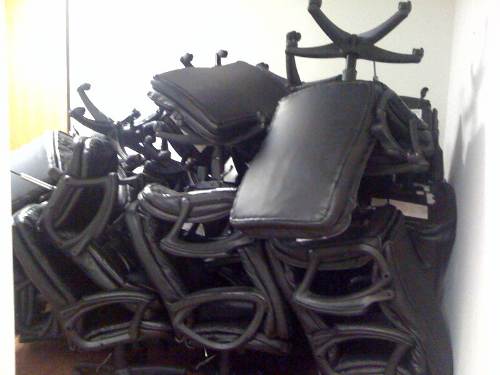


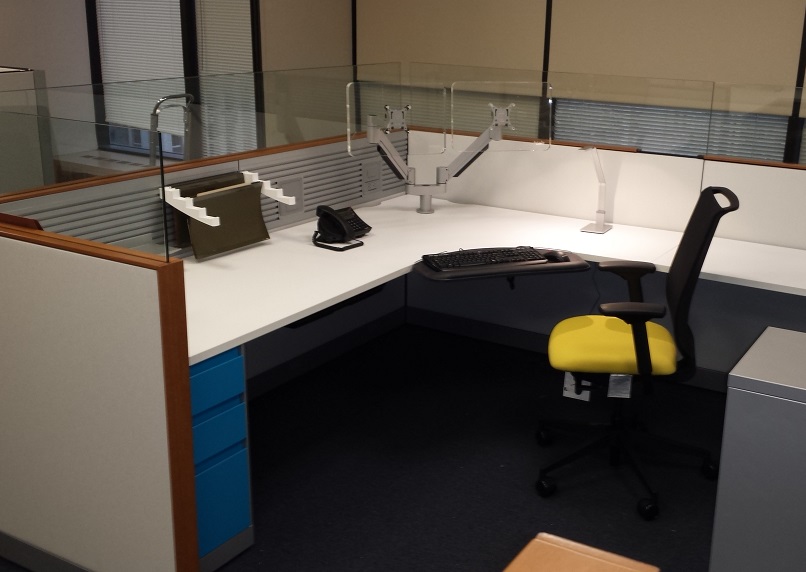
Good chairs in an office environment are the key to good health. The better the chair, the happier your staff.
As us usual, it depends probably on the quality of the chair and the manufacture. If you have a large number say between 200 and 800 then go back and get an agreement with the suppliers/manufacturer to refurb them either on site or off site.
If I was buying that number in the first place a refurb requirement would be part of the orginal purchase deal.
Office chairs are likely to wear a lot quicker than other furniture items. This is why they need to be replaced so frequently. If you make your employees sit in worn chairs they could get unnecessay aches and pains from the poor support offered by a damaged chair, so it is important to do something about old chairs before this happens.
Dear Rich,
You point out a fact that needs to be reinforced, “Since 95% of a persons working life is spent seated, ignoring this is probably not a good practice and should be avoided when this inaction has a potential for a morale issue with a loss in productivity”. At Lewis Alan Office Furniture, Inc. we emphasize the chair as the central focus of the workstation. In today’s marketplace you cannot afford to offer seating that cannot be warranted by both the Mfg. and the Dealer who ultimately interacts with the client on a day to day basis.
I might also add that the two of us share a longstanding relationship with the US Green Building Council and would encourage buyers to look towards those seating options that provide for the “Triple Bottom Line” of socially
responsible, ecologically respectful, and financially sound Mfgs. of seating options. It is inherently better to repair and keep a good chair then to continually toss out and replace bad ones.